Suzanne in the Bath
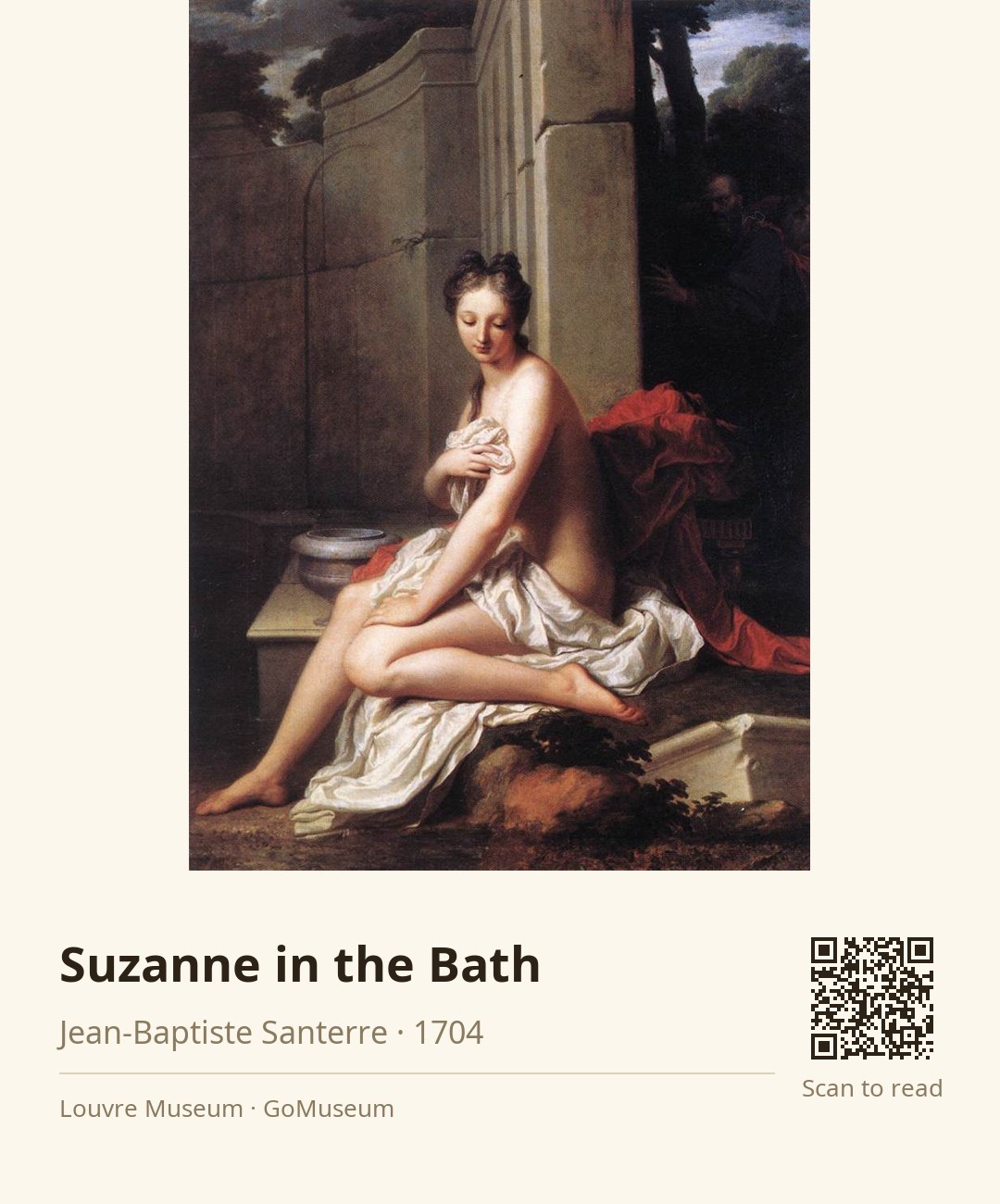
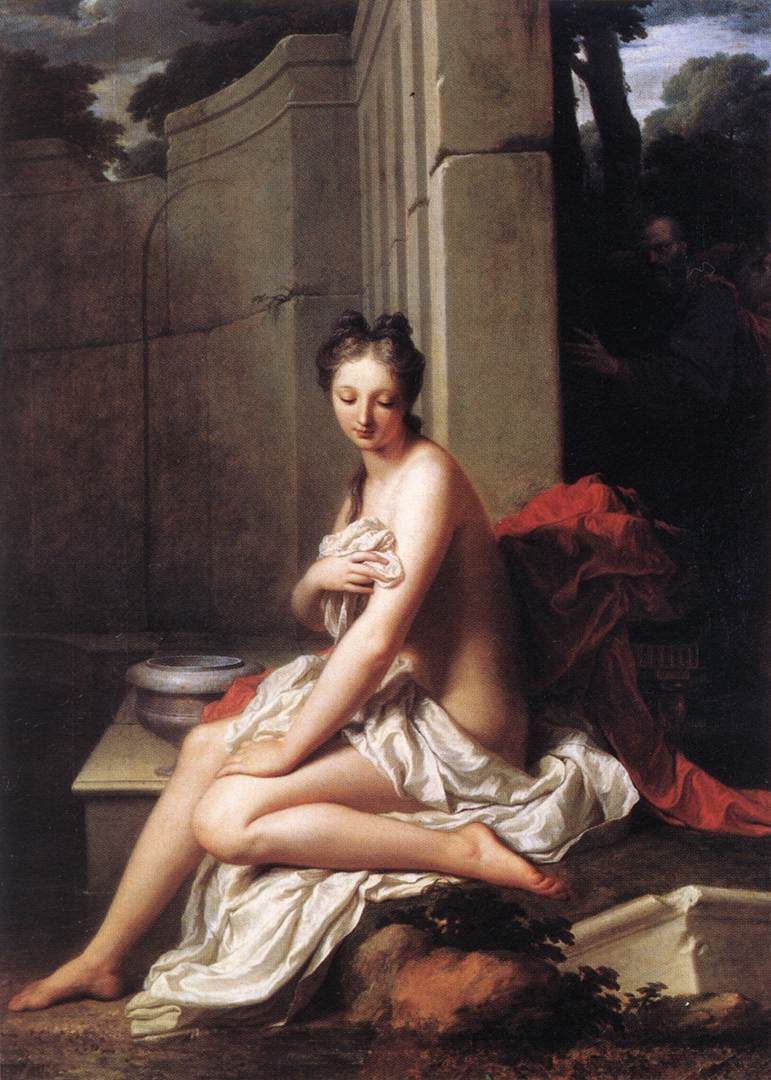
🎧 This work has audio narration — listen in the appThe serene figure of Susanna, partially draped in a delicate white cloth, captures your attention with her elegant pose and downward gaze. Behind her, a striking red fabric contrasts against the muted tones of the scene, while a stone basin to her left hints at the biblical narrative unfolding. The shadowy figure lurking in the background adds an air of tension, suggesting the voyeuristic judgment she faces.
Santerre’s choice to depict Susanna in this moment of vulnerability speaks to the themes of innocence and moral scrutiny prevalent in early 18th-century religious art. The artist blends elements of sensuality with a narrative steeped in biblical lore, reflecting the complex interplay of desire and virtue. This painting, completed in 1704, was a significant work for Santerre, marking his acceptance into the Académie Royale de Peinture et de Sculpture, where he showcased his ability to merge classical themes with a fresh, intimate approach.
Jean-Baptiste Santerre, who lived from 1651 to 1717, became known for his unique style that combined influences from both Dutch and Italian masters, paving the way for future movements in French painting.
Jean-Baptiste Santerre, born on March 23, 1651, in Magny-en-Vexin, was a notable French painter and draughtsman of the Louis XIV style. He trained under Bon Boullogne and quickly gained recognition for his portraits, influenced by both French contemporaries and the Dutch masters. His work is characterized by a unique blend of Northern fantasy portraiture and the allegorical style popular in France at the time. Santerre's most famous painting, "Susanna at the Bath," exemplifies his ability to infuse eroticism into religious themes, a trait that sparked both admiration and controversy.
As a court painter for the Duke of Orléans, he enjoyed considerable success and was a member of the Academy of Painting and Sculpture. His later works, including portraits of the Duke and his mistress, showcased his skill in capturing the essence of his subjects. Santerre's legacy lies in his pioneering role in merging Dutch influences with French painting, paving the way for the Rococo movement and impacting Neoclassical and Romantic artists. His reputation grew posthumously, as his contributions were increasingly appreciated in the 19th and 20th centuries, marking him as a significant figure in art history. Santerre passed away on November 21, 1717, leaving behind a body of work that continues to resonate in the art world.
Jean-Baptiste Santerre's 'Suzanna at the Bath' was completed in 1704, a pivotal year for the artist as it marked his acceptance into the prestigious Académie Royale de Peinture et de Sculpture. This painting was not just a personal triumph; it was his ticket to recognition among the elite of French art. The work was showcased at the Salon, where it garnered attention for its blend of sensuality and biblical narrative. Santerre's reputation grew, leading to commissions from notable patrons, including King Louis XIV and the Duke of Orléans. The painting's provenance traces back to the Académie, emphasizing its significance in Santerre's career.
Santerre's technique in 'Suzanna at the Bath' showcases his mastery of oil paint on canvas, allowing for rich textures and a vibrant color palette. The brushwork is meticulous, particularly in the rendering of Susanna's delicate white cloth, which appears almost translucent against her skin. The large red fabric behind her serves not only as a dramatic backdrop but also enhances the emotional weight of the scene, drawing the viewer's eye to her serene expression. The composition is carefully balanced, with Susanna positioned in the foreground, creating a sense of intimacy. The shadowy figure lurking in the background adds a layer of tension, inviting viewers to ponder the narrative unfolding. Santerre's ability to blend classical themes with a fresh, intimate approach is evident in the way he captures both vulnerability and strength in his subject.
An intriguing tidbit about Santerre is that he was known for his controversial reputation, particularly due to the erotic undertones in his religious works. This led to a scandalous moment in his career when he was commissioned to create an altarpiece for the Chapel of Versailles, which was deemed too provocative for ecclesiastical circles. Despite the backlash, this incident only heightened his profile and showcased his bold approach to art, blending the sacred with the sensual.
Santerre gained a controversial reputation because many of his religious paintings contained erotic undertones, which sparked debates about appropriateness in art.
Santerre's association with the French Regency era contributed to the controversial nature of his work, as this period was marked by a blend of decadence and artistic innovation.