Pope Julius II orders the works of Vatican and Saint-Peter basilica
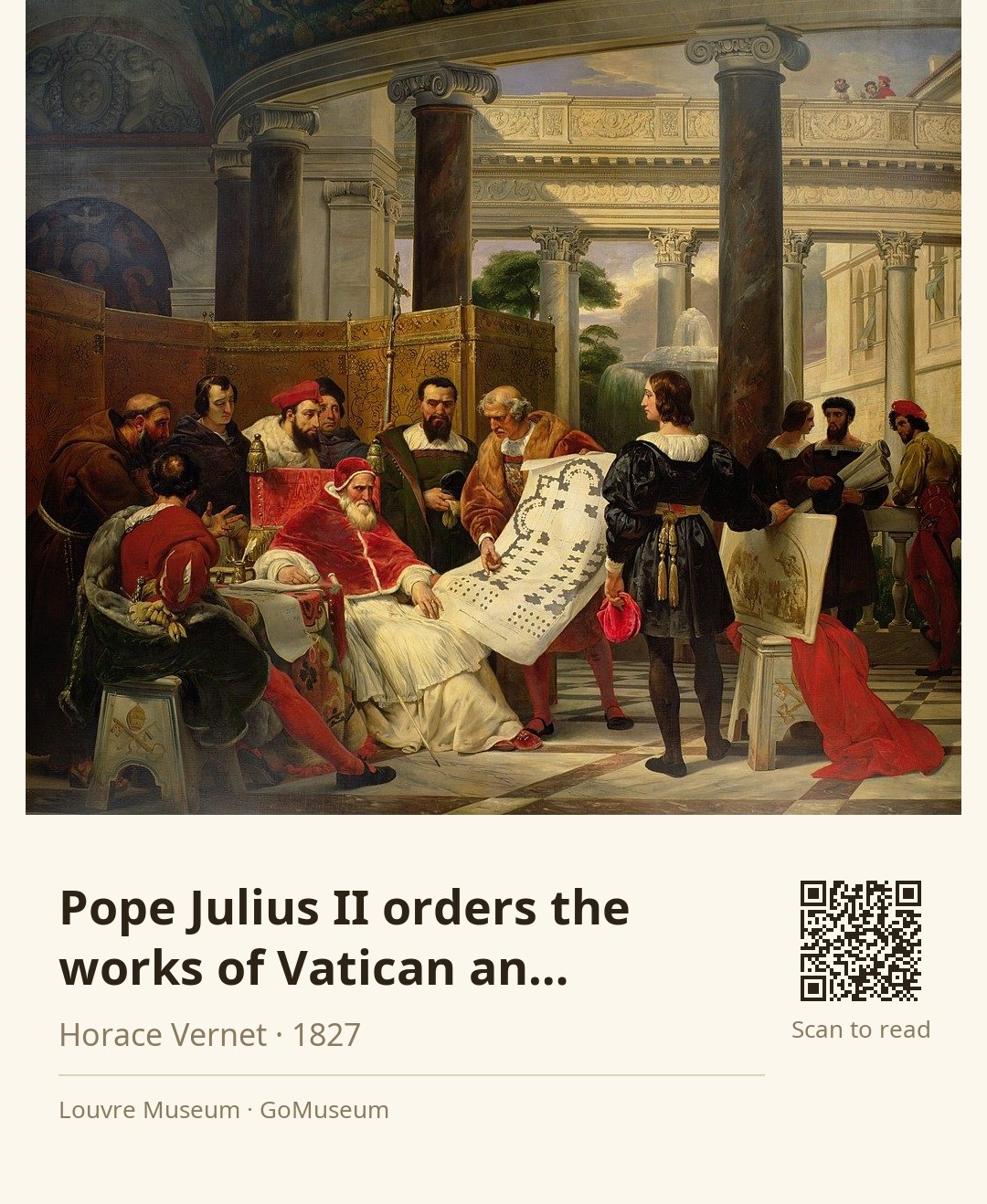
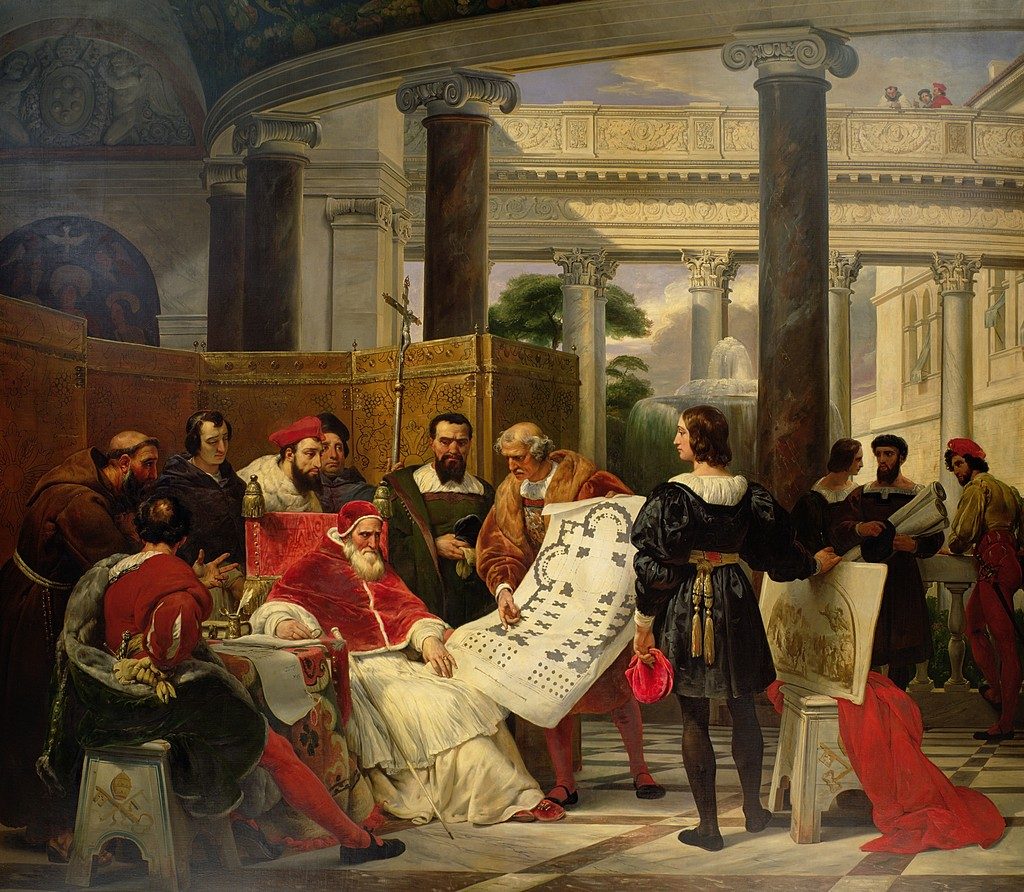
🎧 This work has audio narration — listen in the appPope Julius II, draped in a striking white robe and a vibrant red cape, commands attention at the center of this grand scene. Surrounding him are key figures like the architect Bramante and the painter Raphael, each engaged in a moment of historical significance, with one attendant presenting a large scroll that likely contains architectural plans for the Vatican. The opulence of the setting, marked by towering columns and an ornate ceiling, reflects the ambition and grandeur of the papal projects of the Renaissance.
This gathering illustrates a pivotal moment in art and architecture, as it showcases the collaboration between the most influential artists of the time, all commissioned by Julius II to transform the Vatican into a masterpiece. The intricate details, from the checkered floor to the decorative screen, not only enhance the visual richness but also symbolize the merging of artistic vision and religious authority. Vernet's brushwork captures the textures of the fabrics and the architectural elements, emphasizing the importance of this moment in the context of the Renaissance's cultural revival.
Created in 1827, this painting was exhibited at the Salon des artistes français in Paris, where it contributed to Vernet's growing reputation as a painter of historical scenes. The work stands as a testament to the enduring legacy of Pope Julius II's patronage, which significantly shaped the course of Western art and architecture.
Horace Vernet, born on June 30, 1789, in the Louvre, Paris, was a prominent French painter known for his vivid battle scenes, portraits, and Orientalist works. The son of painter Carle Vernet and grandson of Claude-Joseph Vernet, he grew up in an artistic environment that shaped his career. Rejecting the idealized representations of academic art, Vernet focused on contemporary life, portraying French soldiers with a realistic touch during Napoleon's reign. His early works, such as "Taking of an Entrenched Camp," showcased his talent for capturing the essence of military life.
During the Bourbon Restoration, Vernet gained acclaim for his historical battle paintings, commissioned by influential patrons, including King Louis-Philippe. His works, characterized by their accuracy and dynamic landscapes, earned him a place as director of the French Academy in Rome. Vernet's later career saw him documenting the French army's exploits in Algeria, reflecting the colonial mindset of his time. His commitment to realism persisted even during the Crimean War, where he famously resisted altering his depictions for political reasons.
Vernet's artistic legacy is marked by his ability to blend historical narrative with a personal touch, making him a significant figure in 19th-century art. He passed away in Paris on January 17, 1863, leaving behind a rich body of work that continues to resonate in art history.
Created in 1827, Horace Vernet's painting, titled 'Pope Julius II orders the works of Vatican and Saint-Peter basilica,' was commissioned to capture a moment of monumental significance in the history of art and architecture. It was first exhibited at the Salon des artistes français in Paris that same year, where it garnered attention and praise, contributing to Vernet's rising reputation as a painter of historical scenes. The painting was shown again at the Salon in 1833, further solidifying its place in the artistic landscape of the time.
Vernet's technique in this painting is a masterclass in oil paint handling, showcasing his ability to create depth and texture. The brushwork is meticulous, capturing the intricate details of the fabrics worn by the figures, from the flowing white robe of Pope Julius II to the rich reds and blacks of the surrounding attendants. The use of color is striking; the palette is rich and varied, with deep reds and earth tones that evoke the opulence of the setting. The composition is dynamic, with the central figure of Julius II drawing the eye amidst a backdrop of grand columns and an ornate ceiling, creating a sense of grandeur and authority. The checkered floor adds a layer of complexity, guiding the viewer's gaze through the scene while enhancing the architectural elements. Vernet's choices in scale and perspective amplify the importance of this gathering, making it feel monumental and alive.
An intriguing anecdote about Horace Vernet is that he was not only a painter but also dabbled in early photography. During his travels to Egypt, he took some of the earliest known photographs of Malta, specifically at Fort Manoel, although these photographs are now believed to be lost.
Horace Vernet experimented with early photography during his travels, capturing some of the earliest known photographs of Malta.
During the Bourbon Restoration, Vernet became well-known for his battle paintings commissioned by the duc d'Orleans, which showcased his historical accuracy and dynamic landscapes.
Horace Vernet was born in the Paris Louvre, a notable location as it was during the tumultuous period of the French Revolution.