Madame Boyer-Fonfrède and Her Son Henri
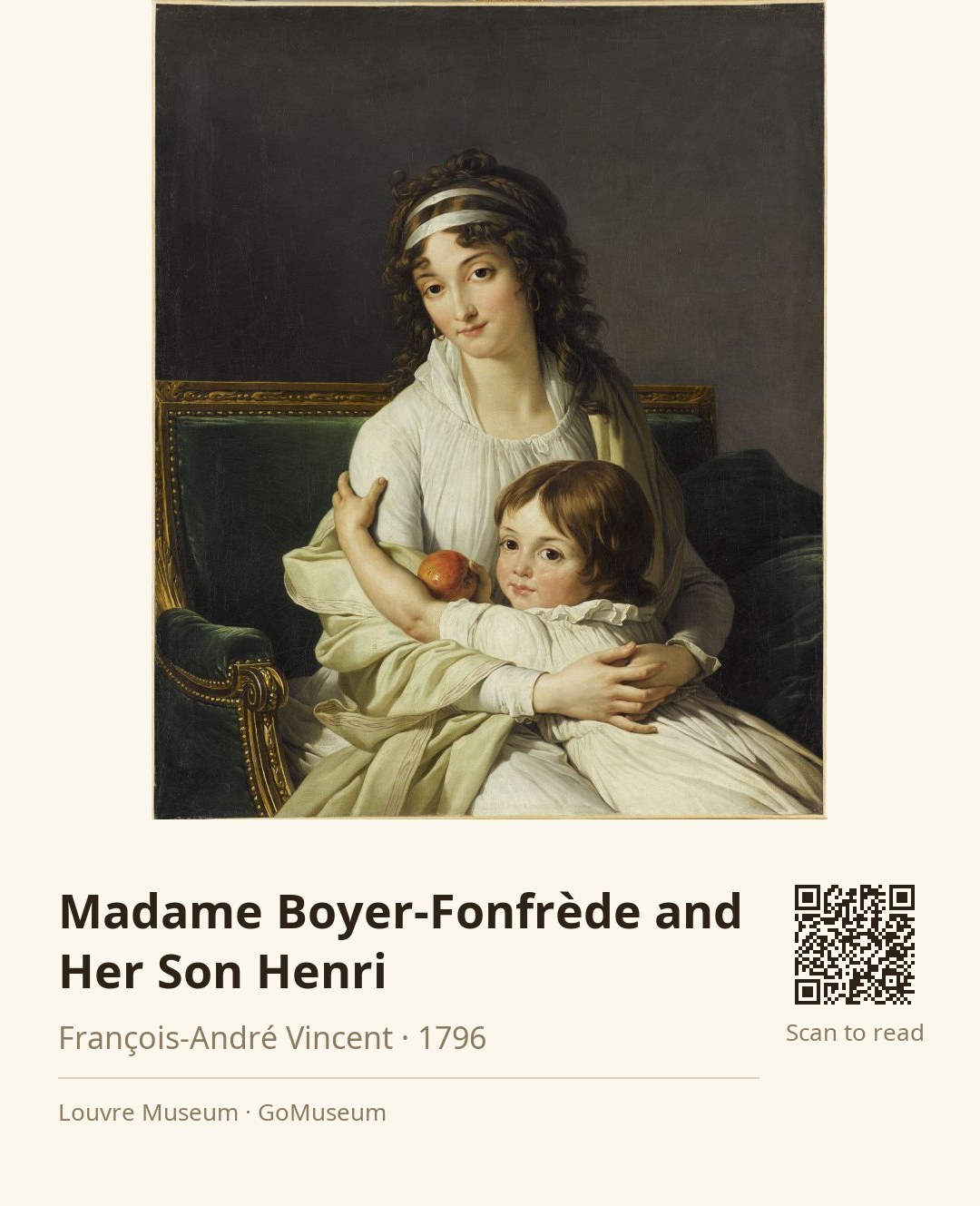
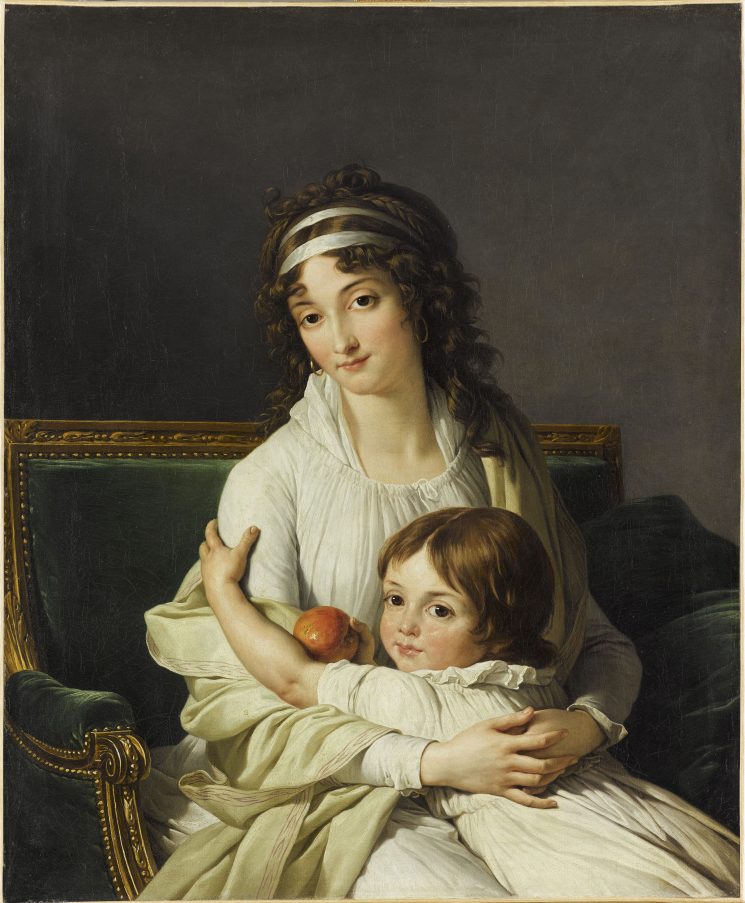
🎧 This work has audio narration — listen in the appThe tender embrace between Madame Boyer-Fonfrède and her son Henri captures a moment of maternal love that transcends time. The woman, adorned in a flowing white dress and a delicate headband, gazes directly at you, while her son, nestled against her, holds an apple, his gentle expression inviting connection. Their seated position on an ornate green chair emphasizes the intimacy of their bond, drawing your attention to the warmth radiating from their faces.
This painting, created by François-André Vincent in 1796, reflects the neoclassical style that was prominent in France at the time, characterized by its focus on human emotion and classical ideals. Vincent, a significant figure in this movement, was influenced by the art of antiquity and the Italian Renaissance, which is evident in the careful rendering of the figures and the harmonious composition. The dark gray background serves to highlight the lightness of their clothing and skin, enhancing the emotional depth of the scene.
Vincent's work often explored themes of family and affection, and this piece is no exception, showcasing the close-knit relationship between mother and child. The artist, who was also a prominent educator and member of the Académie des Beaux-Arts, created this portrait during a period of significant change in France, as the Revolution was reshaping society and art. In 1796, Vincent was already recognized for his contributions to the neoclassical style, and this painting stands as a testament to his mastery of portraiture and emotional expression.
François-André Vincent was a prominent French neoclassical painter born in Paris on December 30, 1746. The son of miniaturist François-Elie Vincent, he honed his craft under the guidance of Joseph-Marie Vien and attended the École Royale des Éleves Protégés. His artistic journey took him to Rome after winning the Prix de Rome in 1768, where he created notable works and portraits influenced by contemporaries like Jean-Honoré Fragonard.
Vincent's career flourished as he became a master of drawings for Louis XVI and later a professor at the Académie royale de peinture et de sculpture. His marriage to fellow artist Adélaïde Labille-Guiard further enriched his artistic environment. A key figure in the neoclassical movement, he was known for his innovative themes and high-quality works, often drawing inspiration from classical antiquity and the Italian Renaissance.
Despite facing competition from Jacques-Louis David, Vincent's contributions were significant, leading to his role as a founding member of the Académie des Beaux-Arts in 1795. As his health declined later in life, he painted less but continued to receive recognition, including the Légion d'honneur. Vincent passed away on August 4, 1816, leaving a lasting legacy in French art history.
In 'Madame Boyer-Fonfrède et son fils Henri,' Vincent employs oil on canvas to create a strikingly intimate portrait. The brushwork is meticulous, capturing the delicate textures of the figures' clothing and the softness of their skin. The choice of a dark gray background serves a crucial role, allowing the lighter tones of the subjects to pop, drawing your attention directly to their expressions. Vincent's use of color is deliberate; the white dress of Madame Boyer-Fonfrède symbolizes purity and maternal love, while the apple held by Henri adds a touch of innocence and playfulness. The composition is carefully balanced, with the figures positioned in a way that emphasizes their connection, inviting viewers into their private moment. This technique not only showcases Vincent's technical prowess but also enhances the emotional resonance of the scene.
Interestingly, Vincent was not only a painter but also a prominent educator. He taught at the Académie royale de peinture et de sculpture, where he influenced many young artists, including his future wife, Adélaïde Labille-Guiard, who was known for her own remarkable portrait work.