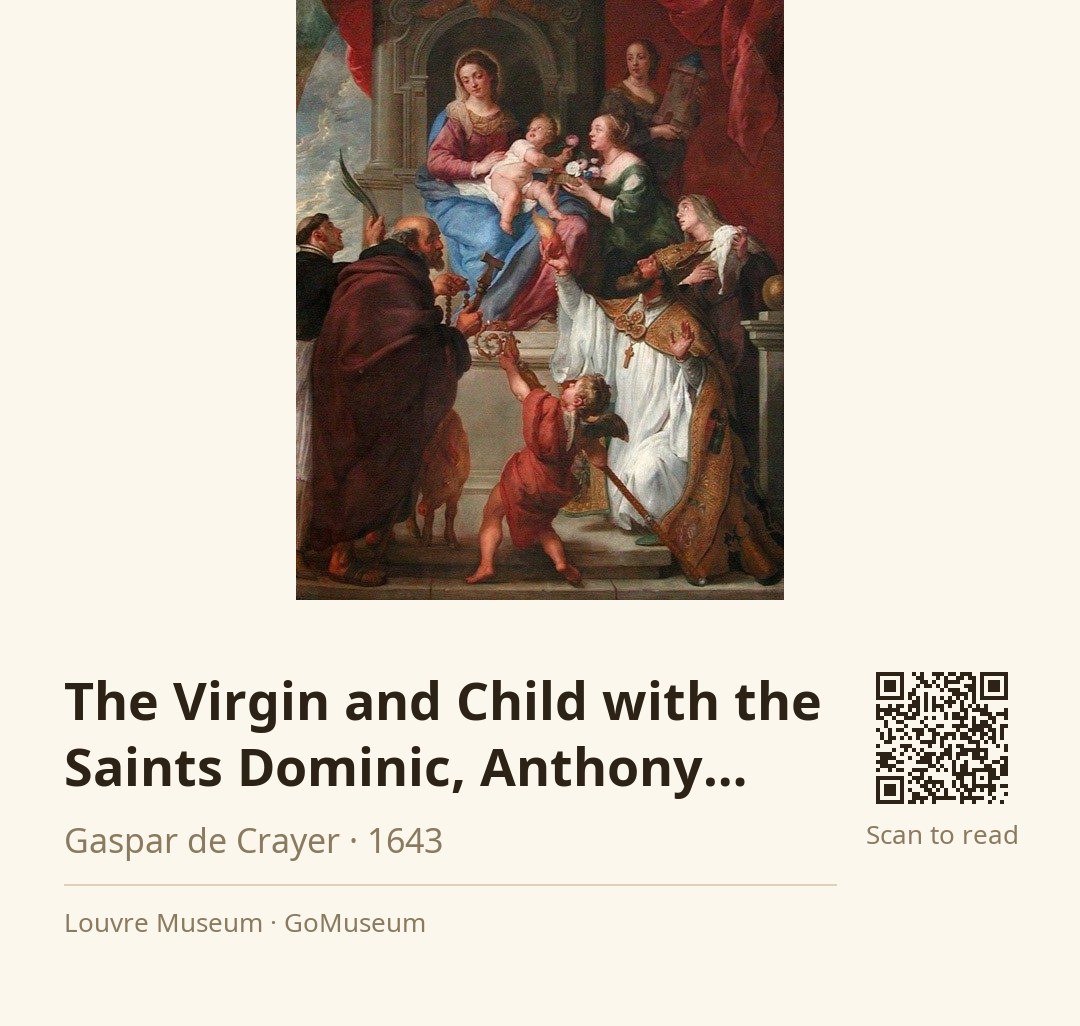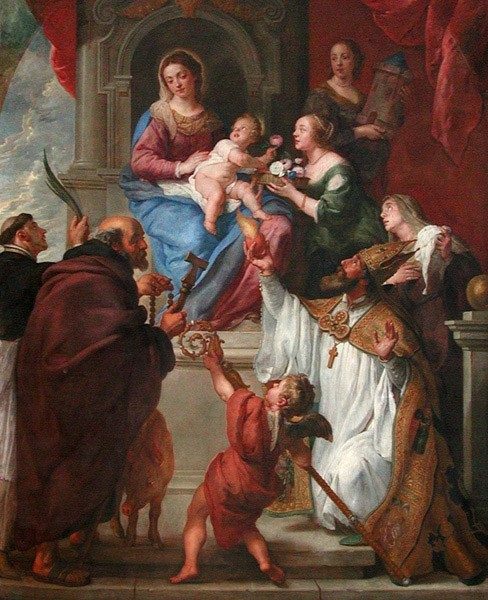
The Virgin and Child with the Saints Dominic, Anthony, Augustine, Monica, Dorothea, and Barbara
🎧 This work has audio narration — listen in the appThe seated Virgin Mary cradles the nude Christ child, enveloped in a rich palette of reds, blues, and greens. To her right, Saint Dorothea offers a bouquet of flowers, while a child in red reaches up, grasping a small object, perhaps a symbol of innocence or devotion. The figures are arranged symmetrically, creating a sense of harmony that draws the eye toward the central mother and child.
Each saint depicted—Dominic, Anthony, Augustine, Monica, Dorothea, and Barbara—carries their own significance, representing virtues and intercessions that were particularly valued in the Catholic faith during the 17th century. The ornate robes and detailed expressions of the figures showcase de Crayer's skill in rendering fabric and emotion, inviting viewers to contemplate the spiritual narrative unfolding before them.
Created in 1643, this painting exemplifies de Crayer's role as a prominent artist in the Southern Netherlands, where he produced numerous altarpieces and portraits, contributing to the visual culture of the time. His work not only served religious purposes but also reflected the artistic influences of his era, particularly the styles of Rubens and Van Dyck.
Gaspar de Crayer, born on November 18, 1584, in Antwerp, was a prominent Flemish painter known for his Counter-Reformation altarpieces and portraits. The son of a decorative painter, he sought greater opportunities in Brussels, where he became a master in the Guild of Saint Luke by 1607. His early works included portraits of Spanish royalty and local officials, establishing his reputation in the region.
De Crayer's style evolved under the influence of Rubens, leading to more monumental and balanced compositions. He played a significant role in the artistic life of Brussels, coordinating decorations for important events and producing numerous altarpieces for churches across Flanders and beyond. His workshop trained many pupils, contributing to the spread of his style.
Despite his success, de Crayer maintained ties to Antwerp and collaborated with local art dealers. He moved to Ghent in 1664, where he continued to receive important commissions until his death on January 27, 1669. His legacy endures through his contributions to religious art and portraiture, marking him as a key figure in the Baroque movement in the Southern Netherlands.
Gaspar de Crayer's painting, titled 'The Virgin and Child with the Saints Dominic, Anthony, Augustine, Monica, Dorothea, and Barbara,' was created in 1643 during a vibrant period for religious art in the Southern Netherlands. Commissioned for a church or monastery, it reflects the Counter-Reformation's emphasis on emotional engagement and spiritual devotion. The painting's provenance traces back to the Augustines Sept Fontaines in Brussels, where it was recorded in 1785 before moving through various hands, including a sale in London in 1787. De Crayer, a prominent figure in the art scene, was known for his altarpieces, and this work stands as a testament to his skill and the fervent religious sentiments of the era.
In 'The Virgin and Child with the Saints,' de Crayer employs oil on canvas to create a rich tapestry of color and texture. The brushwork is meticulous, with each figure rendered in exquisite detail, from the intricate folds of their garments to the lifelike expressions on their faces. The vibrant reds, blues, and greens not only enhance the emotional depth but also draw the viewer into the sacred narrative. The composition's symmetry creates a sense of balance, guiding the eye naturally to the central figures of the Virgin and Child. De Crayer's technique reflects the influence of Rubens, particularly in the monumental quality of the figures and their dynamic poses, which convey both grace and strength. The careful arrangement of saints around the Virgin emphasizes their roles as intercessors, inviting contemplation and reverence.
Interestingly, Gaspar de Crayer's workshop was not just a place for painting; it was a bustling hub of artistic activity where he trained many pupils. Among them was Jan van Cleve III, who would go on to develop his own successful career. This collaborative environment allowed de Crayer to expand his influence, as his students carried forward his techniques and themes, spreading his stylistic approach throughout Flanders and beyond.
Among the pupils trained by Gaspar de Crayer was Jan van Cleve III, who later developed his own successful career as an artist.
Gaspar de Crayer not only became a master of the Brussels Guild of Saint Luke but also served as its dean from 1611 to 1616, indicating his prominent position in the local art community.
In 1635, Gaspar de Crayer was instrumental in coordinating the monumental decorations for the Joyous Entry of Cardinal-Infante Ferdinand of Austria into Ghent, showcasing his influence in both art and civic events.