Portrait of a Man
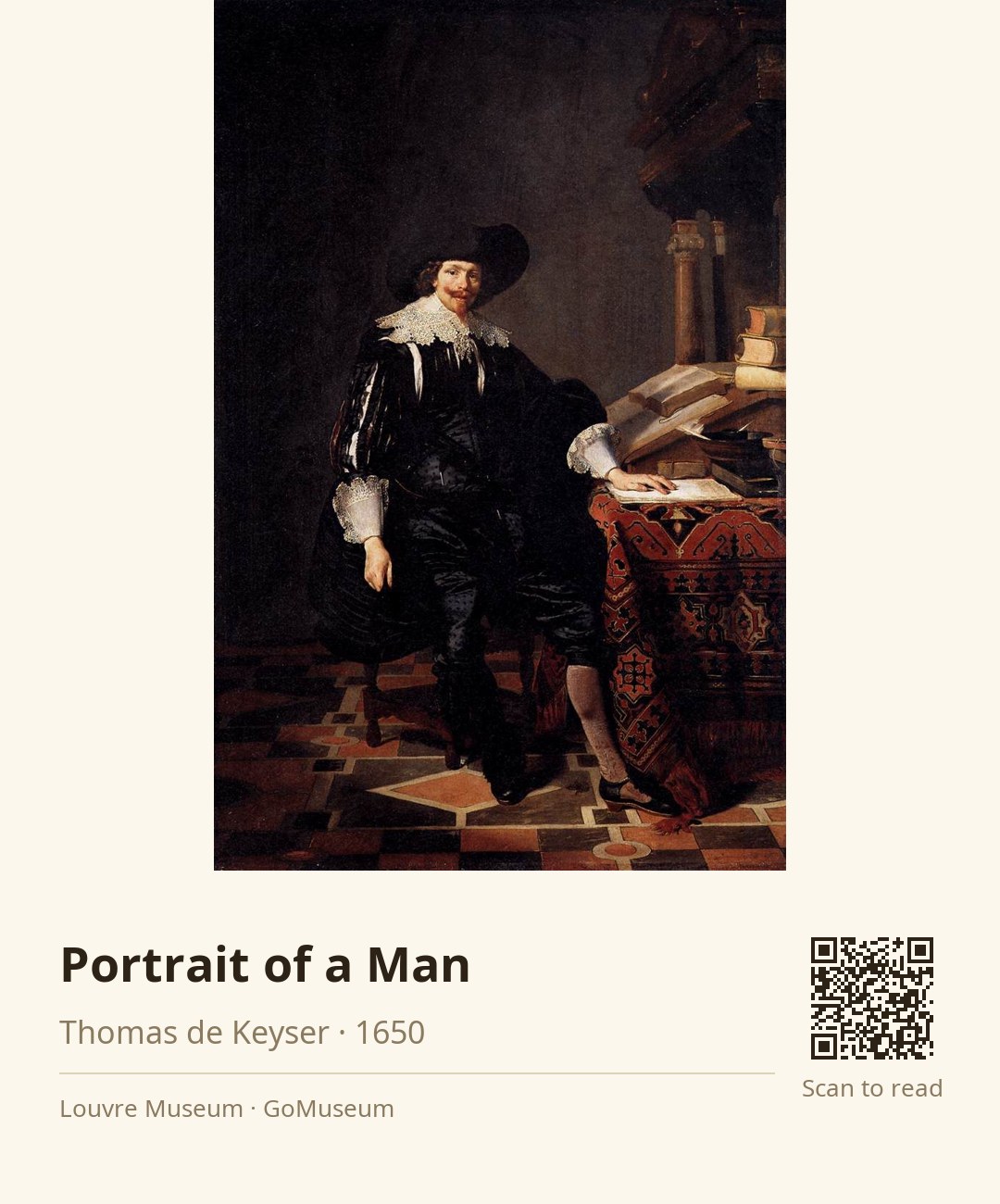
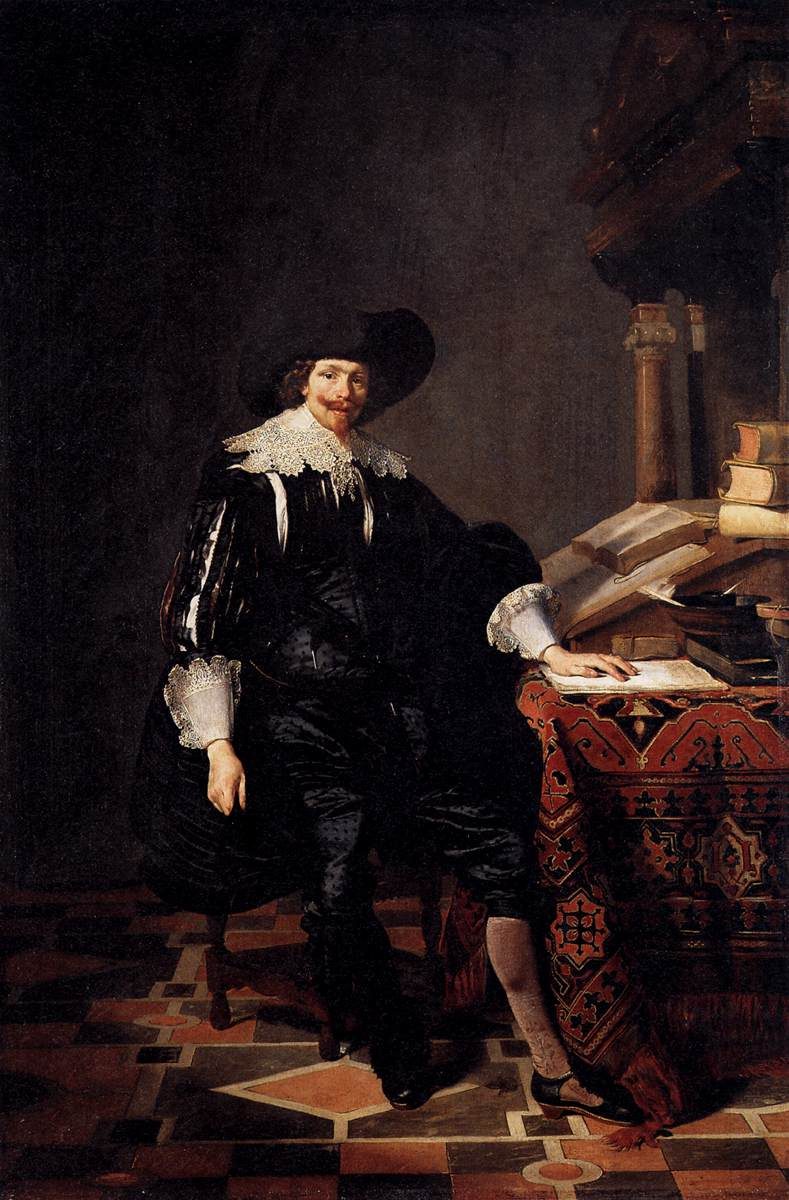
🎧 This work has audio narration — listen in the appThe man in this portrait, dressed in a dark, elaborate outfit with a striking lace collar and cuffs, commands your attention with his direct gaze and slight smile. His right hand rests on a richly patterned tablecloth, adorned with several books, some open, suggesting a moment of contemplation or discussion. The contrast between his dark attire and the vibrant red and black of the tablecloth draws you into the scene, highlighting the elegance of his presence.
This portrayal reflects the status and intellect of the subject, likely a figure of some importance in 17th-century Dutch society. The meticulous detail in the lace and the rich textures of the fabric emphasize the wealth and sophistication of the era, while the geometric pattern of the tiled floor adds depth to the composition, grounding the figure in a well-appointed interior. De Keyser's choice to depict the man in a three-quarters pose enhances the sense of intimacy, inviting viewers to engage with him directly.
Thomas de Keyser, a prominent portrait painter of his time, created this work in 1650, a period when he was navigating the competitive landscape of Dutch portraiture, particularly as Rembrandt began to rise in popularity. De Keyser's portraits are characterized by their rich color and masterful handling, often revealing the personality of his subjects through careful attention to detail.
Thomas de Keyser was a prominent Dutch portrait painter born around 1596, who gained significant acclaim in the Netherlands until the 1630s, when Rembrandt's rising fame overshadowed him. The son of architect and sculptor Hendrik de Keyser, Thomas was immersed in the arts from a young age, training under his father and later becoming a member of the Guild of St. Luke. His early works, characterized by a rich golden hue and masterful chiaroscuro, reflect influences from contemporaries like Cornelis van der Voort and Nicolaes Eliaszoon Pickenoy.
Despite his talent, de Keyser struggled against the competition posed by Rembrandt, leading to a decline in commissions. His notable works include the group portrait of the Amsterdam burgomasters and various mythological scenes. He also operated a successful business in bluestone, which he eventually sold. De Keyser's legacy is marked by the confusion of his works with those of Rembrandt, as many were misattributed to the latter. He passed away in 1667, leaving behind a significant collection of portraits that continue to be celebrated in major museums worldwide, including the Rijksmuseum and the National Gallery in London.
This portrait, created by Thomas de Keyser in 1650, was commissioned during a time when the artist was navigating the competitive waters of Dutch portraiture. De Keyser was once the most sought-after portrait painter in the Netherlands, but by the 1630s, he faced stiff competition from the rising star, Rembrandt. The painting has a rich provenance, having once belonged to Rodolphe Kann, a notable collector. It has been exhibited in various prestigious locations, including the Rijksmuseum in Amsterdam, where many of de Keyser's works reside.
De Keyser's technique in this portrait showcases his mastery of oil paint, with a focus on rich color and texture. The dark background serves to elevate the figure, allowing the intricate details of the lace collar and cuffs to pop with vibrancy. His brushwork is meticulous, revealing the luxurious fabric of the subject's attire, while the geometric pattern of the tiled floor adds a sense of depth and stability to the composition. The three-quarters pose not only invites intimacy but also enhances the dimensionality of the figure, making it feel as if he might step out of the frame. The careful arrangement of the books on the table suggests a narrative of intellect and contemplation, inviting viewers to ponder the man's story.
Interestingly, many of de Keyser's works were often misattributed to Rembrandt, highlighting the significant influence he had on the younger artist. This confusion speaks to the high regard in which de Keyser was held during his lifetime, as well as the challenges of distinguishing between the two masters' styles in the eyes of art historians.
As Rembrandt gained popularity in the 1630s, de Keyser's commissions declined, marking a significant shift in the landscape of Dutch portrait painting.