Young Girl Holding Flowers
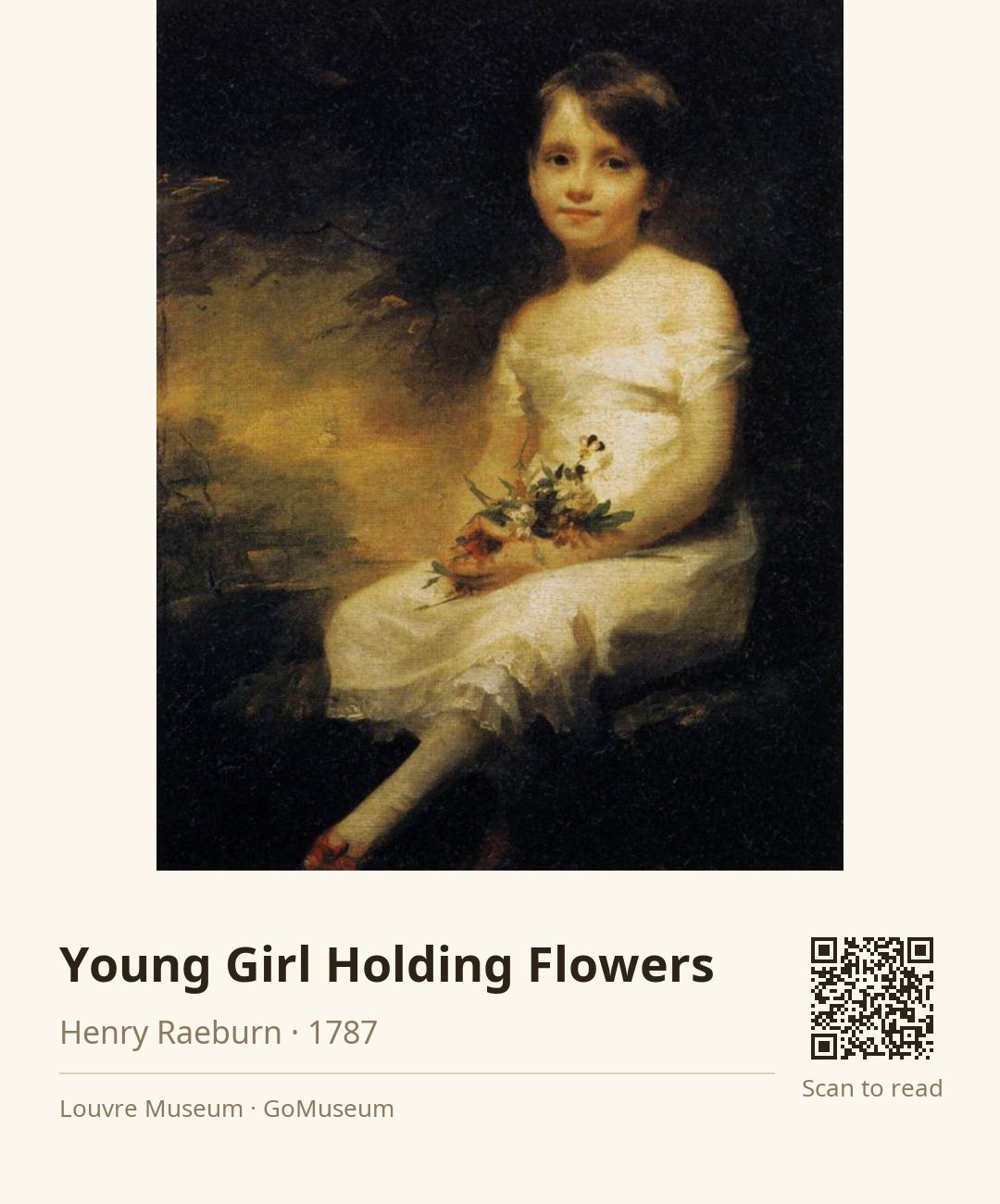
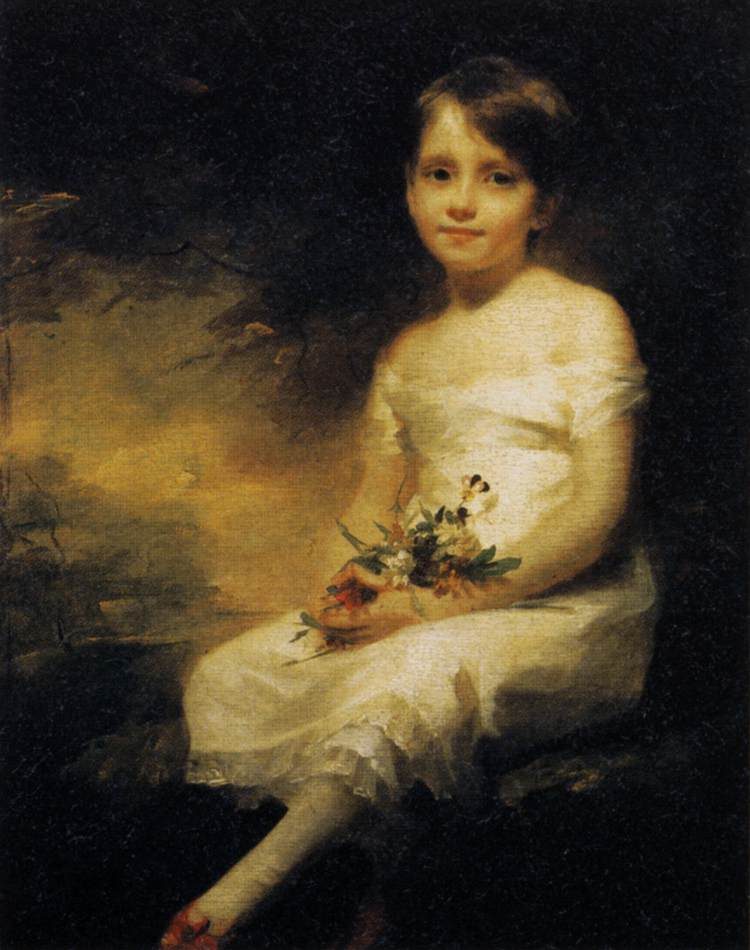
🎧 This work has audio narration — listen in the appThe young girl in white, seated gracefully with a small bouquet of flowers in her lap, draws you in with her calm expression and direct gaze. Her hair is neatly styled, and the soft lighting highlights the delicate textures of her dress and the vibrant blooms, creating a gentle contrast against the dark background.
This portrayal captures not just the innocence of youth but also the artistry of Henry Raeburn, who expertly blends realism with a sense of intimacy. The muted palette, featuring subtle variations of white, brown, and green, enhances the serene atmosphere, inviting viewers to connect with the subject on a personal level. Raeburn's smooth brushwork showcases his skill in rendering fabric and floral details, reflecting his self-taught mastery of oil painting after his studies in Italy.
Raeburn returned to Edinburgh in 1787, the same year he created this portrait of Nancy Graham, marking a significant moment in his burgeoning career as a leading Scottish portrait painter.
Sir Henry Raeburn, born on March 4, 1756, in Stockbridge, Edinburgh, was a distinguished Scottish portrait painter renowned for his powerful characterization and dramatic use of light. Orphaned at a young age, he was raised by his brother and educated at Heriot's Hospital. Initially apprenticed to a goldsmith, Raeburn's artistic journey began with miniature portraits before he transitioned to oil painting, largely self-taught. His marriage to Ann Edgar, a wealthy widow, provided him the means to study in Italy, where he was influenced by masters like Michelangelo.
Raeburn's return to Edinburgh in 1787 marked the beginning of a prolific career. He captured the likenesses of prominent figures, including Sir Walter Scott and various Scottish intellectuals, becoming a pivotal figure in the Scottish art scene. His portraits are celebrated for their realism and emotional depth, bridging the gap between neoclassicism and the emerging romantic style. Despite limited exposure to the broader English art world, Raeburn's commitment to his native Scotland enriched its artistic landscape. He was appointed Portrait Painter to King George IV in Scotland and left a lasting legacy, influencing generations of artists. Raeburn passed away on July 8, 1823, in Edinburgh, leaving behind a remarkable body of work that continues to resonate in art history.
Raeburn's technique in 'Young Girl Holding Flowers' showcases his mastery of oil paint and smooth brushwork, which creates a lifelike texture in the girl's white dress and the delicate flowers she holds. The muted palette, dominated by soft whites, browns, and greens, enhances the serene atmosphere, allowing the viewer to focus on the girl's calm expression and direct gaze. Raeburn's choice of a dark, indistinct background serves to isolate the subject, drawing the viewer's attention to her features and the intricate details of her attire. The composition is balanced, with the girl positioned slightly to the right, creating a sense of movement and inviting the viewer into her world. This thoughtful arrangement, combined with the soft lighting that highlights her face, evokes a feeling of intimacy, making the viewer feel as though they are sharing a moment with her.
Interestingly, Raeburn was initially trained as a goldsmith before turning to painting. His background in jewelry-making gave him a unique perspective on detail and craftsmanship, which he applied to his portraits.
Henry Raeburn was originally trained as a goldsmith before he transitioned to painting.
Raeburn was the apprentice of the jeweller who created a memorial locket for Charles Darwin after his death.