Venus and Cupid Spied on by a Satyr
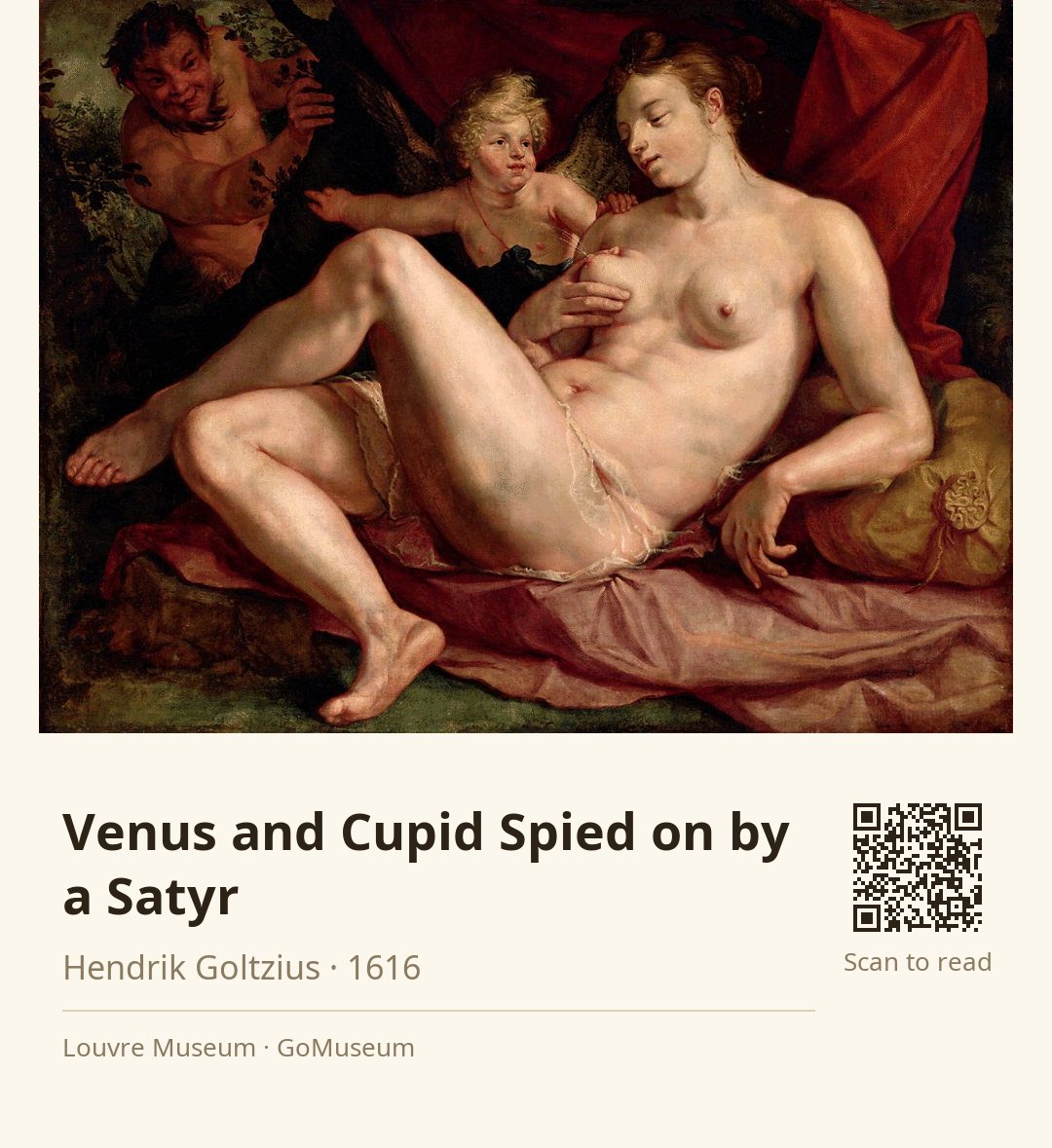
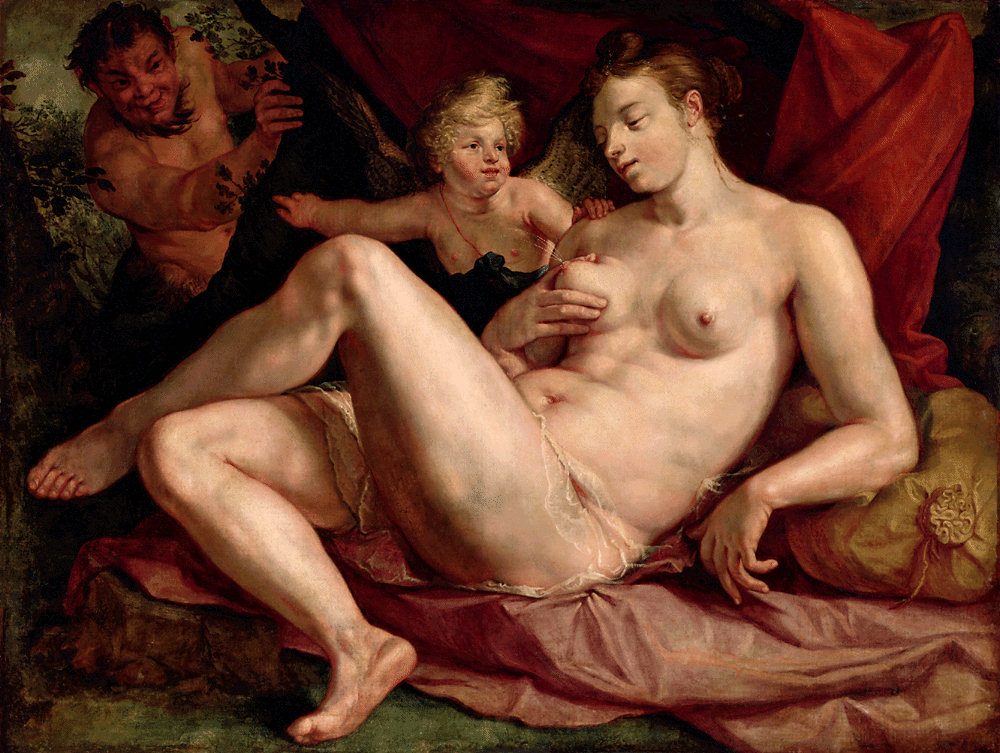
🎧 This work has audio narration — listen in the appThe reclining figure of Venus, draped in rich red and brown fabrics, draws your eye immediately. Her serene expression and closed eyes suggest a moment of tranquility, while the small winged Cupid beside her reaches out, creating a tender connection. In the background, a satyr peeks from behind a curtain, adding an element of playful intrigue to this intimate scene.
This juxtaposition of the divine and the mischievous captures the essence of mythological storytelling, where love and desire are often intertwined with the unexpected. The warm color palette enhances the softness of the figures, inviting you into a world where beauty and seduction reign. Goltzius’s smooth brushwork emphasizes the contours of their bodies, highlighting the sensuality of the moment while maintaining a sense of narrative depth.
Hendrik Goltzius, a leading figure of the early Baroque period, created this painting in 1616, showcasing his mastery not only in engraving but also in oil painting.
Hendrick Goltzius, born in 1558 in the Duchy of Jülich, was a pivotal figure in the evolution of printmaking during the early Baroque period. Initially trained by his father, a glass painter, Goltzius faced a significant challenge when a childhood accident left his right hand deformed. This adversity shaped his unique engraving style, characterized by a commanding line and expressive compositions.
In 1577, he moved to Haarlem, where he became a prominent engraver for publisher Philip Galle. Goltzius's work, which included engravings after his own designs and those of contemporaries, played a crucial role in disseminating Mannerism across Europe. He established a drawing academy with fellow artists, fostering a community that studied the human figure from life.
His travels to Italy in 1590 profoundly influenced his artistic development, allowing him to study the works of Michelangelo and other masters. Goltzius's engravings, noted for their technical mastery and exuberance, earned him recognition as the leading Dutch engraver of his time. He continued to innovate throughout his life, producing both engravings and paintings until his death in 1617 in Haarlem. His legacy endures, with his works housed in major collections worldwide, marking him as a significant figure in art history.
Hendrik Goltzius painted 'Venus and Cupid Spied on by a Satyr' in 1616, a time when he was already recognized as a leading figure in the early Baroque movement. The painting's provenance includes notable collectors like Trochtchinski and Baron Schlichting Basile, indicating its value and desirability. Over the years, it has been referenced in various bibliographies, including works by Demonts and Michel, which highlight its significance in Goltzius's oeuvre and the broader context of 17th-century art.
Goltzius employed oil paint on canvas for this work, allowing for a rich texture and depth of color that enhances the sensuality of the figures. His brushwork is notably smooth, which creates a soft, almost ethereal quality to the flesh tones of Venus and Cupid. The warm palette, dominated by reds and browns, envelops the viewer in a cozy, intimate atmosphere. The figures are closely grouped, drawing the eye to their interaction, while the satyr peeking from behind the curtain adds a playful tension. Goltzius's technique showcases his mastery of form and composition, with the reclining Venus's body elegantly draped, emphasizing her curves and the luxurious fabrics around her. This careful handling of paint and composition invites viewers into a narrative that feels both personal and mythological.
Interestingly, Goltzius faced a significant challenge in his youth when he suffered a severe hand injury that left his right hand deformed. This injury forced him to adapt his technique, leading to a unique style characterized by a commanding line quality in his engravings.
The academy allowed artists to study the human figure from life, fostering a collaborative environment that contributed to the development of Dutch art during that period.