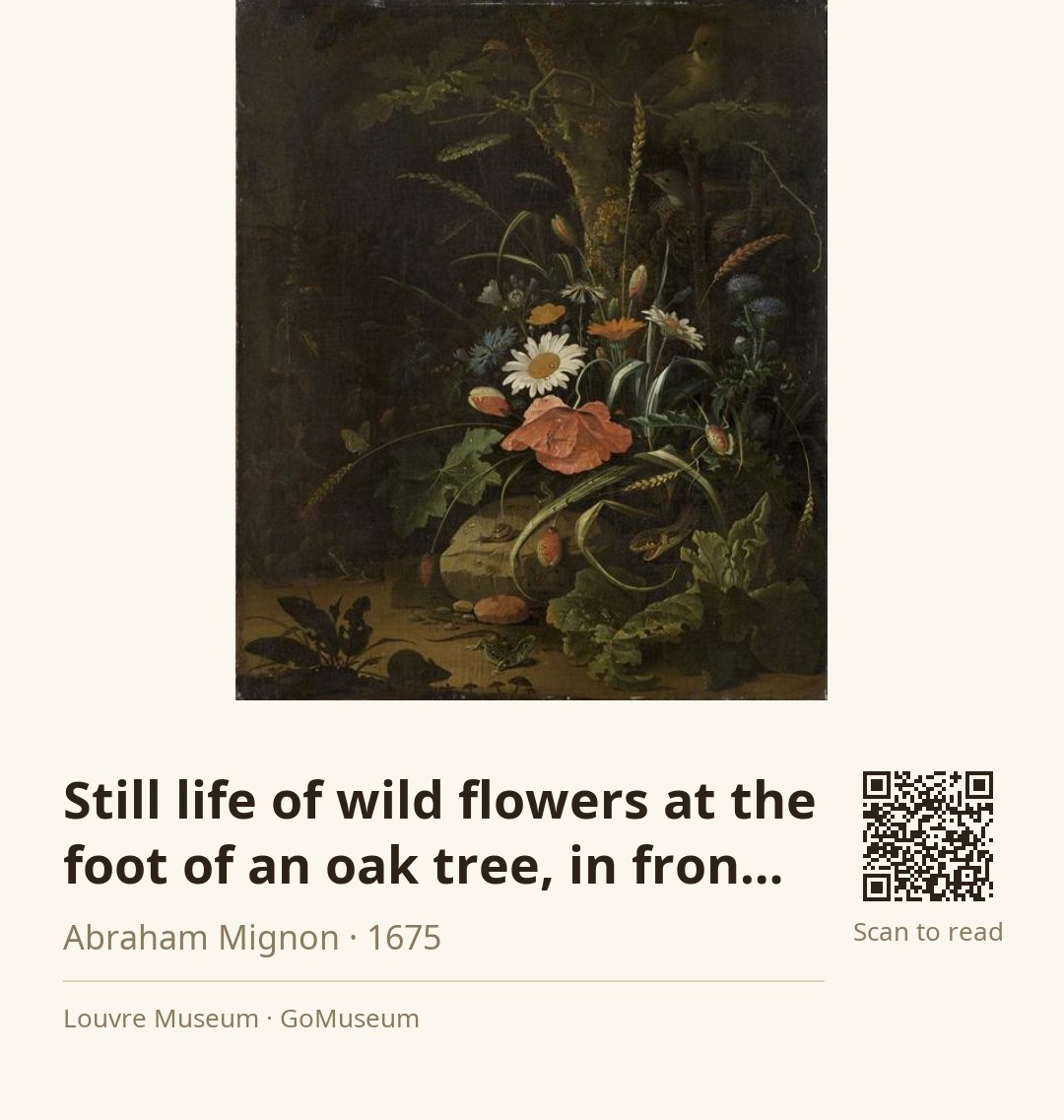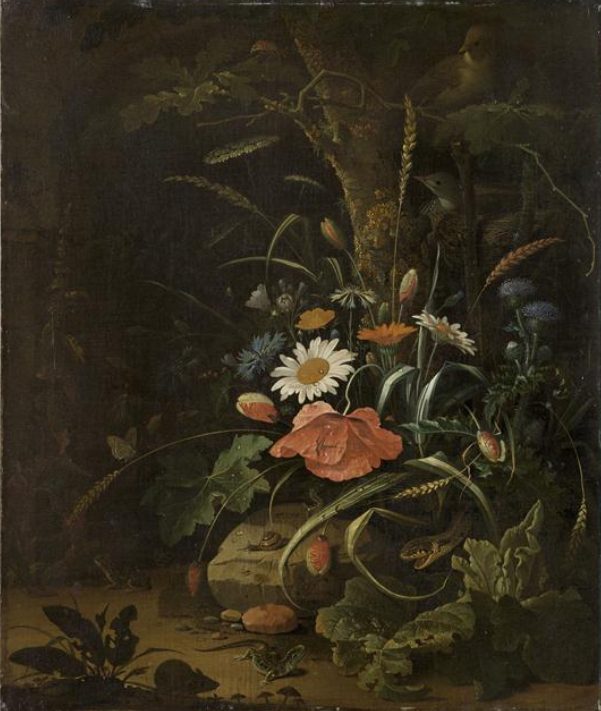
Still life of wild flowers at the foot of an oak tree, in front of a grotto
🎧 This work has audio narration — listen in the appThe vibrant red poppy at the forefront of this still life draws your eye immediately, surrounded by delicate white daisies and bright orange blossoms, all set against a dark, shadowy backdrop. The lush arrangement of wildflowers, interspersed with green leaves and a small lizard peeking through, creates a sense of life and movement, as if these elements are caught in a moment of natural beauty.
Mignon’s choice of a rich, earthy palette enhances the vividness of the flowers, contrasting deep greens and browns with the bright colors that seem to leap from the canvas. This composition reflects his mastery in capturing the intricate details of flora and fauna, showcasing not just the beauty of nature but also the artist's technical skill in rendering textures and colors with precision. The shadowy grotto in the background adds depth, inviting contemplation of the natural world that surrounds these blooms.
Abraham Mignon, a Dutch still life painter active in the late 17th century, specialized in floral compositions and was influenced by the works of Jan Davidszoon de Heem. His paintings were highly sought after by collectors of his time, including royalty, and he left a legacy of approximately 400 still-life works before his untimely death in 1679.
Abraham Mignon, born on June 21, 1640, in Frankfurt, was a Dutch still life painter renowned for his exquisite flower and fruit compositions. His artistic journey began under the tutelage of Jacob Marrel, a prominent flower painter, who recognized Mignon's talent and entrusted him with his business. Mignon later moved to the Dutch Republic, where he became an assistant to Jan Davidszoon de Heem, a key figure in still life painting. His works are characterized by meticulous detail, a cooler palette, and a distinctive arrangement of flowers and fruits, often set against dark backgrounds.
Mignon's life was marked by his strong Calvinist beliefs, which influenced both his personal and professional choices. He married Maria Willaerts in 1675, further intertwining his life with the art world through familial connections. Despite his short life—he died at 39—Mignon's prolific output of around 400 paintings garnered significant attention from collectors, including royalty. His legacy continued through his students, such as Maria Sibylla Merian, and his influence can be seen in the works of later artists who emulated his style. Mignon's contributions solidified his place in the history of still life painting, reflecting the beauty and complexity of nature.
Mignon’s technique in this painting is a masterclass in oil painting, showcasing his skillful brushwork and careful paint handling. The vibrant colors of the flowers pop against the dark, shadowy background, creating a striking contrast that draws the viewer in. His use of a rich, earthy palette not only enhances the vibrancy of the blooms but also adds depth to the overall composition. The layering of paint allows for intricate textures, particularly in the petals of the poppy and the delicate white daisies. Mignon's choice to depict the flowers in a dense arrangement creates a sense of abundance and life, while the shadowy grotto in the background adds an element of mystery. The careful placement of the small lizard among the foliage introduces a dynamic element, suggesting a moment frozen in time, where nature is both beautiful and alive. This meticulous attention to detail and the naturalistic approach to composition are hallmarks of Mignon's style, reflecting his training under the greats of still life painting.
Mignon was influenced by Jacob Marrel, who not only provided him with artistic training but also trusted him to manage his business.
Mignon's paintings were highly valued and collected by elite members of society, including royalty, during the 17th and 18th centuries.
Mignon arranged the flowers in a dense composition, which enhances the feeling of abundance and vitality in the artwork.