Path along the Wood
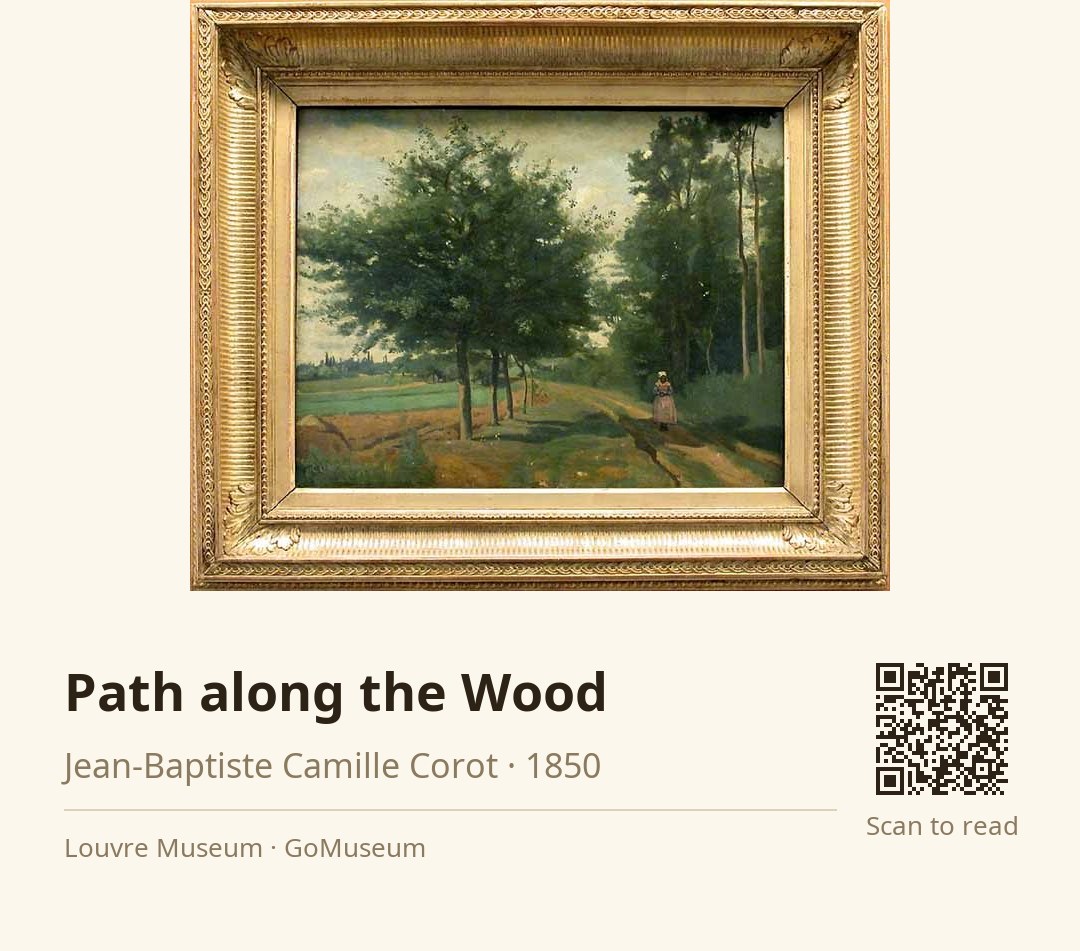
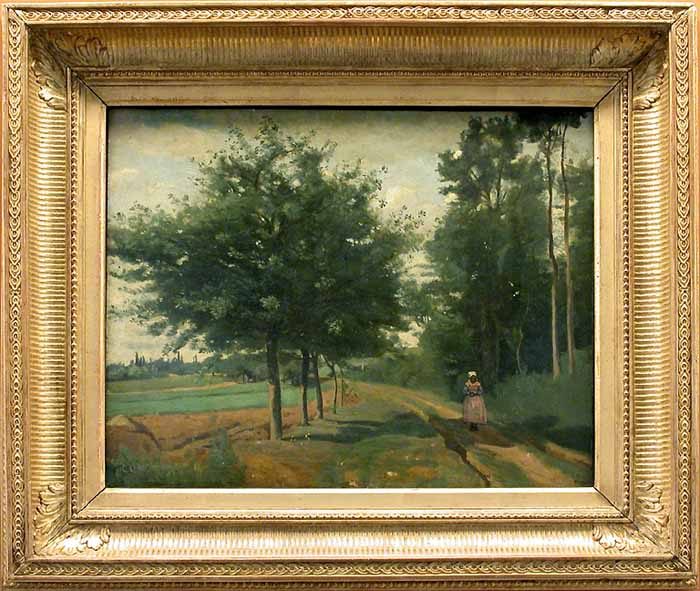
🎧 This work has audio narration — listen in the appA woman in a long dress strolls along a dirt path, her figure gently framed by the lush greenery of a serene rural landscape. To her left, a broad-leaved tree stands tall, its dense foliage casting soft shadows on the ground, while the middle distance reveals more trees forming a natural canopy overhead. The earthy greens and browns of the palette, combined with Corot's soft brushwork, evoke a tranquil atmosphere that invites you to imagine the peaceful sounds of nature surrounding her.
This scene captures a moment of everyday life, reflecting the harmony between humanity and the natural world. Corot’s ability to blend the figures with the landscape speaks to his deep appreciation for the beauty of the countryside, a theme that resonates throughout his work. The painting exemplifies the shift in 19th-century landscape art, moving away from idealized representations to a more realistic portrayal of nature, influenced by the likes of John Constable and J.M.W. Turner.
Created in 1850, "Path along the Wood" showcases Corot's mastery of oil on canvas, marking a significant moment in his career as he began to gain recognition as a pivotal figure in the evolution of landscape painting.
Jean-Baptiste-Camille Corot, born on July 16, 1796, in Paris, was a pivotal French landscape and portrait painter whose work bridged the Neo-Classical tradition and the emerging Impressionist movement. Coming from a well-off bourgeois family, he was able to pursue art without financial constraints after receiving a yearly allowance following his sister's death in 1822. Initially uninterested in art, Corot's passion ignited during nature walks with a family friend, leading him to study under Achille Etna Michallon, who encouraged outdoor painting.
Corot's early career was marked by a struggle between commercial obligations and his artistic aspirations, but he eventually dedicated himself fully to painting. He became known for his serene landscapes, often capturing the essence of light and atmosphere, which would later influence Impressionists. Despite being regarded as an amateur for much of his life, he gained recognition around 1850 and became a founding figure of the Barbizon School, emphasizing realism in nature. Corot's legacy endures as a bridge between classical ideals and modern artistic expression, making him a significant figure in art history. He passed away on February 22, 1875, leaving behind a vast and influential body of work.
The painting presents a tranquil rural landscape, where a dirt path meanders through the scene, inviting you to imagine walking along it. In the foreground, a woman in a long dress and bonnet walks gracefully, her figure harmoniously integrated into the lush greenery that surrounds her. To her left, a large tree with dense foliage stands out, casting gentle shadows on the ground, while the middle distance is filled with more trees that create a natural canopy overhead. In the background, open fields stretch towards the horizon, punctuated by hints of distant structures under a cloudy sky. The earthy palette of greens and browns, combined with Corot's soft brushwork, captures the serene atmosphere of the countryside, making the viewer feel the calmness of this everyday moment.
Interestingly, the painting is also known by another title: 'Environs de Mortain. Chemin bordé à gauche par des pommiers, dit aussi Le sentier le long du bois.'
Corot was born in Paris, specifically at 125 Rue du Bac, which has since been demolished.
Corot's father was a wig maker, and his mother was a milliner.
Corot's work was significant in landscape painting as it both referenced Neo-Classical traditions and anticipated the innovations of Impressionism.