Bonaparte Visiting the Plague Victims of Jaffa
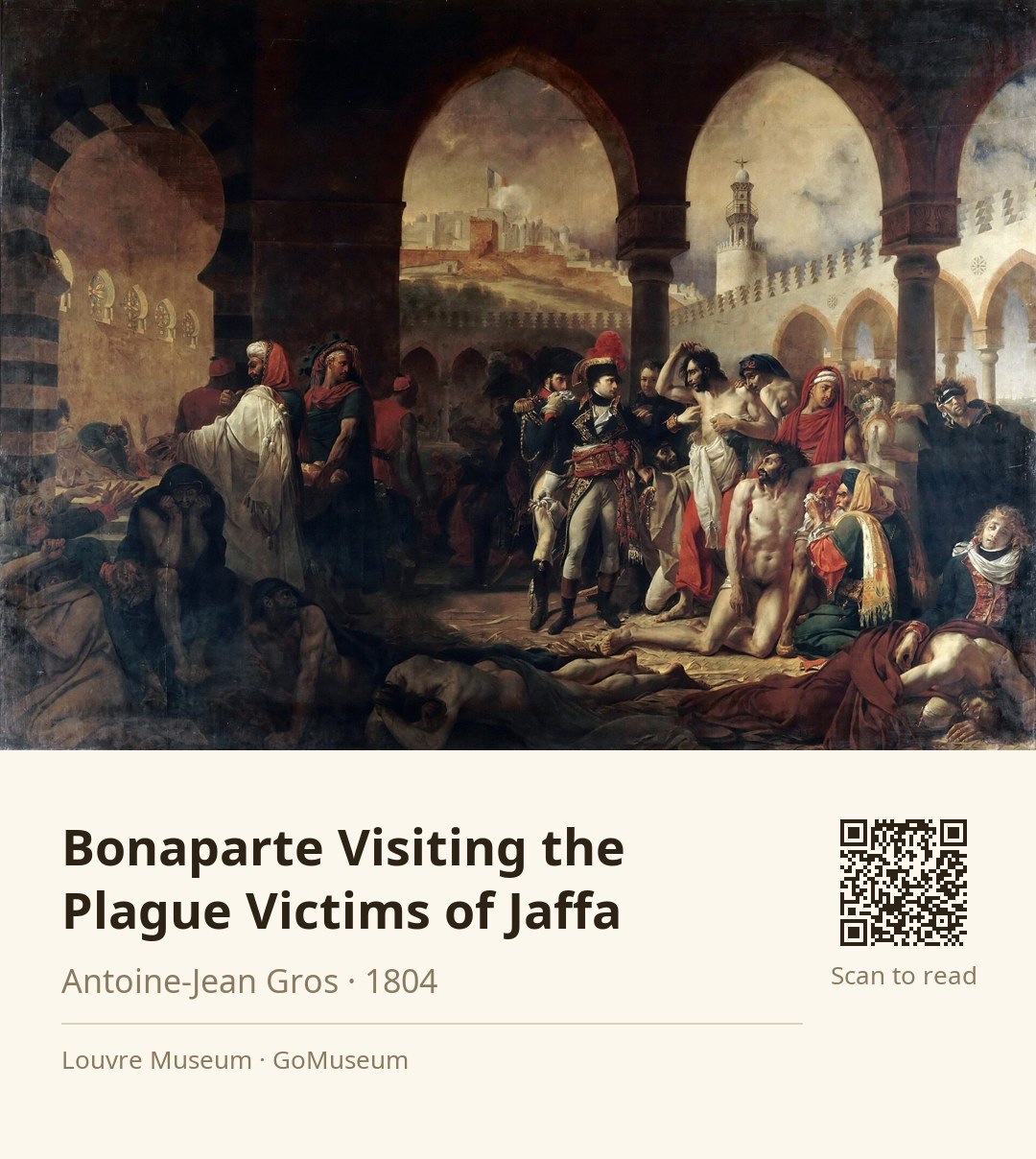
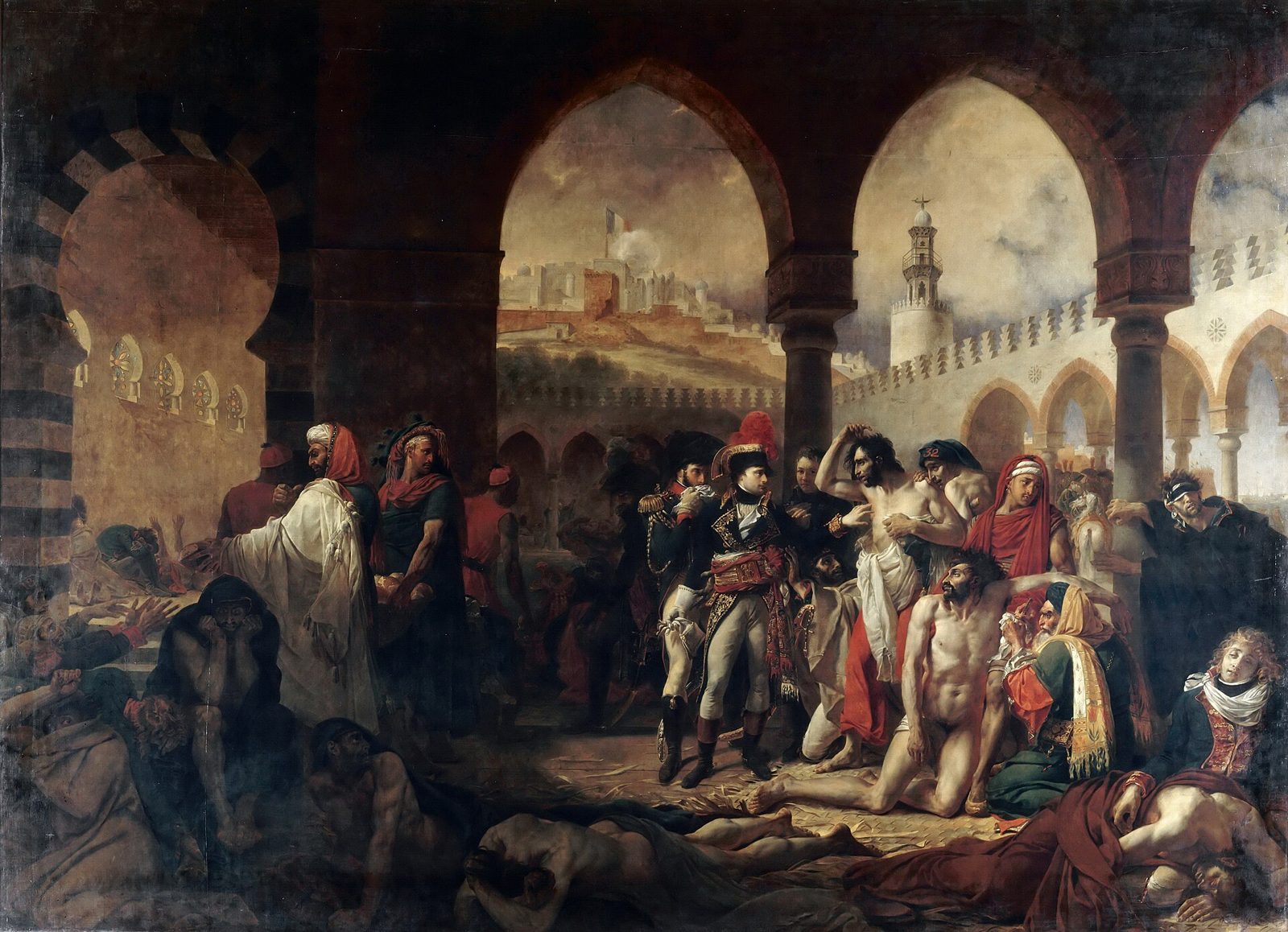
🎧 This work has audio narration — listen in the appTake a moment to really look at this painting, "Bonaparte Visiting the Plague Victims of Jaffa." Notice how Napoleon is at the center, reaching out to a sick soldier, his expression a mix of compassion and determination. Look closely at the figures around him—the sick men with their bandaged bodies, the doctor tending to another patient, and the stark contrast of light and shadow that Gros uses to emphasize the scene's gravity.
These details matter because they reveal the dual purpose of this artwork. On one hand, it’s a portrayal of a heroic moment, showcasing Napoleon as a caring leader amidst a crisis. On the other, it’s a carefully crafted piece of propaganda, commissioned to counteract rumors of his cruelty during the siege of Jaffa, where he had ordered the execution of prisoners. Gros captures this tension beautifully, making you question the reality behind the myth.
Painted in 1804, this piece was created shortly after Napoleon declared himself Emperor, a time when he was keen to shape his public image. Gros, a student of the renowned Jacques-Louis David, was tasked with immortalizing this moment, blending historical fact with artistic interpretation.
As you stand here, consider this: what do you think Gros wanted you to feel about Napoleon? Was he a compassionate leader, or was this just a façade? Let the painting provoke your thoughts about the nature of power and the stories we choose to believe.
Antoine-Jean Gros was a prominent French painter born on March 16, 1771, in Paris. He was a student of Jacques-Louis David, and his early life was marked by artistic promise, nurtured by a family of painters. Gros gained fame during the French Revolution, particularly for his portrait of Napoleon Bonaparte at the Battle of Arcole, which led to a close relationship with the emperor. His works often depicted historical events, blending neoclassicism with emerging romanticism, showcasing both grandeur and emotional depth.
After spending time in Genoa, where he painted portraits, Gros returned to Paris and became a celebrated artist. His notable works include "Bonaparte Visiting the Plague Victims of Jaffa," which served to counter negative propaganda against Napoleon. Despite his success, Gros struggled with the changing artistic landscape, feeling overshadowed by the rise of Romanticism. His later years were marked by personal turmoil, culminating in his tragic suicide in 1835. Gros's legacy lies in his ability to capture the complexities of his subjects, securing his place in art history as a bridge between neoclassicism and romanticism.
Antoine-Jean Gros painted 'Bonaparte Visiting the Plague Victims of Jaffa' in 1804, commissioned by Napoleon himself. This painting was intended to counteract negative press surrounding Napoleon's actions during the siege of Jaffa, where he was accused of ordering the execution of plague victims. The artwork debuted at the Salon of the Académie des Beaux-Arts on September 18, 1804, just before Napoleon's coronation as emperor. Gros was guided by Dominique Vivant Denon, who had firsthand experience of the Egyptian campaign. The painting's reception was mixed; while it elevated Gros's status, it also sparked debates about the historical accuracy of the depicted events, as many accounts from the time did not corroborate the scene's authenticity. Today, it resides in the Louvre, a testament to its enduring legacy and the complex narrative it presents about power and compassion.
In this painting, Gros employs a dramatic interplay of light and shadow to enhance the emotional weight of the scene. Notice how Napoleon stands at the center, bathed in light, symbolizing hope and authority, while the figures around him are shrouded in darkness, representing despair and suffering. The brushwork is meticulous, with the sick men rendered in a way that emphasizes their vulnerability, their bodies almost sculptural in their agony. The composition draws from Jacques-Louis David's 'Oath of the Horatii,' using arcades to create a sense of depth and structure. The two-color arcade divides the painting into realms of light and shadow, reinforcing the contrasting themes of heroism and tragedy. Gros's choice to depict Napoleon reaching out to a sick soldier not only illustrates a moment of compassion but also serves as a calculated political statement, crafting an image of a benevolent leader amidst chaos.
Commissioned by Napoleon himself in 1804, it served not just as a portrayal of a moment in history but as a calculated move in the realm of propaganda. Gros's work helped to shape the myth of Napoleon as a compassionate leader, countering the brutal realities of his military campaigns. The painting's dramatic composition and emotional depth influenced future artists, steering them towards a blend of neoclassicism and romanticism. It also opened the door for the exploration of Orientalism in art, as Gros depicted the Eastern setting and characters with a blend of admiration and exoticism. Remember, this piece is not just about a historical event; it’s about how art can be wielded as a tool for shaping public perception and legacy.
Interestingly, the historical authenticity of the scene is contested. While Gros's painting suggests a noble act of compassion, many accounts from the time, including those from Napoleon's own generals, do not confirm that such a visit occurred as depicted. In fact, some reports indicate that Napoleon hurried past the lazaretto, raising questions about the veracity of the heroic narrative Gros sought to portray.
The painting features the Armenian Saint Nicholas Monastery in the background, which is often mistaken for a mosque due to its architectural style, including a prominent horseshoe arch.
Gros was born into a family of artists, with both his father and mother being painters, which nurtured his artistic talent from a young age and led him to study under the influential Jacques-Louis David.
The oversized French flag in the background not only symbolizes Napoleon's authority but also serves as a visual reminder of the French presence and dominance during the siege of Jaffa, reinforcing the propaganda message of the painting.