The Moneylender and his Wife
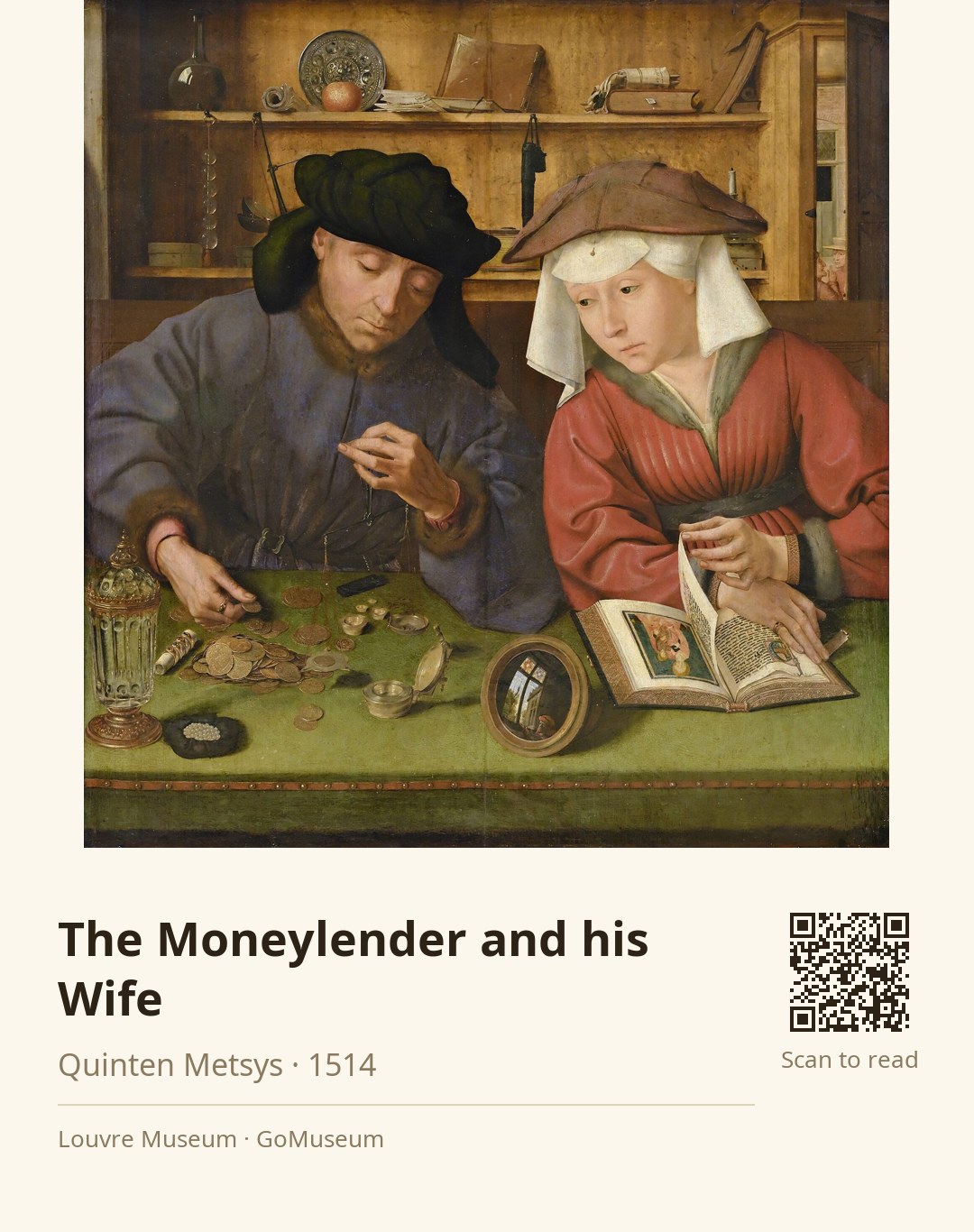
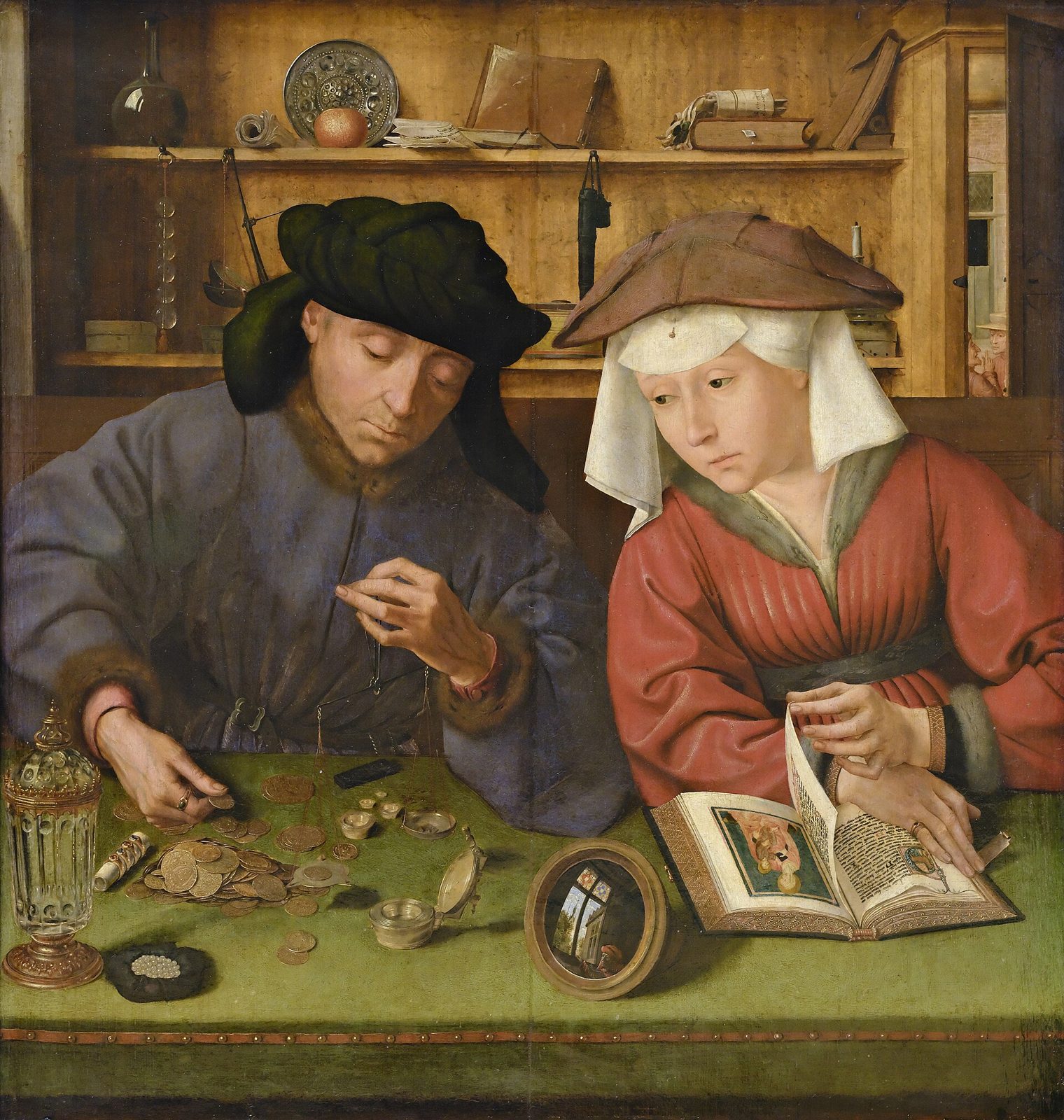
🎧 This work has audio narration — listen in the appTake a moment to really look at "The Moneylender and His Wife." Notice how the man is intently weighing gold and jewels, while his wife is absorbed in a book of devotion. This juxtaposition is key. The man’s focus on wealth contrasts sharply with her spiritual engagement, hinting at a deeper moral commentary.
These details matter because they reflect the tension between materialism and spirituality in 16th-century Antwerp, a bustling hub of commerce and trade. The couple, dressed as well-to-do burghers rather than nobility, symbolizes the rise of the merchant class during a time when financial dealings were becoming increasingly important.
Quentin Matsys, the artist, created this piece in 1514, right in the heart of the Renaissance. His work often carried moral lessons, and here, he seems to caution against the dangers of greed. The objects on the table—gold coins, a crystal goblet, and precious rings—are not just symbols of wealth but also serve as a reminder of the fleeting nature of material possessions.
As you stand here, consider: what do you think Matsys is saying about the balance between wealth and faith? How does that resonate with our own lives today?
Quentin Matsys, born around 1466 in Leuven, was a pivotal Flemish painter of the Early Netherlandish tradition. Initially trained as a blacksmith, he transitioned to painting, possibly inspired by a romantic pursuit. Matsys settled in Antwerp, where he became a master in the Guild of Saint Luke by 1491, marking the rise of Antwerp as a leading artistic center. His works, often imbued with religious themes and satirical commentary, reflect a blend of realism and moral complexity, showcasing influences from earlier masters like Van Eyck and Van der Weyden.
Matsys is celebrated for his detailed portraits and altarpieces, with notable works such as "The Money Changer and His Wife," which critiques societal values. His style is characterized by a firm outline, meticulous detail, and a rich palette, contributing significantly to the evolution of Flemish art in the 16th century. As the founder of the Antwerp school, Matsys played a crucial role in shaping the artistic landscape of his time, leaving a legacy that would influence generations of artists. He passed away in 1530, remembered as a master of both religious and secular themes, bridging tradition and innovation in the Renaissance.
In 1514, the Flemish artist Quinten Metsys completed 'The Moneylender and His Wife,' a painting that would find its home in the Louvre. Commissioned during a time when Antwerp was bustling with commerce and cultural exchange, this work reflects the lives of well-to-do burghers rather than nobility. The painting captures a moment of everyday life, with the moneylender weighing gold while his wife reads a devotional book. This scene resonates with the growing demand for money-lenders in Antwerp, a city that was welcoming many immigrants fleeing the Spanish Inquisition. Interestingly, Metsys' follower, Marinus van Reymerswaele, would revisit this motif 25 years later, showing the lasting impact of Metsys' work. The painting also caught the eye of Cornelis van der Geest, a prominent admirer who owned several of Metsys' pieces and even honored the artist a century later with a commemorative plaque in Antwerp Cathedral.
As you gaze at 'The Moneylender and His Wife,' take a moment to appreciate Matsys' masterful technique. The brushwork is meticulous, with each detail rendered with a realism that draws you in. Notice how the light dances across the gold coins and the crystal goblet, creating a luminous quality that almost makes them pop off the canvas. The composition is carefully structured; the man and woman are positioned in a way that emphasizes their contrasting focuses — wealth versus spirituality. The convex mirror reflects the outside world, inviting you to consider the broader implications of their choices. Matsys uses color not just for beauty but to evoke emotion; the warm tones of the gold juxtaposed with the cooler hues of the wife's book create a visual tension that mirrors the moral conflict at play. This isn't just a scene; it's a narrative crafted with intention.
One fascinating tidbit about 'The Moneylender and His Wife' is that it features a signed and dated scroll, which is quite rare for works of this period. This scroll, placed above the book, reads 'Quentin Matsys / Schilder 1514,' providing a direct connection to the artist and the year it was created.
The convex mirror reflects the outside world, specifically a window that opens to the street, hinting at the bustling life of Antwerp and inviting viewers to consider the broader societal implications of the couple's choices.
The painting's motif was later adopted by Matsys' follower, Marinus van Reymerswaele, who created a similar work 25 years later, demonstrating the lasting impact of Matsys' themes of morality and materialism in art.