Apollo Vanquishing the Python
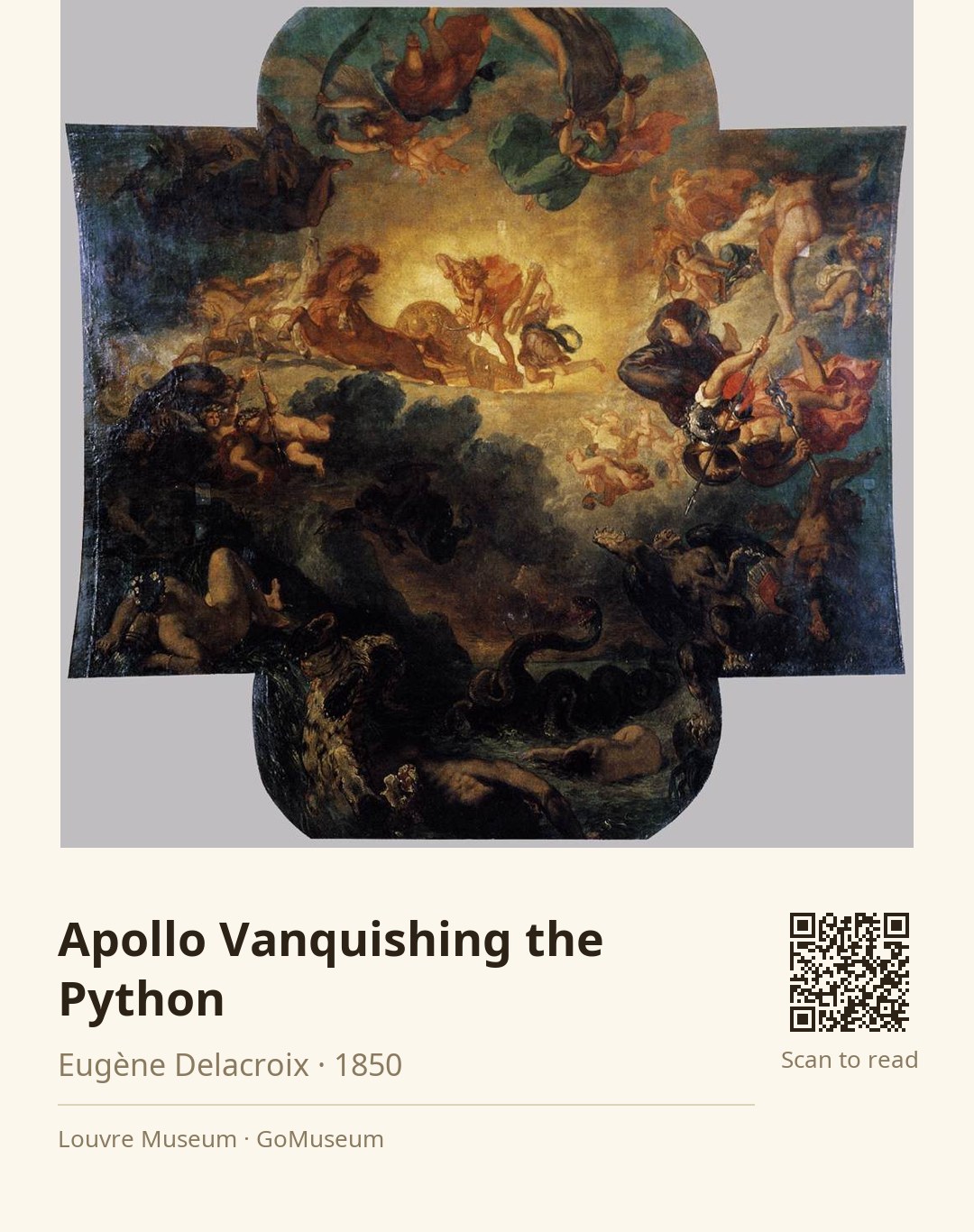
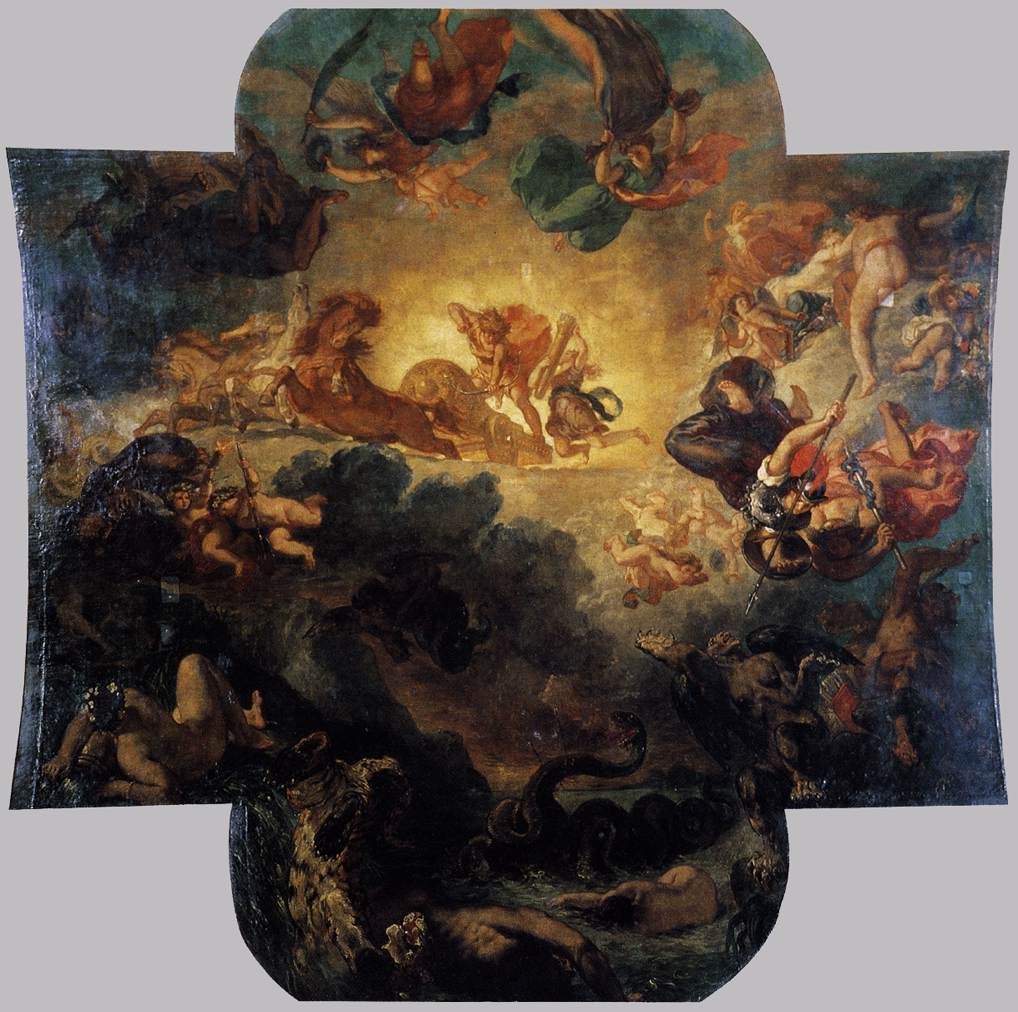
🎧 This work has audio narration — listen in the appApollo stands triumphant in the center of this dynamic scene, his golden chariot pulled by spirited horses as he confronts the monstrous Python. Surrounding him are various figures, some brandishing weapons, while others, draped in flowing garments, evoke a sense of celestial grandeur. The rich palette of warm golds contrasts sharply with the deep shadows, enhancing the drama of this mythological battle.
This vivid imagery captures the moment of Apollo's victory over Python, a creature born from Gaia, who guarded the oracle of Delphi. The swirling clouds and indistinct forms below suggest the chaos of the battle, while Apollo's commanding presence symbolizes the triumph of order over chaos. Delacroix's vigorous brushwork amplifies the energy of the scene, immersing viewers in the action and emotion of this mythic confrontation.
Commissioned to complete the long-unfinished ceiling of the Apollo Gallery at the Louvre, Delacroix's painting was finalized in 1851, marking the end of an artistic endeavor that had spanned nearly two centuries. The work reflects not only the artist's Romantic style but also the enduring legacy of classical mythology in the visual arts.
Eugène Delacroix, born on April 26, 1798, in Charenton-Saint-Maurice, emerged as a pivotal figure in the French Romantic movement. He diverged from the Neoclassical ideals of his contemporaries, such as Ingres, drawing inspiration from the vibrant colors and dynamic forms of Rubens and the Venetian Renaissance. His works, characterized by dramatic themes and a passion for the exotic, often reflected his travels in North Africa and his fascination with the sublime forces of nature, influenced by literary figures like Lord Byron.
Delacroix's career was marked by both acclaim and controversy; his early painting, "The Barque of Dante," stirred public debate but was ultimately recognized by the state. His later masterpieces, including "Liberty Leading the People," showcased his ability to blend historical and contemporary narratives, solidifying his status as a master of expressive brushwork and color theory. His innovative techniques laid the groundwork for Impressionism and inspired the Symbolist movement.
Despite personal struggles, including early orphanhood and financial hardships, Delacroix's legacy endures. He is celebrated not only for his paintings but also for his lithographs and writings, which reveal his artistic philosophy. As one of the last old masters, his influence resonates through art history, marking him as a cornerstone of Romanticism and a precursor to modern artistic movements. Delacroix passed away on August 13, 1863, leaving a profound impact on the art world.
Eugène Delacroix's 'Apollo Vanquishing the Python' was painted between 1850 and 1851 as part of a grand project to complete the ceiling of the Apollo Gallery at the Louvre, a task that had been left unfinished for nearly two centuries. The gallery's original design was initiated by Charles Le Brun in the 17th century, but it languished for years due to various interruptions, including the construction of Versailles. Delacroix's work was commissioned to fill the central caisson, and upon its completion, it was met with mixed reviews.
An interesting tidbit about 'Apollo Vanquishing the Python' is that it was part of a much larger project that had been stalled for nearly 188 years. The Apollo Gallery's ceiling was originally envisioned by Charles Le Brun, but due to various interruptions, including the demands of the Palace of Versailles, it remained incomplete until Delacroix took on the challenge.
After Delacroix completed the painting, it received mixed reviews from critics and the public.
Delacroix was influenced by the art of Rubens and Venetian Renaissance painters, focusing on color and movement in his style.