 Image: Sailko · Sailko · Sailko · Daderot
The Goat Amalthea with the Infant Jupiter and a Faun
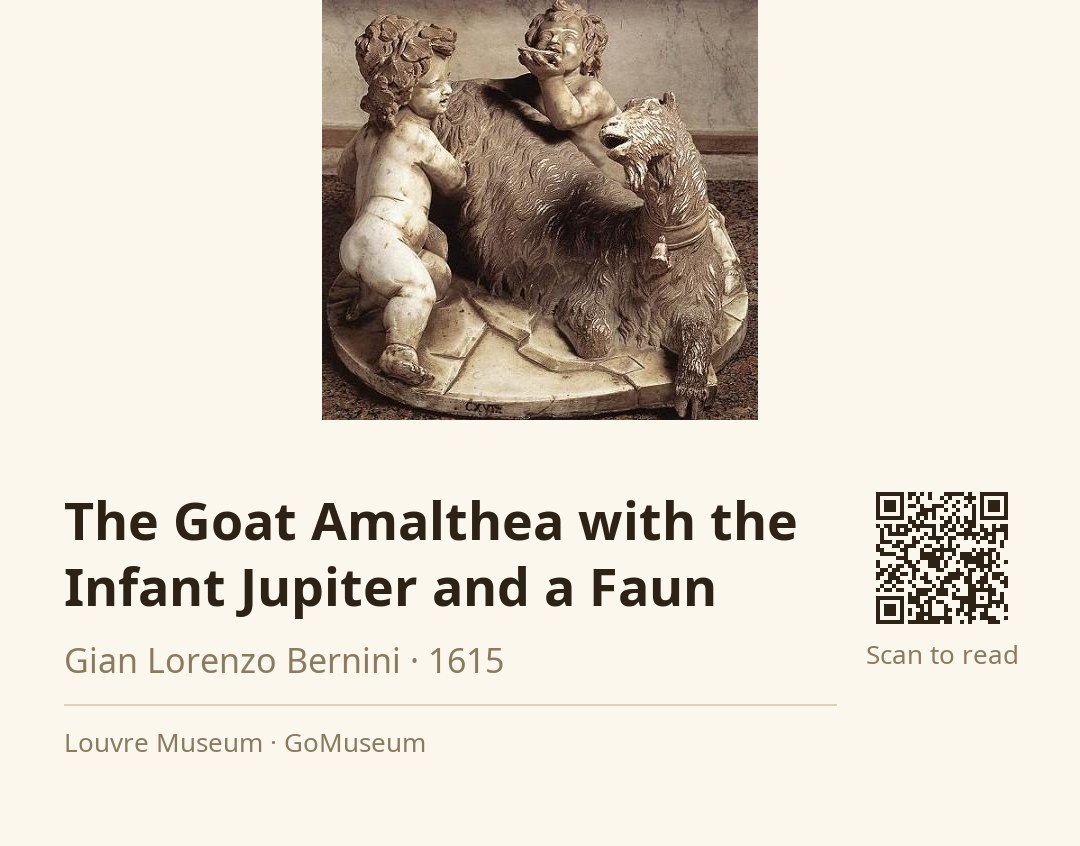
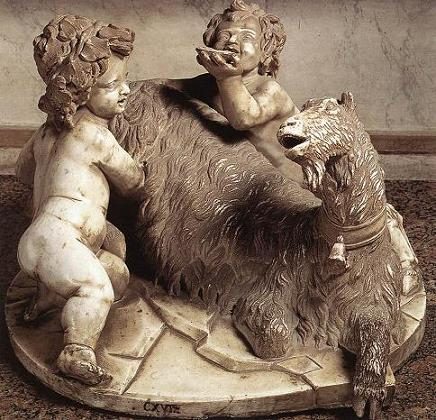
🎧 This work has audio narration — listen in the appTake a moment to really look at Bernini's "The Goat Amalthea with the Infant Jupiter and a Faun." Notice how the goat's fur seems almost alive, each strand meticulously carved to catch the light. And look at the expressions on the faces of the infant Jupiter and the faun—there's a playful innocence that draws you in, isn’t there?
These details matter because they showcase Bernini’s extraordinary skill at capturing emotion and movement in marble, a medium that can often feel cold and lifeless. Here, he breathes life into stone, making it feel as if the figures might leap off their pedestal at any moment.
As you stand here, think about the context: Bernini was just a young artist when he created this piece, yet he was already showing signs of the genius that would later define his career. Imagine the excitement in Rome as his talent began to unfold, capturing the attention of powerful patrons.
So, what do you think Bernini felt as he sculpted this piece? Did he know he was on the brink of greatness? Let that question linger as you take in the beauty of this early masterpiece.
Gian Lorenzo Bernini, born on December 7, 1598, in Naples, was a preeminent Italian sculptor, architect, and painter, celebrated as a defining figure of Baroque art. Recognized as a prodigy from a young age, his talent was nurtured by his father, a Mannerist sculptor, and quickly garnered the attention of influential patrons, including Pope Paul V, who famously predicted Bernini would be the "Michelangelo of his age."
Bernini's work is characterized by dynamic movement, intricate forms, and a theatrical quality that set the standard for Baroque sculpture. His masterpieces, such as the Ecstasy of Saint Teresa and the Fountain of the Four Rivers, exemplify his ability to blend sculpture with architecture, creating cohesive visual narratives. His architectural contributions include the design of St. Peter's Basilica's grand colonnade, which remains a hallmark of Roman urban planning.
Throughout his life, Bernini was deeply engaged with the Counter-Reformation, using his art to convey the Catholic Church's power and spirituality. His versatility extended to painting and theatrical productions, where he showcased his multifaceted creativity. Bernini's legacy as a transformative artist solidified his place in art history, influencing generations and earning him the title of the first pan-European sculptor. He passed away on November 28, 1680, in Rome, leaving behind a monumental body of work that continues to inspire awe.
As you admire Bernini's sculpture, take a closer look at the intricate details of the goat's fur. Each strand is not just carved but seems to ripple with life, a testament to Bernini's masterful technique. He used a chisel to create a texture that mimics the softness of fur, allowing light to dance across the surface. Notice how the smoothness of Jupiter's skin contrasts with the rougher texture of the goat, enhancing the lifelike quality of the figures. This interplay of textures is a hallmark of Bernini's work, showcasing his ability to manipulate marble into forms that evoke both softness and strength.
This remarkable piece, 'The Goat Amalthea with the Infant Jupiter and a Faun,' was crafted by a young Gian Lorenzo Bernini between 1609 and 1615, marking his emergence as a sculptor. Commissioned by Cardinal Scipione Borghese, a powerful patron and nephew of Pope Paul V, the sculpture was intended for the Borghese collection, where it remains today. Interestingly, in 1615, a carpenter was paid to create a wooden pedestal for the sculpture, hinting at its importance and the care taken in its presentation.
His prodigious talent was recognized early on, and he was often compared to Michelangelo. This piece, along with others he made during his youth, showcased his extraordinary skill and foreshadowed his later masterpieces. It's fascinating to think that such a significant work came from someone so young, isn't it?