Saint Jerome
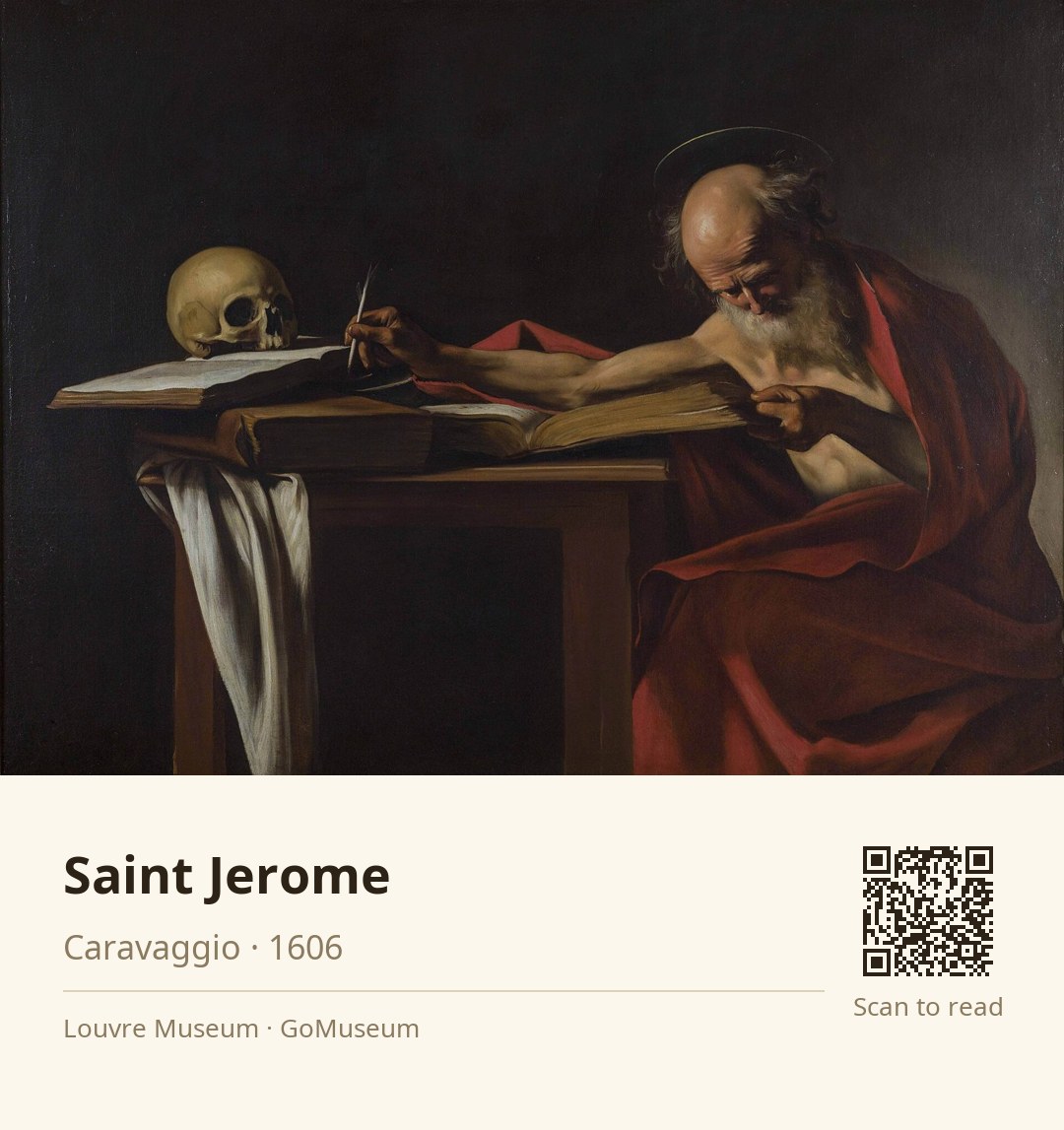
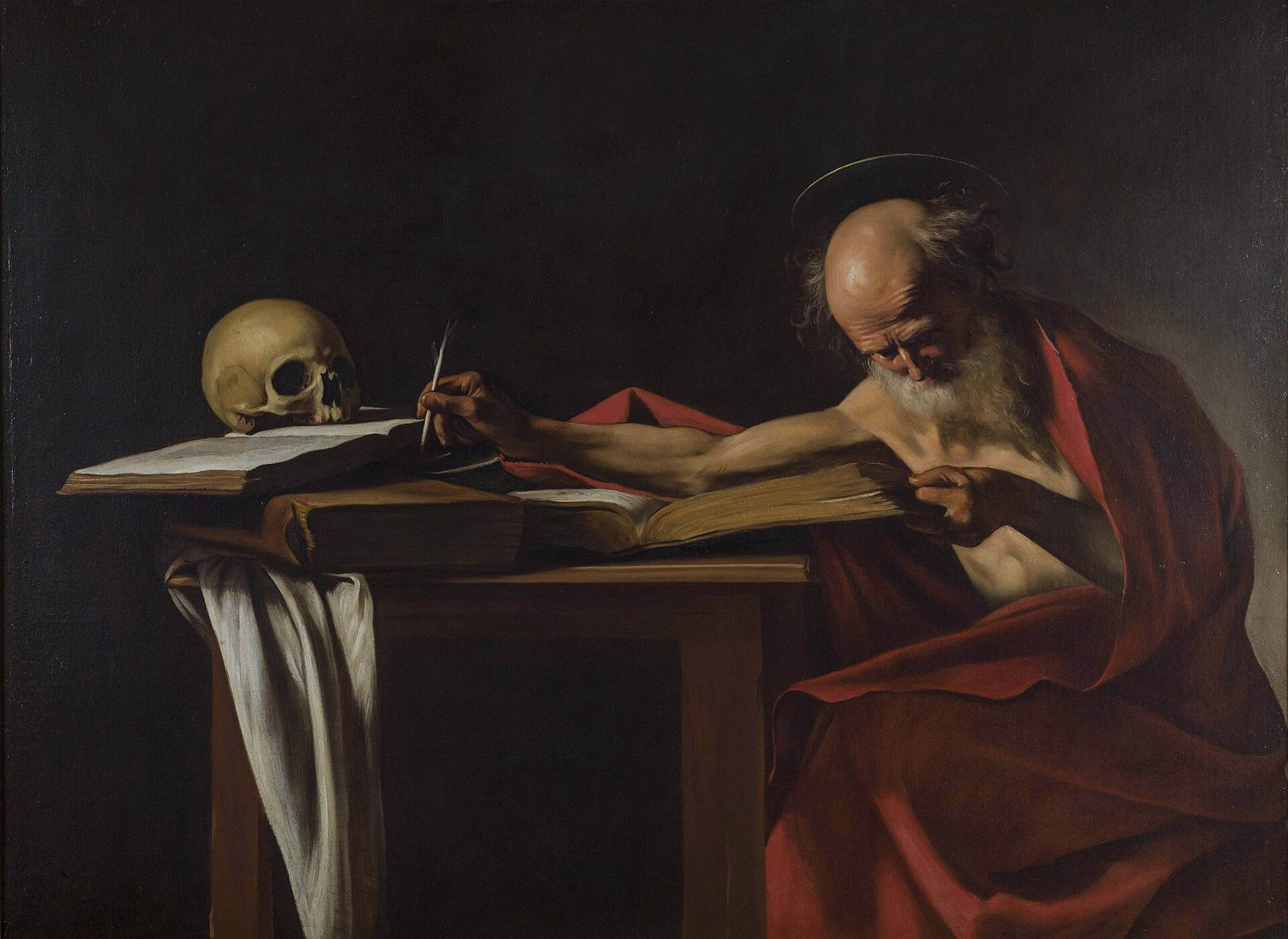
🎧 This work has audio narration — listen in the appTake a moment to really look at Caravaggio's "Saint Jerome." Notice how the light falls dramatically across the figure, illuminating his intense expression while casting deep shadows around him. That contrast isn’t just for show; it’s a hallmark of Caravaggio’s style, known as tenebrism, which captures the struggle between knowledge and ignorance, life and death.
Now, focus on the crumpled books and the skull on the table. The skull, a classic memento mori, reminds us of mortality, while the books symbolize the pursuit of wisdom. This juxtaposition reflects Saint Jerome’s role as a translator of the Bible, emphasizing the tension between earthly existence and spiritual enlightenment. Caravaggio was known for his ability to convey deep human emotions, and here, you can almost feel Jerome’s dedication to his work, lost in thought yet acutely aware of the fleeting nature of life.
Created around 1606 for Cardinal Scipione Borghese, this painting is part of a series where Caravaggio explored the theme of Saint Jerome, a popular subject during the Counter-Reformation.
As you stand here, consider this: What thoughts do you think were racing through Jerome’s mind as he translated sacred texts? How does that resonate with your own quest for understanding in today’s world?
Michelangelo Merisi da Caravaggio, born in Milan in 1571, became one of the most influential figures in Baroque art. His early life was marked by tragedy and hardship, losing family members to the plague and growing up in poverty after his mother’s death. Caravaggio trained as a painter in Milan, where he developed a keen eye for realism, influenced by the naturalism of Lombard art and the dramatic compositions of the Counter-Reformation.
Moving to Rome in the early 1590s, Caravaggio's career flourished as he gained recognition for his innovative use of chiaroscuro, known as tenebrism, which brought a striking emotional depth to his subjects. His paintings often depicted intense moments of struggle and suffering, reflecting both physical and psychological states. However, his tumultuous personal life, marked by violence and legal troubles, led to his exile from Rome after killing a man in a brawl.
Despite his troubled existence, Caravaggio continued to produce powerful works in Naples, Malta, and Sicily until his untimely death in 1610. His legacy, initially overshadowed by his notorious reputation, was rediscovered in the 20th century, cementing his status as a precursor to modern painting. His influence is evident in the works of many artists, and he remains a pivotal figure in the history of Western art.
This painting is part of a series where Caravaggio delved into the theme of Saint Jerome, a popular subject at the time. The work's provenance is intriguing; while it was attributed to Caravaggio, there were periods when it was mistakenly credited to Jusepe de Ribera in the Borghese inventories from 1700 until 1893. The painting is housed in the Galleria Borghese in Rome, a collection that reflects the cardinal's taste and influence. Interestingly, the painting's reception was complex, as it was not mentioned in a 1613 poem about the Borghese collection, raising questions about its early history and how it was perceived in the art world of the time.
In "Saint Jerome," Caravaggio employs his signature tenebrism to create a striking visual impact. The dramatic interplay of light and shadow not only highlights Jerome's intense concentration but also enhances the emotional weight of the scene. Notice how the warm tones of Jerome's scarlet robe contrast with the cooler hues surrounding him, establishing a dialogue between life and death, knowledge and ignorance. The composition is carefully structured; Jerome's outstretched arm creates a horizontal line that connects him to the skull on the table, a memento mori that underscores the fleeting nature of life. The brushwork is meticulous yet dynamic, with a sense of restlessness that mirrors Jerome's intellectual struggle. The unfinished details in the beard and books suggest a sense of urgency, as if Caravaggio captured a moment in time rather than a polished final product. This technique invites viewers to engage with the painting on a deeper level, reflecting on the themes of mortality and the pursuit of wisdom.
By portraying Jerome in a moment of intense concentration, Caravaggio breaks away from the idealized representations common in earlier art. This raw, human depiction influenced countless artists, sparking a movement known as Caravaggism, where followers adopted his dramatic use of light and shadow, known as tenebrism. The painting not only reflects the Counter-Reformation's emphasis on personal piety but also challenges viewers to engage with the subject on a deeper emotional level. Remember, this isn't just a saint at work; it's a moment that changed how we see spirituality in art, making it more relatable and visceral.
Imagine the artist, in a moment of desperation, creating this profound work not just as a commission, but as a gesture of gratitude. This connection adds a layer of personal stakes to the painting, intertwining the fates of both the artist and the cardinal in the turbulent world of 17th-century Rome.
For nearly two centuries, this painting was mistakenly attributed to Jusepe de Ribera in the Borghese inventories, which highlights the complexities of art attribution and the challenges in recognizing an artist's work. It wasn't until 1893 that it was definitively recognized as a work by Caravaggio.
The painting displays signs of being unfinished, particularly in the details of Saint Jerome's beard and the books on the table, which lack the meticulous finishing characteristic of Caravaggio's other works. This unfinished quality adds a sense of urgency and spontaneity, as if Caravaggio captured a fleeting moment of inspiration.