Image: Unknown artistUnknown artist
Altar of Domitius Ahenobarbus
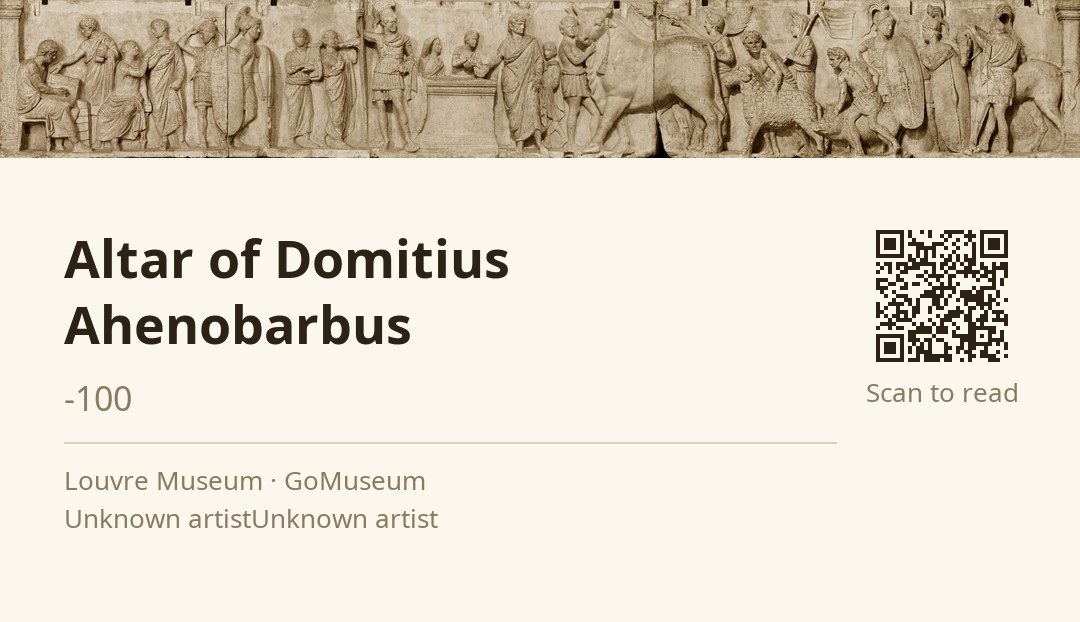
🎧 This work has audio narration — listen in the appAs you stand before the Altar of Domitius Ahenobarbus, take a moment to really absorb the intricate details carved into this ancient marble. Look closely at the figures on the left side of the frieze, where an official records the identity of a Roman citizen. Notice how the man holds wax tablets, his hand raised in an oath—a gesture that speaks volumes about the importance of civic duty in ancient Rome.
These details matter because they capture a pivotal moment in Roman society: the census. This was not just a headcount; it was a declaration of identity, property, and allegiance to the state. The relief showcases one of the earliest examples of continuous narrative in Roman art, allowing us to witness the very act of citizenship being recorded, a cornerstone of Roman identity.
The altar’s panels blend mythological themes with this civic scene, illustrating how the Romans viewed their gods as integral to their everyday lives.
So, as you gaze at this remarkable piece, think about the weight of that oath—the promise of loyalty and duty that shaped the Roman world. What would you pledge your loyalty to if you were standing here centuries ago?
As you look closely at the Altar of Domitius Ahenobarbus, notice the exquisite craftsmanship of the Parian marble. The sculptor has carved intricate details that bring the figures to life. The smoothness of the marble contrasts with the sharpness of the lines, especially in the folds of the clothing and the expressions on the faces. You can almost feel the tension in the hand of the official as he records the citizen's identity. This relief is not just a flat surface; it has depth and texture, inviting you to explore the narrative it unfolds. The way the light plays on the polished marble enhances the drama of the scene, making it feel dynamic and alive, as if the figures might step out of their stone confines at any moment.
This altar was not merely decorative; it was a significant part of the temple's cultic function, which was located on the Field of Mars in Rome. The reliefs were uncovered during renovations in the early 17th century, when the Santacroce family was expanding their palace. Imagine the excitement of discovering these ancient artworks, which had been repurposed as courtyard decoration! Over the centuries, the altar has traveled, with parts now housed in prestigious museums like the Louvre and the Glyptothek in Munich. Each relocation adds layers to its story, connecting it to different eras and audiences.
One intriguing detail about the Altar of Domitius Ahenobarbus is that it originally served as a base for cult statues, not as an altar in the traditional sense. The altar's design, with its four panels, was specifically created to support these statues, which included representations of Neptune and other mythological figures. This functional aspect adds a layer of complexity to its artistic significance, as it was meant to engage worshippers in both civic and religious life.