 Image: Thesupermat
Flowers in a Crystal Vase Standing on a Stone Pedestal, with a Dragonfly
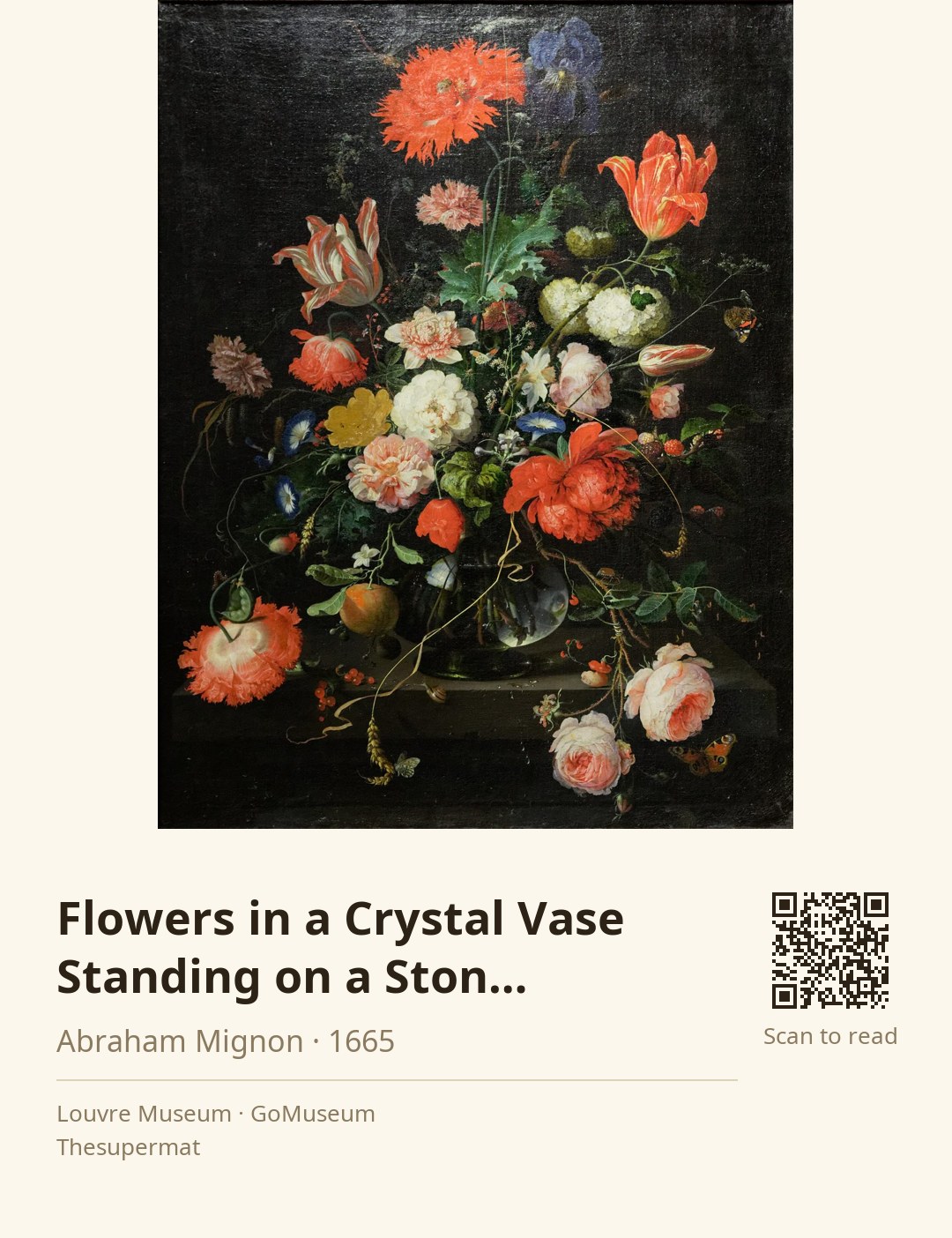
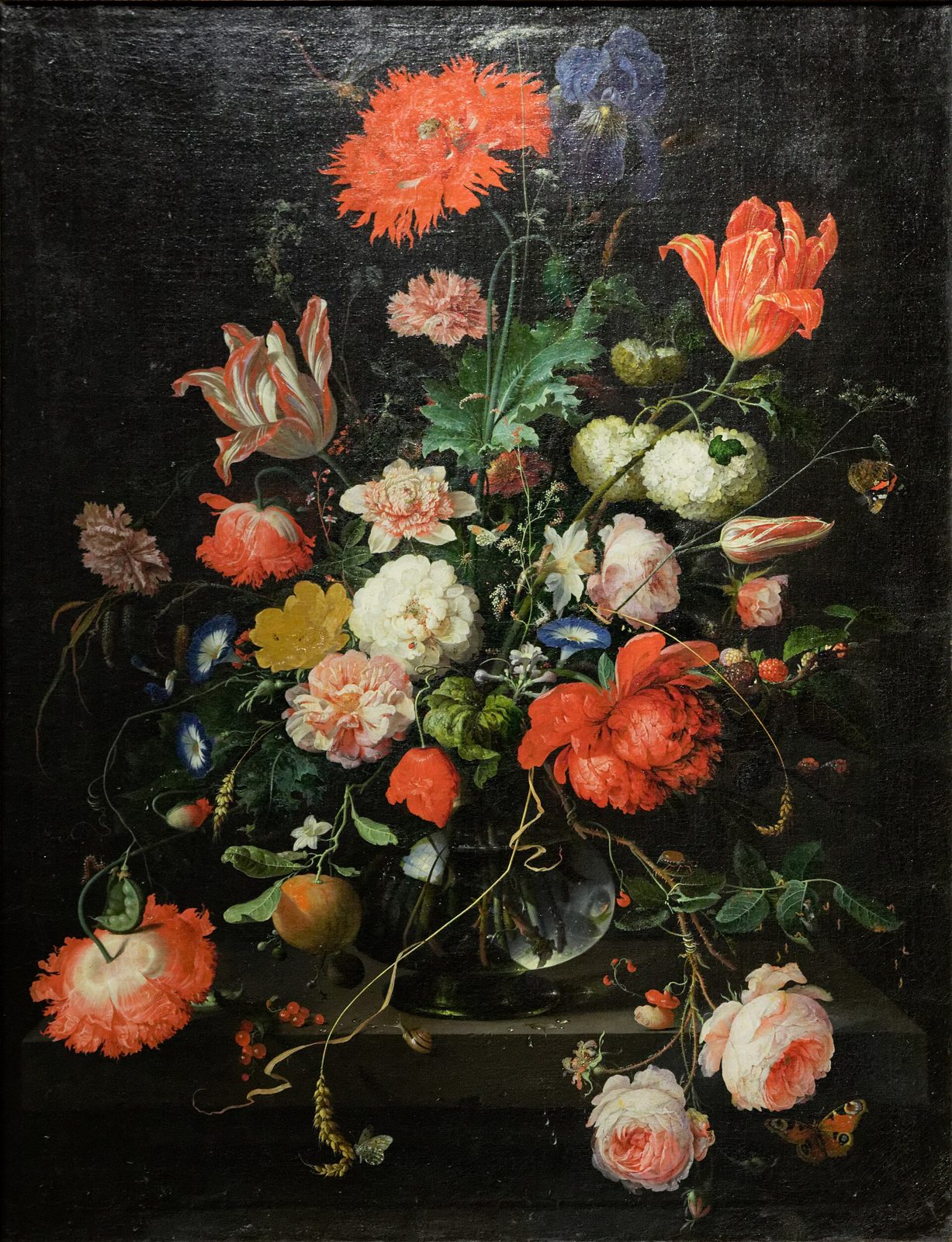
🎧 This work has audio narration — listen in the appThe vibrant bouquet of red and orange poppies, striped tulips, and delicate peonies in this painting bursts forth from a crystal vase, creating a striking contrast against the dark background. The meticulous detail captures the flowers' vivid colors and intricate textures, while a dragonfly flits among them, adding a touch of life to the stillness of the arrangement.
This composition reflects the artist Abraham Mignon's mastery of still life, showcasing his ability to blend realism with a sense of movement, as leaves and petals spill over the edge of the stone pedestal. Mignon, trained under the influential flower painter Jacob Marrel, developed a unique style that emphasized precision and a cooler palette, distinguishing his work from that of his contemporaries like Jan Davidszoon de Heem. His paintings were highly sought after in the 17th century, collected by prominent figures, including Louis XIV of France.
Created in 1665, "Flowers in a Crystal Vase Standing on a Stone Pedestal, with a Dragonfly" exemplifies Mignon's elaborate floral compositions that captivated audiences of his time.
Abraham Mignon, born on June 21, 1640, in Frankfurt, was a Dutch still life painter renowned for his exquisite flower and fruit compositions. His artistic journey began under the tutelage of Jacob Marrel, a prominent flower painter, who recognized Mignon's talent and entrusted him with his business. Mignon later moved to the Dutch Republic, where he became an assistant to Jan Davidszoon de Heem, a key figure in still life painting. His works are characterized by meticulous detail, a cooler palette, and a distinctive arrangement of flowers and fruits, often set against dark backgrounds.
Mignon's life was marked by his strong Calvinist beliefs, which influenced both his personal and professional choices. He married Maria Willaerts in 1675, further intertwining his life with the art world through familial connections. Despite his short life—he died at 39—Mignon's prolific output of around 400 paintings garnered significant attention from collectors, including royalty. His legacy continued through his students, such as Maria Sibylla Merian, and his influence can be seen in the works of later artists who emulated his style. Mignon's contributions solidified his place in the history of still life painting, reflecting the beauty and complexity of nature.
Mignon's works were highly sought after during the 17th century, with this particular piece finding its way into the collection of Louis XIV of France, a notable patron of the arts. The painting's provenance reflects its esteemed status, having also been associated with the Beringhem marquis de and the Couronne de France. Mignon's career was marked by his training under Jacob Marrel, a significant figure in flower painting, and his subsequent work with Jan Davidszoon de Heem, another master of still life.
The brushwork is meticulous, revealing a keen attention to detail that brings each flower to life. The vibrant reds, oranges, and pinks pop against the dark background, creating a striking contrast that draws the eye. Mignon employs a cooler palette, a choice that sets his work apart from contemporaries like de Heem. The composition is dense, with flowers overlapping and intertwining, creating a sense of abundance and movement. Leaves and petals spill over the edge of the stone pedestal, inviting the viewer into the scene. The use of oil paint allows for rich texture and depth, enhancing the realism of the flowers. The dragonfly flitting among the blooms adds a dynamic element, suggesting a moment frozen in time, where nature's beauty and fragility coexist.
Abraham Mignon's family originally came from Hainaut in the Southern Netherlands and immigrated to Germany due to religious reasons.
Mignon was asked by Jacob Marrel to train his stepdaughter, Maria Sibylla Merian, in the art of still-life painting.
Mignon's artistic development was significantly influenced by his training with Jacob Marrel and his work with Jan Davidszoon de Heem, both prominent figures in still life painting.