Bouquet of Flowers
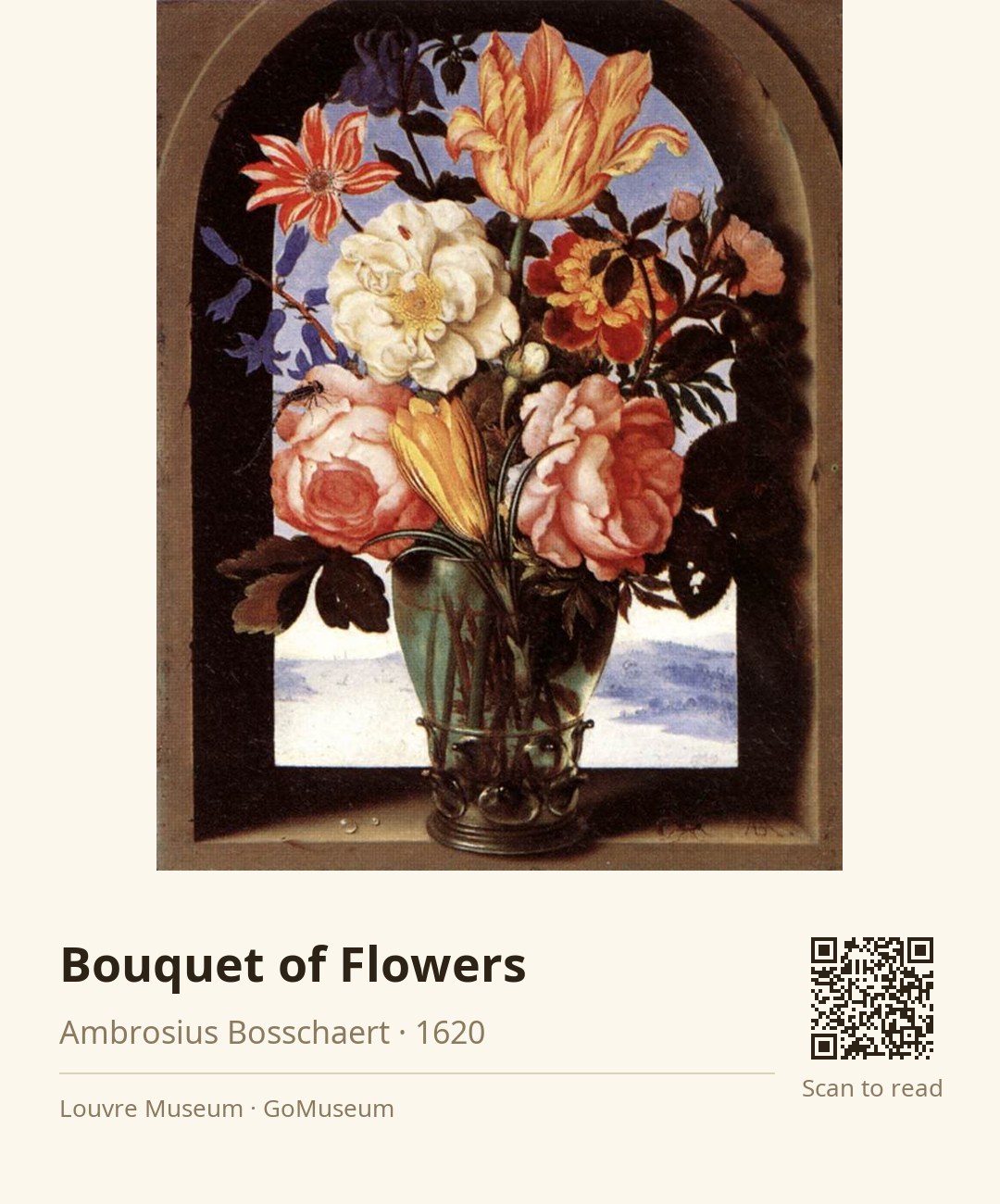
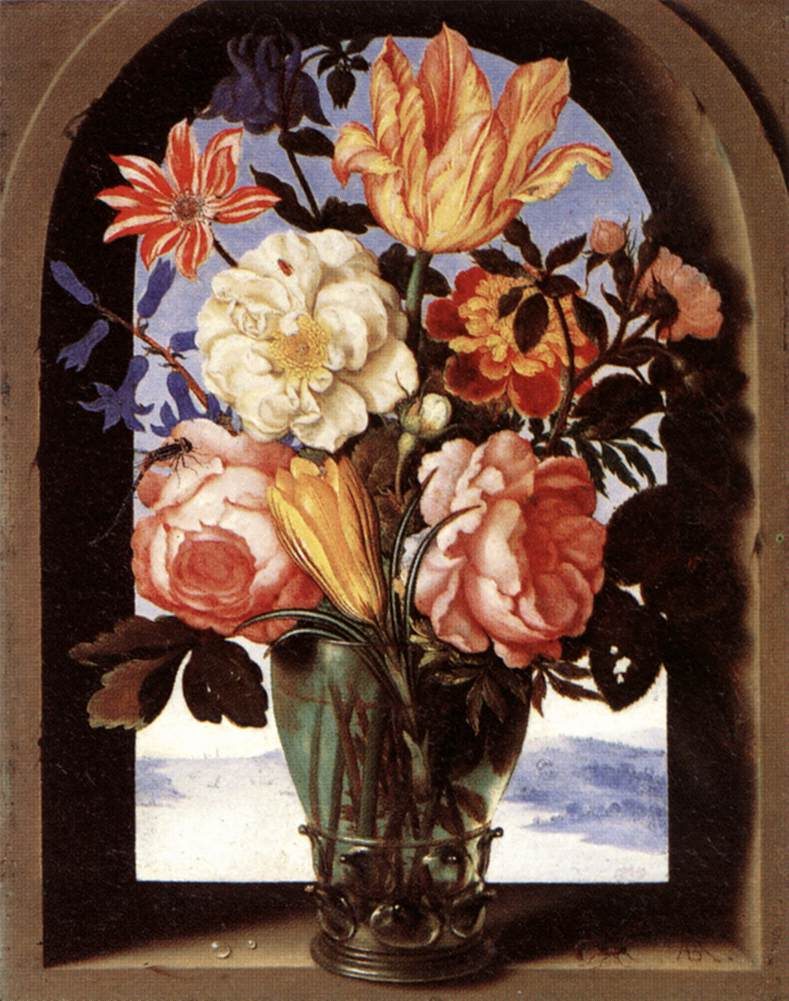
🎧 This work has audio narration — listen in the appThe vibrant yellow and red striped tulip in this bouquet draws the eye immediately, showcasing Ambrosius Bosschaert’s mastery of color and detail. Surrounding it are delicate white and pink roses, along with a variety of other blooms, all arranged in a glass vase that reflects light beautifully, adding depth to the composition. The small insect perched on one of the flowers hints at the life that surrounds these still moments, emphasizing the connection between nature and art.
Bosschaert, a pioneer of floral still life painting in the early 17th century, meticulously crafted each element in this work, blending scientific accuracy with artistic flair. His arrangements often included flowers that bloomed in different seasons, creating a timeless quality that appealed to collectors of his time. The arched window frame opens to a serene landscape, enhancing the sense of space and inviting viewers to contemplate the beauty of nature captured within the confines of the vase.
Born in Antwerp and later settling in Middelburg, Bosschaert became a leading figure in the floral genre, influencing generations of artists. His work, including this 1620 painting, reflects the burgeoning interest in exotic flowers during the Dutch Golden Age, a trend that made floral portraits highly sought after.
Ambrosius Bosschaert the Elder, born in Antwerp in 1573, was a pioneering Flemish-born Dutch still life painter renowned for establishing floral still lifes as an independent genre. His family relocated to Middelburg in 1587 due to religious persecution, where he became a prominent figure in the local art scene. Joining the Guild of Saint Luke at twenty-one, he later served as dean, solidifying his influence. Bosschaert's meticulous and symmetrical floral compositions, often painted on copper, combined scientific accuracy with symbolic meanings, featuring popular flowers like tulips and roses.
He fathered three sons who followed in his artistic footsteps, ensuring the continuation of his legacy. His brother-in-law, Balthasar van der Ast, also contributed to the flourishing floral painting tradition. Despite his success and high demand, Bosschaert produced relatively few works, balancing his role as an art dealer. He passed away in The Hague in 1621 while working on a commission, leaving behind a significant impact on Dutch flower painting and a dynasty that thrived well into the mid-17th century. His artistry not only reflected the era's fascination with exotic flowers but also laid the groundwork for future generations of still life painters.
In 'Bouquet of Flowers', Bosschaert employs oil paint on an oak panel, a choice that enhances the vibrancy and depth of color in his floral arrangements. The brushwork is precise, allowing for intricate details in each petal and leaf, showcasing his scientific approach to botany. The composition is carefully balanced, with the dense cluster of flowers filling the arched window frame, creating a sense of abundance. The glass vase is rendered with remarkable clarity, capturing reflections that add a three-dimensional quality to the piece. The interplay of colors, particularly the striking yellow and red tulip against the softer hues of the roses, draws the viewer's eye and creates a dynamic visual experience. Bosschaert's technique not only highlights the beauty of each flower but also evokes a sense of life and vitality, making the still life feel almost alive.
Interestingly, Bosschaert was not just a painter; he was also an art dealer, which meant he had a keen understanding of the market and the tastes of collectors. This dual role likely influenced his artistic choices, as he created works that not only showcased his talent but also catered to the desires of affluent buyers. Despite his success, he produced a relatively small number of paintings, as much of his time was devoted to managing his art dealings.