David with the Head of Goliath
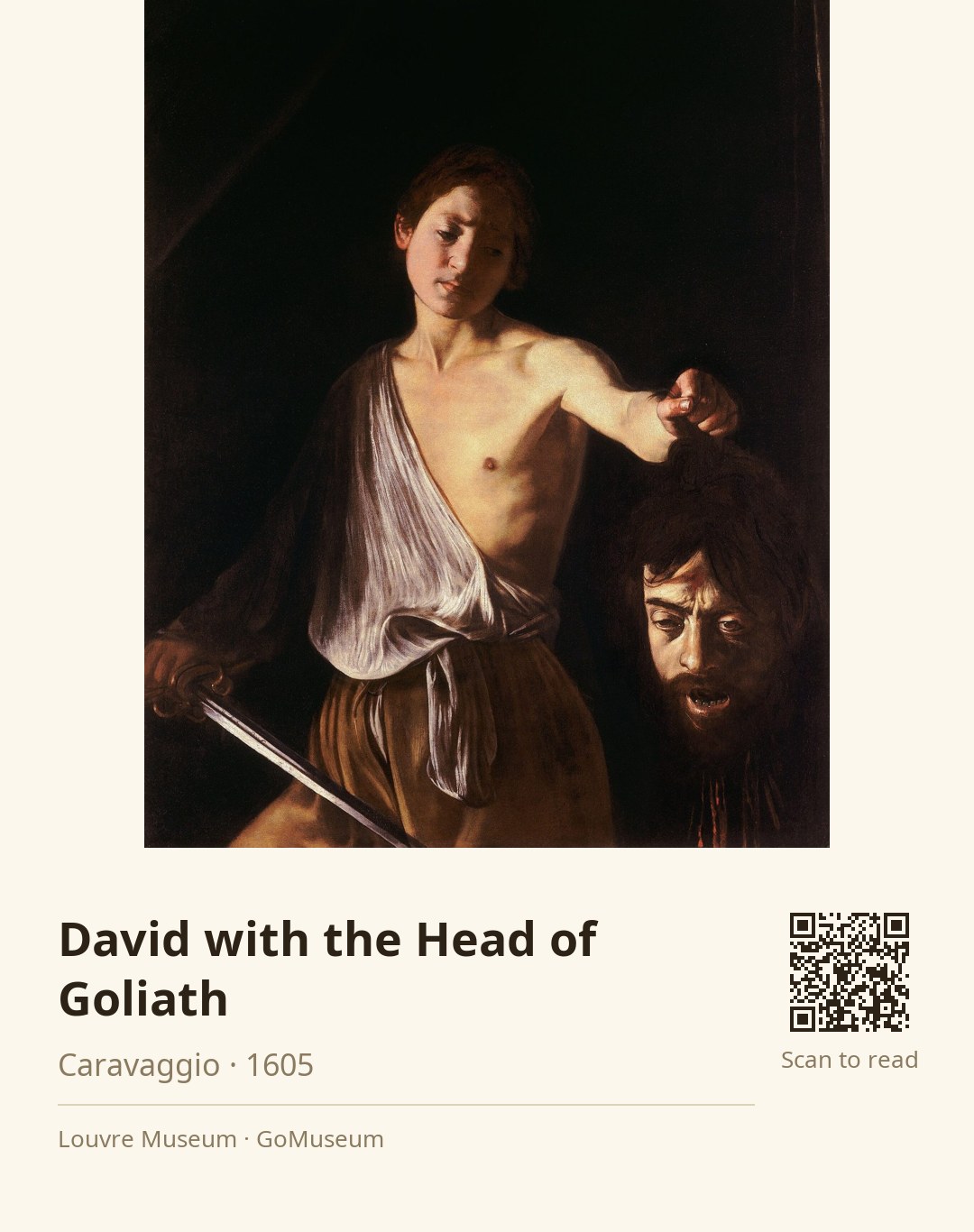
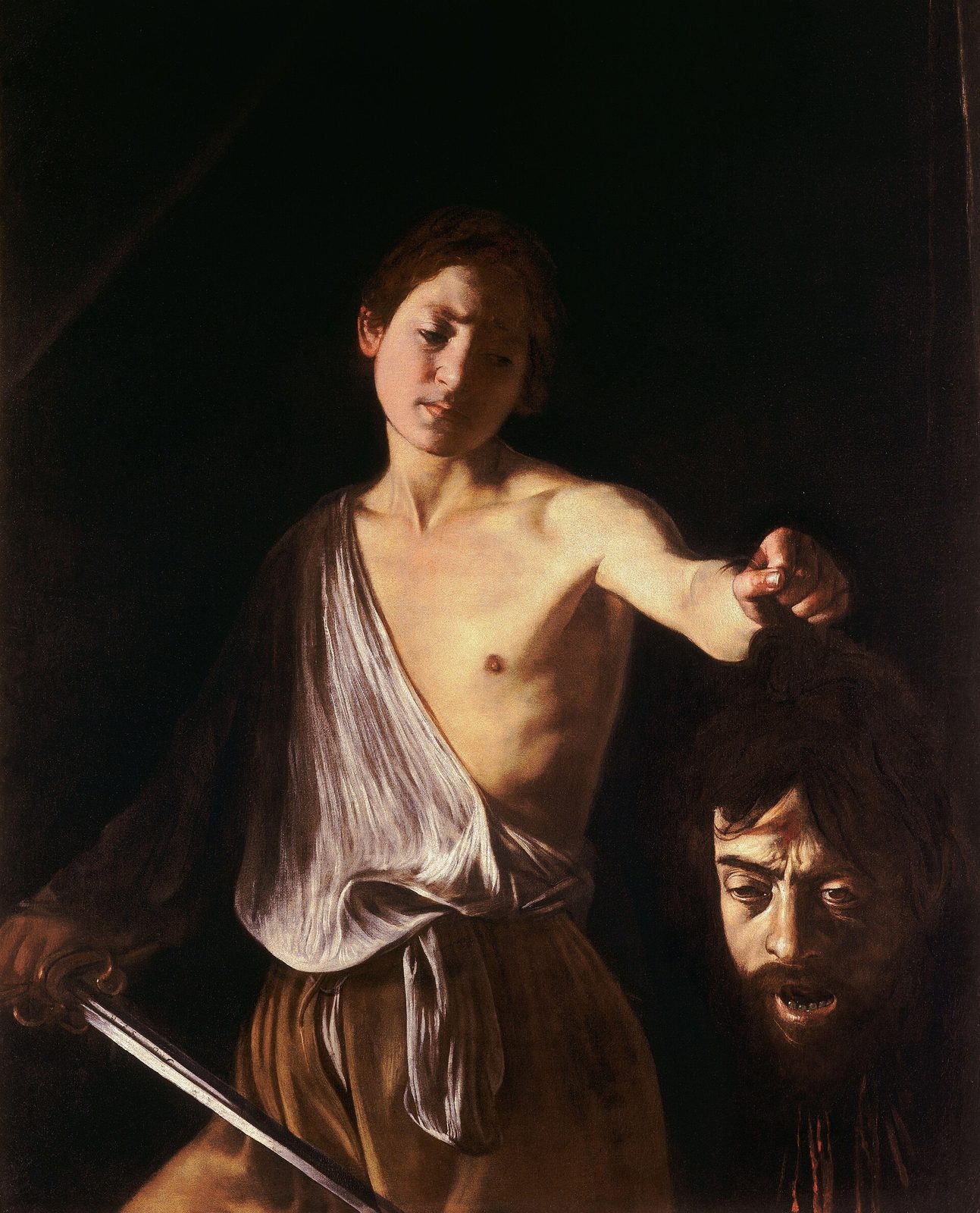
🎧 This work has audio narration — listen in the appTake a moment to really look at Caravaggio's "David with the Head of Goliath." Notice how David's expression is not one of triumph, but rather a mix of sadness and compassion. His gaze is heavy, almost as if he’s mourning the very life he has just taken. Now, focus on the head of Goliath, which he holds by the hair, blood dripping down. This isn’t just a trophy; it’s a poignant reminder of the cost of victory.
These details matter because they shift the narrative of the biblical story. Instead of celebrating a hero, Caravaggio invites us to empathize with both David and Goliath. The inscription on David's sword, often interpreted as "humility kills pride," adds another layer, suggesting that true strength lies in recognizing the weight of one's actions.
Created in 1605, this painting reflects Caravaggio's own tumultuous life, marked by violence and a quest for redemption. Some believe he even painted himself as Goliath, confronting his own demons through this artwork.
As you stand here, consider what it means to confront your own battles. Do you see a victor in David, or a young man grappling with the consequences of his choices?
Michelangelo Merisi da Caravaggio, born in Milan in 1571, became one of the most influential figures in Baroque art. His early life was marked by tragedy and hardship, losing family members to the plague and growing up in poverty after his mother’s death. Caravaggio trained as a painter in Milan, where he developed a keen eye for realism, influenced by the naturalism of Lombard art and the dramatic compositions of the Counter-Reformation.
Moving to Rome in the early 1590s, Caravaggio's career flourished as he gained recognition for his innovative use of chiaroscuro, known as tenebrism, which brought a striking emotional depth to his subjects. His paintings often depicted intense moments of struggle and suffering, reflecting both physical and psychological states. However, his tumultuous personal life, marked by violence and legal troubles, led to his exile from Rome after killing a man in a brawl.
Despite his troubled existence, Caravaggio continued to produce powerful works in Naples, Malta, and Sicily until his untimely death in 1610. His legacy, initially overshadowed by his notorious reputation, was rediscovered in the 20th century, cementing his status as a precursor to modern painting. His influence is evident in the works of many artists, and he remains a pivotal figure in the history of Western art.
Caravaggio's 'David with the Head of Goliath' was likely commissioned by Cardinal Scipione Borghese in 1606, a pivotal moment for the artist as he sought redemption after a tumultuous life marked by violence. The painting, which is now housed in the Galleria Borghese in Rome, was part of Borghese's collection by 1650. Scholars debate its exact creation date, with some suggesting it was painted as early as 1605, while others lean towards 1609-1610. This work is particularly fascinating because it serves as a dual self-portrait: Caravaggio may have depicted himself as Goliath, confronting his own demons, while the model for David is thought to be Cecco del Caravaggio, his assistant. This complex interplay of identities adds depth to the narrative of the painting, reflecting Caravaggio's struggles and aspirations for forgiveness. The painting's presence in the Borghese collection also suggests a personal plea for mercy from the powerful cardinal, who had the authority to grant Caravaggio a pardon for his past crimes.
In 'David with the Head of Goliath,' Caravaggio employs a dramatic use of chiaroscuro, a technique that highlights the emotional intensity of the scene. Notice how David's face is illuminated, drawing your attention to his conflicted expression of sadness and compassion, while Goliath's severed head, dripping with blood, is cast in shadow. This stark contrast not only emphasizes the gravity of the moment but also creates a visceral connection between the viewer and the subjects. The composition is carefully structured; David's upward gaze towards Goliath's head evokes a sense of moral contemplation. The sword, inscribed with the phrase 'humility kills pride,' serves as a visual anchor, linking David's triumph to a deeper, more introspective narrative. The positioning of the figures, with David's body angled towards the viewer, invites you into the emotional turmoil of the scene, making you question the nature of victory and the cost of one's actions.
Caravaggio's 'David with the Head of Goliath' is not just a striking visual narrative; it’s a profound commentary on the human condition and the artist's own tumultuous life. This painting, created around 1605, marks a pivotal moment in Baroque art, showcasing Caravaggio's innovative use of chiaroscuro to evoke deep emotional resonance. By depicting David not in triumph but in a state of somber reflection, Caravaggio invites viewers to grapple with the complexities of victory and loss. The intimate connection between David and Goliath—where David embodies both the victor and the artist himself—challenges the viewer to consider themes of redemption and self-identity. This duality has influenced countless artists and remains a touchstone for discussions about the interplay of light, shadow, and human emotion in art. Remember, this isn't just a biblical tale; it's Caravaggio's personal plea for understanding amidst his own struggles.
One intriguing aspect of 'David with the Head of Goliath' is the possibility that Caravaggio painted himself as Goliath, a reflection of his own struggles and a confrontation with his past. This self-representation adds a layer of intimacy and vulnerability to the work, as it suggests that the artist was not just depicting a biblical story, but also grappling with his own identity and the consequences of his actions. The notion of David holding the head of Goliath can be seen as a metaphor for Caravaggio's own battle against the demons of his turbulent life.
David's gaze, directed towards Goliath's severed head, conveys a sense of moral contemplation and inner conflict, suggesting that his victory comes with a heavy emotional burden rather than pure triumph.