Portrait of Madame Récamier
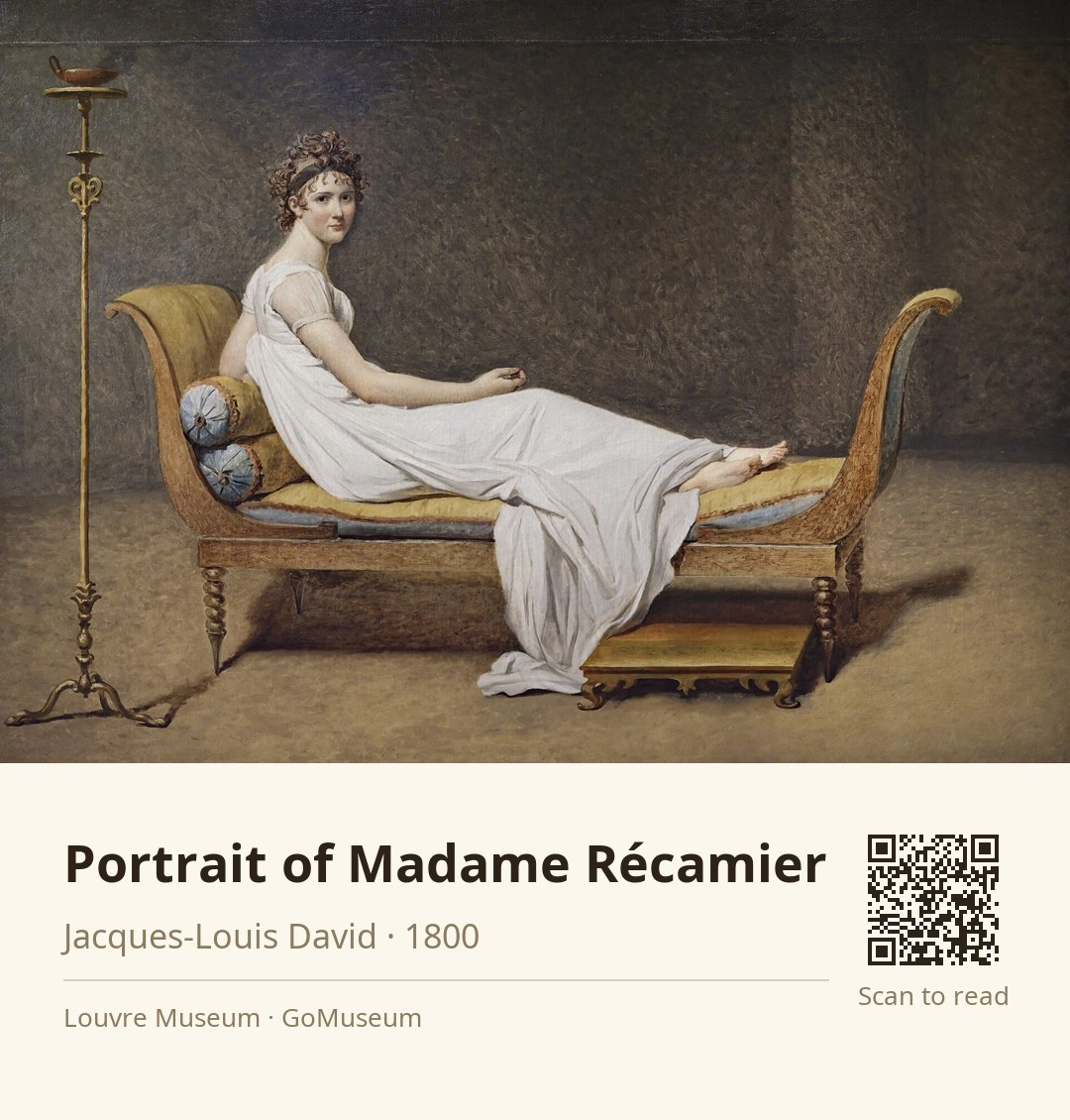
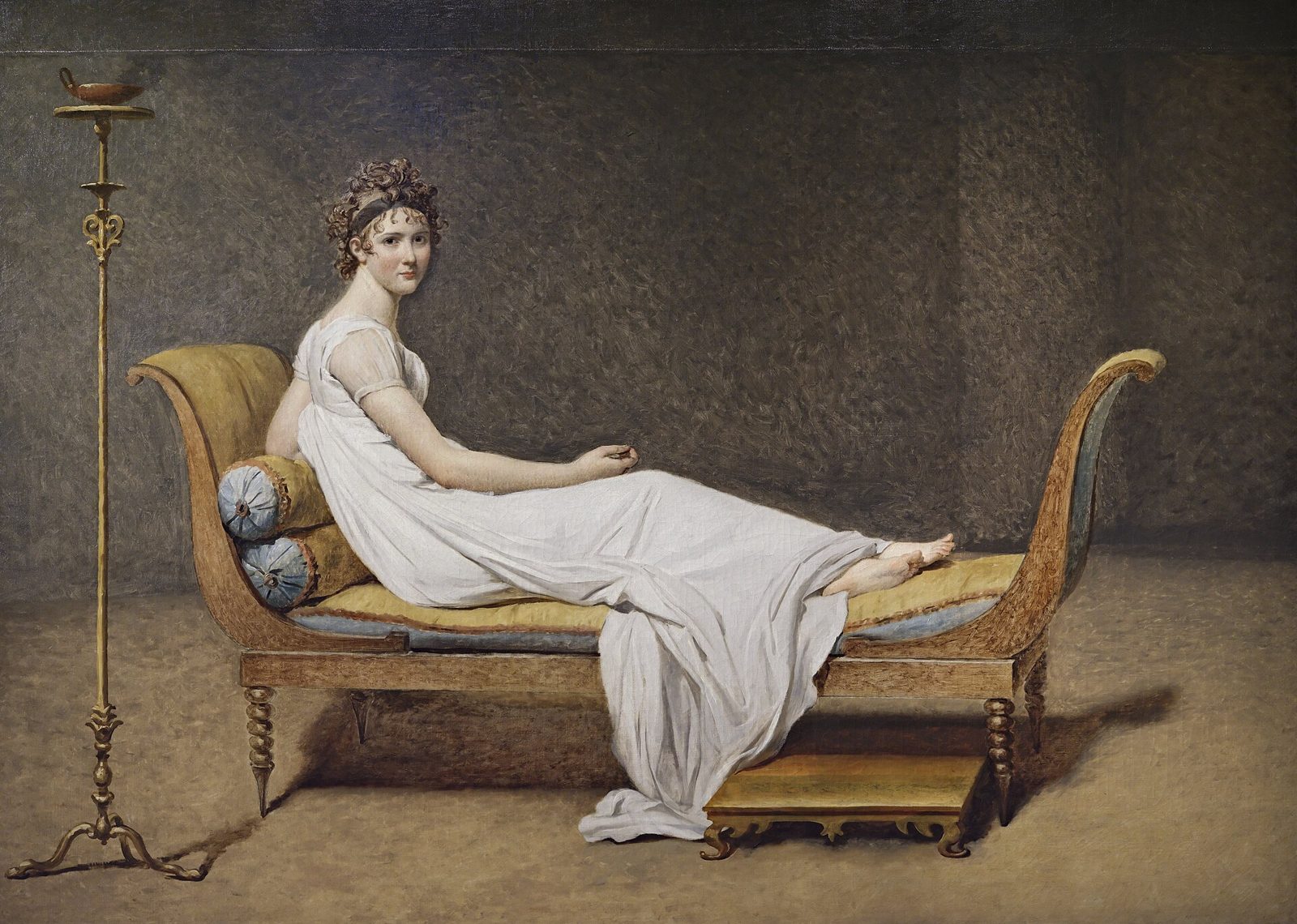
🎧 This work has audio narration — listen in the appTake a moment to really look at Madame Récamier, reclining elegantly on her fainting couch. Notice how her white dress stands out against the muted earthy tones of the room. It’s almost as if she’s glowing, isn’t it?
Now, let’s focus on the details of her pose. Her body is gracefully twisted, drawing your eye along the curve of her arm and back. This innovative horizontal format was quite a departure from the more traditional vertical portraits of the time, creating a sense of intimacy and distance all at once. It’s as if she exists in her own world, inviting you to ponder her thoughts while keeping you at arm’s length.
This painting, started in 1800 by Jacques-Louis David, was left unfinished due to a quarrel between the artist and his model, Madame Récamier. While her head is meticulously detailed, the rest of the canvas remains loose and incomplete, a testament to the artist’s struggle with his subject. David intended to capture not just her likeness but the ideals of femininity and charm, which makes this unfinished state all the more poignant.
As you stand here, think about the impact of this portrait. It reflects not only Récamier’s beauty but also the shifting social dynamics of the time, where women like her began to wield influence in elite circles. What do you think her expression conveys? Is she aware of her power, or is she lost in thought?
Jacques-Louis David was a pivotal French painter born on August 30, 1748, in Paris. He emerged as the leading figure of the Neoclassical movement, marking a significant shift in artistic taste from the frivolity of Rococo to a more austere and emotionally charged classical style. His early life was marked by personal tragedy, losing his father at a young age, which shaped his character and determination to pursue art against familial expectations.
David's career flourished during the tumultuous political landscape of France, where he became an ardent supporter of the French Revolution, aligning himself with figures like Robespierre. His political engagement influenced his art, producing iconic works such as "The Death of Marat" and "The Coronation of Napoleon," which reflect both historical narratives and his personal convictions. After the fall of Napoleon, David faced exile but continued to influence generations of artists, establishing a legacy that shaped academic painting in the early 19th century. His works remain celebrated in major museums, particularly the Louvre, solidifying his status as a cornerstone of Western art history. David's life and art were inextricably linked to the evolving identity of France, embodying the spirit of revolution and the quest for artistic integrity.
The 'Portrait of Madame Récamier' was commissioned by the renowned Parisian socialite, Juliette Récamier, who was a prominent figure in elite circles of early 19th-century France. Jacques-Louis David began this portrait in May 1800, but it remained unfinished due to a quarrel between the artist and his model. Récamier, known for her beauty and charm, was often late for her sittings, which frustrated David. Their relationship soured when she decided to commission another artist, François Gérard, for her portrait. David's work was eventually acquired by the Louvre in 1826, long after his death, and was well-received, with critics noting its unique qualities.
The use of a horizontal format was a bold choice, breaking away from the traditional vertical portraits of the time. This format creates a sense of intimacy and distance, inviting viewers to engage with Madame Récamier while simultaneously keeping her at arm's length. Notice how the muted earthy tones of the background contrast with her immaculate white dress, which seems to glow under the light. The brushwork is particularly interesting; while her head is rendered with meticulous detail, the rest of the canvas is left loose and unfinished, emphasizing the tension between the artist's ambition and the reality of their collaboration. The candelabrum in the background serves as a diagonal anchor, guiding your eye through the composition while enhancing the sense of space around her. This interplay of light and shadow, along with the unfinished elements, evokes a feeling of restlessness, as if the painting itself is caught in a moment of anticipation.
This painting, left unfinished, captures the essence of its subject, Juliette Récamier, a prominent socialite of her time. David's innovative horizontal format broke with tradition, inviting viewers to engage with the subject in a more intimate yet detached manner. This approach influenced countless artists who followed, as they sought to blend realism with classical ideals.
Did you know that the Portrait of Madame Récamier is actually unfinished? This intriguing detail stems from a bit of drama between the artist, Jacques-Louis David, and his subject, Juliette Récamier. She was notoriously late for her sittings, which frustrated David to no end. In fact, their quarrels led him to abandon the painting altogether when he learned she had commissioned another artist, François Gérard, to create her portrait. Imagine being so captivating that you could inspire multiple artists, yet leave one feeling jilted!
As a prominent socialite and salon hostess, Madame Récamier's beauty and charm were well-known, and her status allowed her to be the subject of multiple artists, including David and Gérard, reflecting the era's fascination with elite femininity.
The candelabrum not only serves as a diagonal anchor that guides the viewer's eye through the composition, but its extinguished lamp and drifting smoke add an element of stillness and contemplation to the scene, enhancing the sense of intimacy and distance between the viewer and Madame Récamier.