 Image: Masur
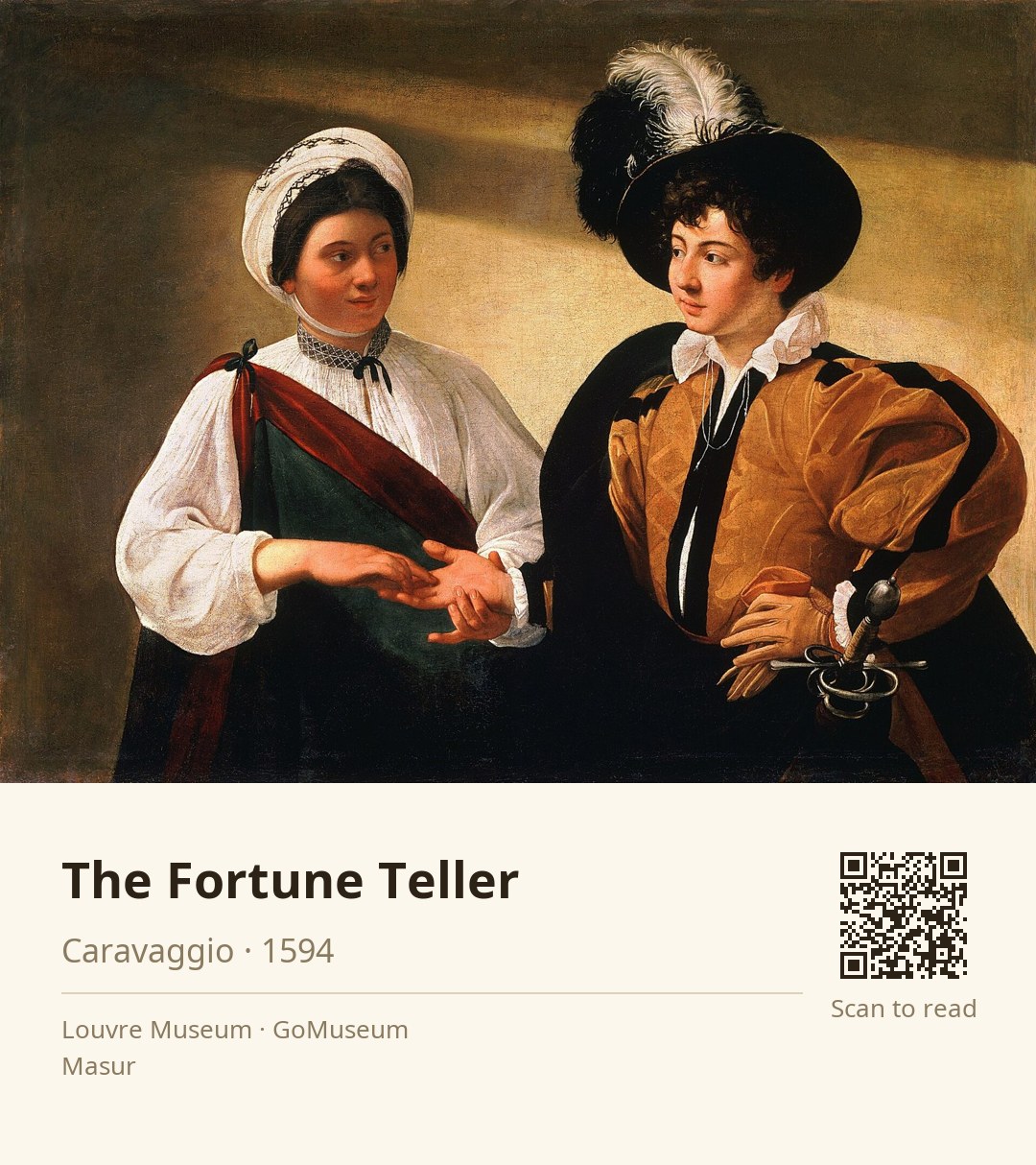
The Fortune Teller
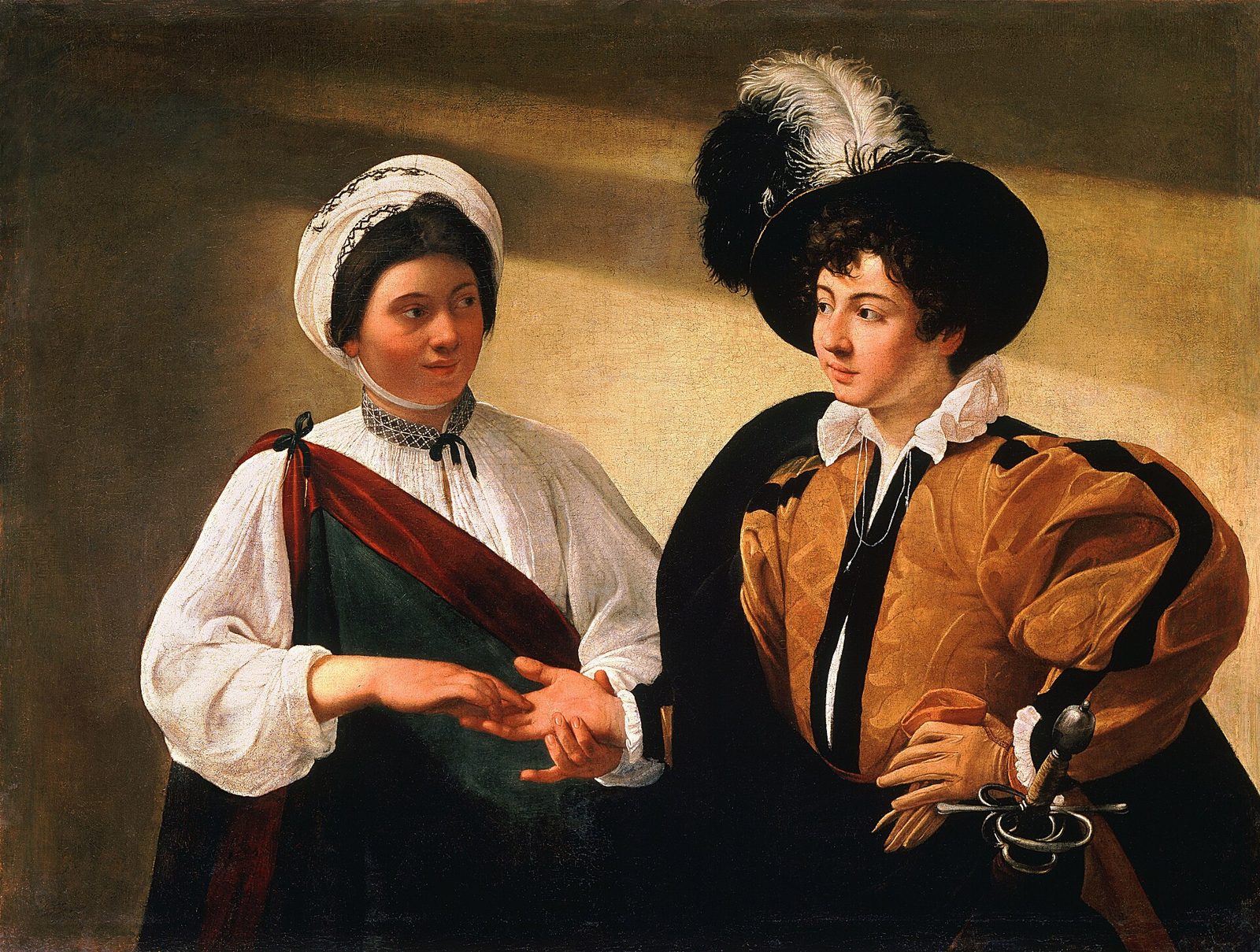
🎧 This work has audio narration — listen in the appTake a moment to gaze at Caravaggio's "The Fortune Teller." Notice how the young man, dressed in his foppish attire, is completely captivated by the Romani girl reading his palm. Look closely at her hand; while she strokes his, she’s slyly slipping off his ring. This moment of deception is not just a theft; it’s a powerful commentary on vanity and trust.
Why does this matter? Caravaggio brilliantly captures the tension between allure and deceit. The boy’s infatuation blinds him to the reality of his situation, making him a victim of his own desires. This scene reflects a deeper truth about human nature—how easily we can be misled when we let our guard down, especially in the face of beauty.
He chose real people from the streets of Rome as his models, breaking away from the idealized forms of the Renaissance.
As you stand here, consider this: What illusions might you be falling for in your own life?
Michelangelo Merisi da Caravaggio, born in Milan in 1571, became one of the most influential figures in Baroque art. His early life was marked by tragedy and hardship, losing family members to the plague and growing up in poverty after his mother’s death. Caravaggio trained as a painter in Milan, where he developed a keen eye for realism, influenced by the naturalism of Lombard art and the dramatic compositions of the Counter-Reformation.
Moving to Rome in the early 1590s, Caravaggio's career flourished as he gained recognition for his innovative use of chiaroscuro, known as tenebrism, which brought a striking emotional depth to his subjects. His paintings often depicted intense moments of struggle and suffering, reflecting both physical and psychological states. However, his tumultuous personal life, marked by violence and legal troubles, led to his exile from Rome after killing a man in a brawl.
Despite his troubled existence, Caravaggio continued to produce powerful works in Naples, Malta, and Sicily until his untimely death in 1610. His legacy, initially overshadowed by his notorious reputation, was rediscovered in the 20th century, cementing his status as a precursor to modern painting. His influence is evident in the works of many artists, and he remains a pivotal figure in the history of Western art.
Caravaggio's "The Fortune Teller" was painted around 1594, during a transformative time in his career. This piece was one of the first to showcase his departure from the idealized forms of the Renaissance, opting instead for raw, lifelike representations. Initially, it caught the eye of the young artists and avant-garde collectors of Rome, but Caravaggio's financial struggles led him to sell it for a mere eight scudi. The painting eventually found its way into the collection of the wealthy banker Marchese Vincente Giustiniani, who became a significant patron for the artist. In 1595, Caravaggio painted a second version for Cardinal Francesco Maria del Monte, who had also acquired another of his works. This second version, now housed in the Louvre, features a more dynamic composition and refined details, marking a clear evolution in Caravaggio's style. The reception of both versions was notable; in 1603, poet Gaspare Murtola even dedicated a madrigal to the piece, drawing parallels between the deceit depicted and the illusionistic qualities of Caravaggio's art.
Take a closer look at the brushwork in "The Fortune Teller". Caravaggio’s technique is all about contrast—his use of chiaroscuro creates a dramatic interplay of light and shadow that draws your eye right to the central action. Notice how the light cascades over the figures, illuminating the boy's foppish attire while casting the background into a shadowy ambiguity. This choice not only heightens the tension but also enhances the emotional stakes of the scene. The figures are cropped at the waist, creating an intimate, almost voyeuristic feel, as if you're peering into a private moment. The Romani girl's hand movements are particularly striking; they convey both grace and cunning, as she deftly slips the ring from the boy's finger. The texture of the fabrics—the boy's doublet and the girl's shawl—are rendered with meticulous detail, showcasing Caravaggio's ability to capture the essence of his subjects in a way that feels almost tactile. This is not just a painting; it’s a moment frozen in time, rich with narrative and emotional depth.
In the second version of 'The Fortune Teller', the young man is believed to be modeled after Mario Minniti, a fellow painter and friend of Caravaggio. This connection highlights the artist's practice of using people from his immediate circle as subjects for his work.