The barrier of Clichy
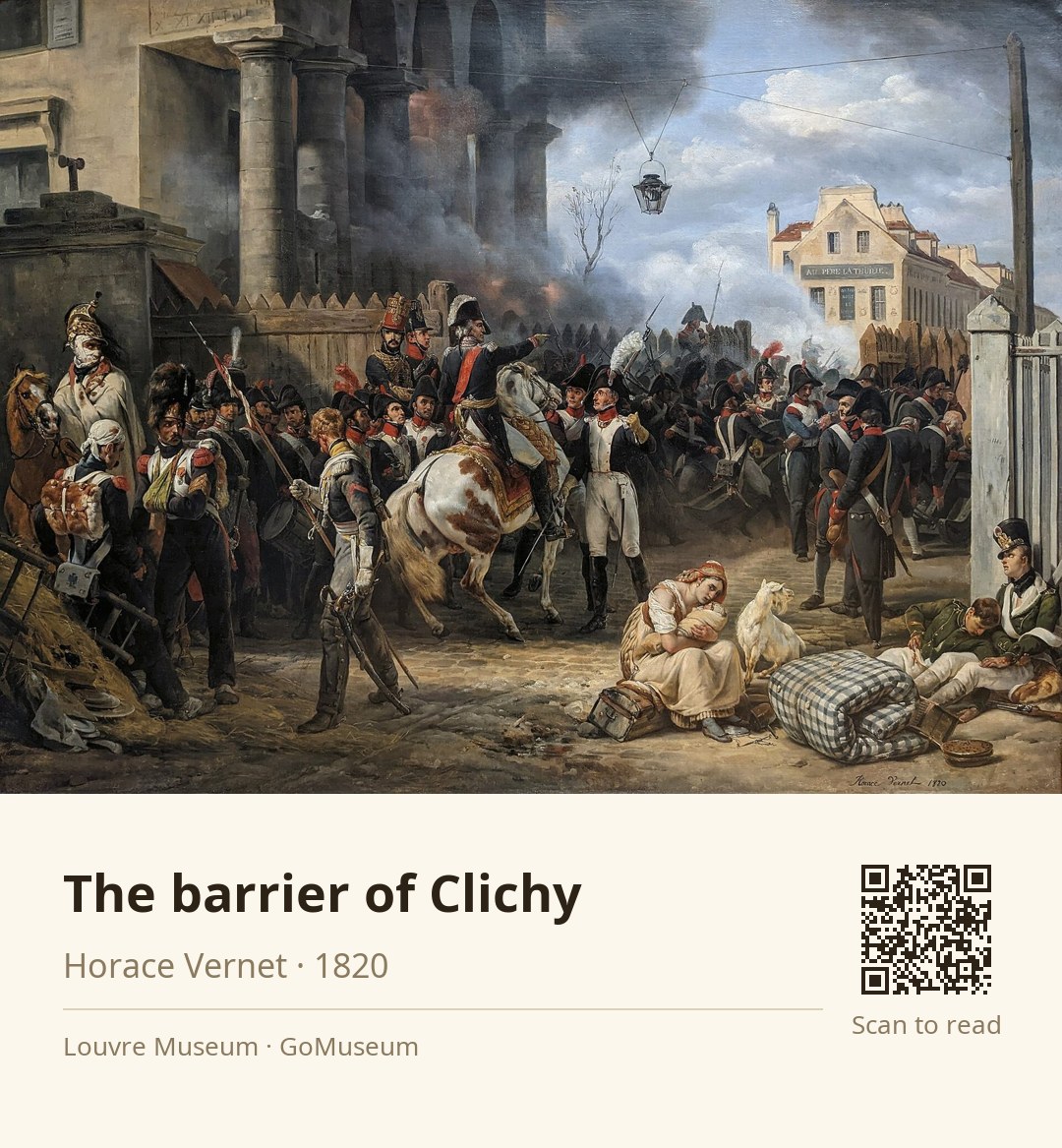
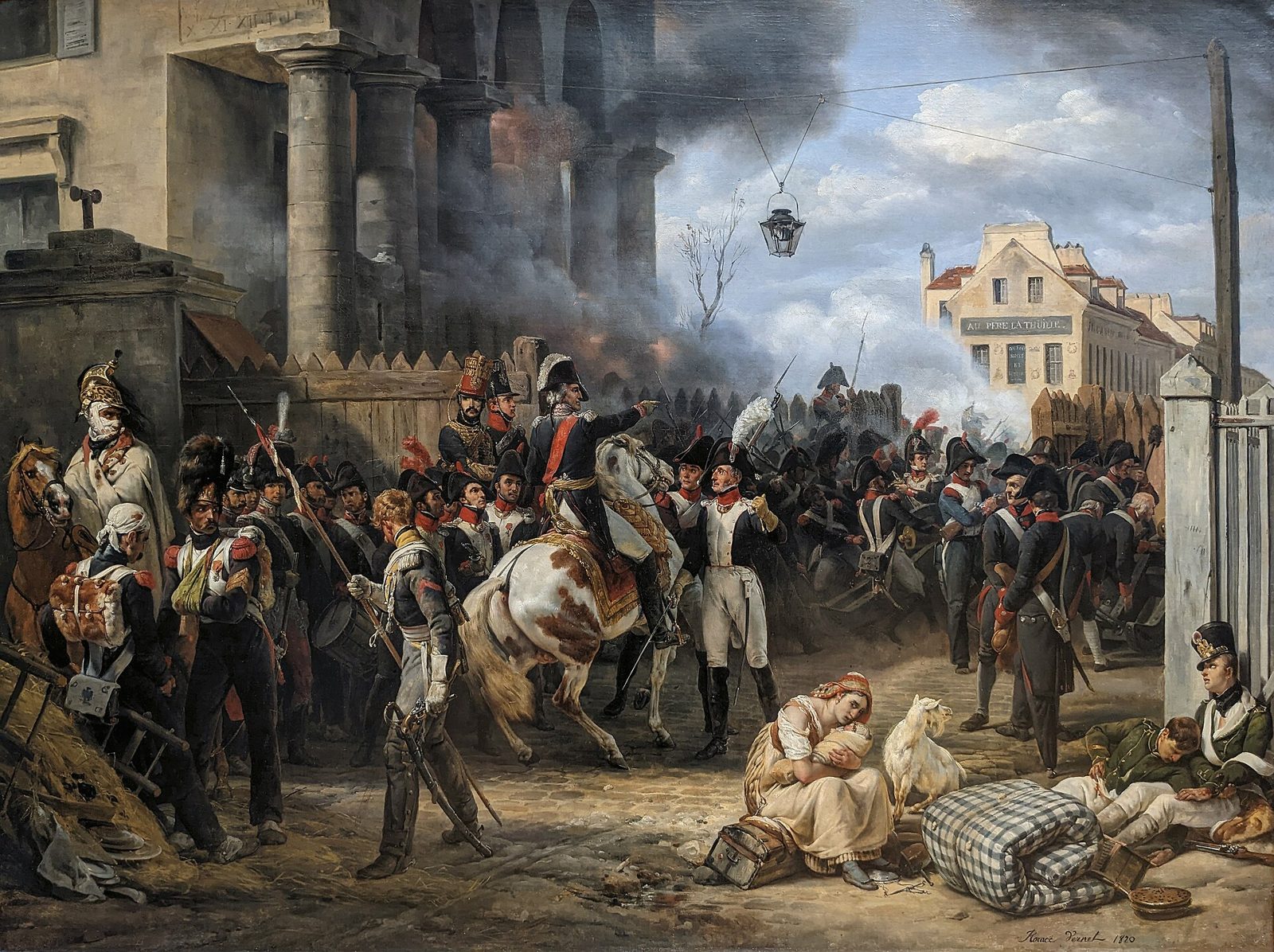
🎧 This work has audio narration — listen in the appTake a moment to really look at "The Barrier of Clichy" by Horace Vernet. Notice how the foreground is bustling with activity, yet the soldiers seem to be caught in a moment of pause rather than combat. Look closely at the expressions on their faces—there’s a mix of determination and despair.
Vernet, who fought in this very battle, captures not just the glory of heroism but the heavy weight of reality that soldiers face. He paints a scene that’s more than just a fight; it’s a snapshot of human emotion amidst chaos.
Created in 1820, this painting reflects Vernet's own experience as a member of the National Guard during the defense of Paris in 1814. His brushstrokes convey the tension of the moment, showing us that battles are not just won or lost—they are filled with stories of sacrifice and resilience.
As you stand here, think about what it means to be in the midst of such turmoil. How do you think these soldiers felt, knowing they were part of a pivotal moment in history? Let that question linger as you take in the scene before you.
Horace Vernet, born on June 30, 1789, in the Louvre, Paris, was a prominent French painter known for his vivid battle scenes, portraits, and Orientalist works. The son of painter Carle Vernet and grandson of Claude-Joseph Vernet, he grew up in an artistic environment that shaped his career. Rejecting the idealized representations of academic art, Vernet focused on contemporary life, portraying French soldiers with a realistic touch during Napoleon's reign. His early works, such as "Taking of an Entrenched Camp," showcased his talent for capturing the essence of military life.
During the Bourbon Restoration, Vernet gained acclaim for his historical battle paintings, commissioned by influential patrons, including King Louis-Philippe. His works, characterized by their accuracy and dynamic landscapes, earned him a place as director of the French Academy in Rome. Vernet's later career saw him documenting the French army's exploits in Algeria, reflecting the colonial mindset of his time. His commitment to realism persisted even during the Crimean War, where he famously resisted altering his depictions for political reasons.
Vernet's artistic legacy is marked by his ability to blend historical narrative with a personal touch, making him a significant figure in 19th-century art. He passed away in Paris on January 17, 1863, leaving behind a rich body of work that continues to resonate in art history.
Horace Vernet's 'The Barrier of Clichy' was painted in 1820, capturing a pivotal moment during the defense of Paris on March 30, 1814. Commissioned by the goldsmith Jean-Baptiste-Claude Odiot, who also fought in the battle, the painting reflects Vernet's own experience as a soldier in the National Guard. Initially, the work was met with resistance, being refused entry to the 1822 Paris Salon due to its perceived Napoleonic undertones, which the Bourbon government found troubling. This censorship sparked a studio exhibition by Vernet in protest, ultimately boosting his reputation as a leading battle painter in France. The painting was later gifted to the Chambre des Pairs in 1835, moved to the musée du Luxembourg in 1837, and finally found its home in the Louvre in 1874, where it remains today.
In 'The Barrier of Clichy,' Vernet employs a striking composition that draws the viewer's eye from the bustling foreground to the distant chaos of battle. Notice how he contrasts the vibrant colors and dynamic brushwork of the soldiers with the more subdued tones of the background. The soldiers, caught in a moment of pause, are depicted with meticulous attention to detail, showcasing their uniforms with historical accuracy. This choice emphasizes the human experience of war—beyond mere combat. Vernet's decision to place leaders giving orders in the foreground, alongside wounded soldiers, highlights the emotional weight of the scene, transforming it into a narrative of resilience amid despair.
The painting's initial rejection and subsequent exhibition brought Vernet into the public eye, establishing him as a prominent figure in battle painting. His work influenced later artists by emphasizing the emotional and human aspects of warfare rather than glorifying it. This approach laid the groundwork for future representations of conflict, steering the focus toward the experiences of soldiers and the realities of battle, which would resonate in the works of artists in the years to come.
One interesting tidbit about 'The Barrier of Clichy' is that it inspired Alexandre Dumas to write a five-act military play titled 'La Barrière de Clichy,' which premiered in 1851. The play featured a tableau inspired by Vernet's painting, showcasing the lasting impact of the artwork beyond the canvas and into the realm of theater.
The studio exhibition, held in protest of the painting's censorship, garnered significant attention and ultimately boosted Vernet's reputation, establishing him as a leading battle painter in France.