Saint George and the Dragon
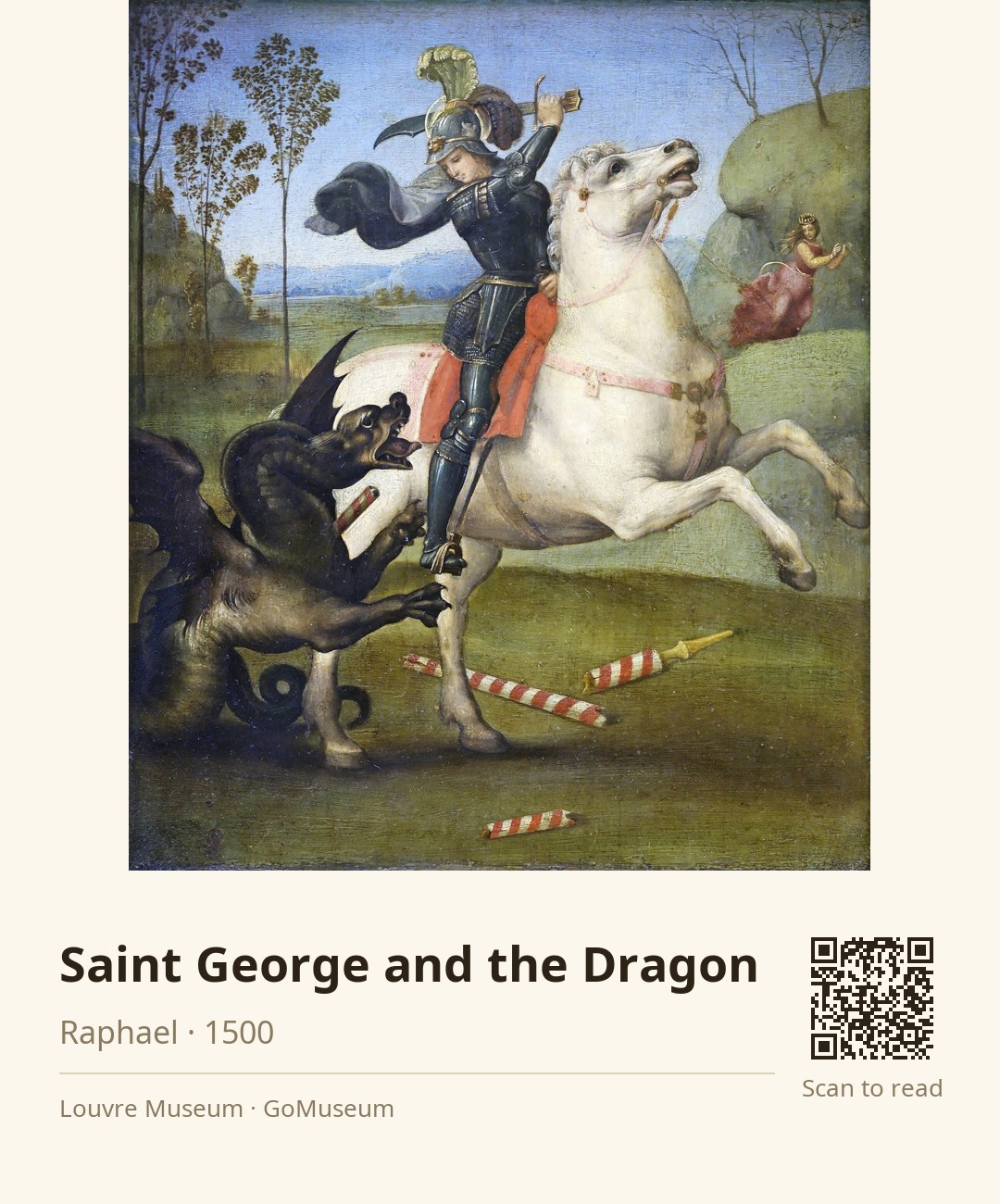
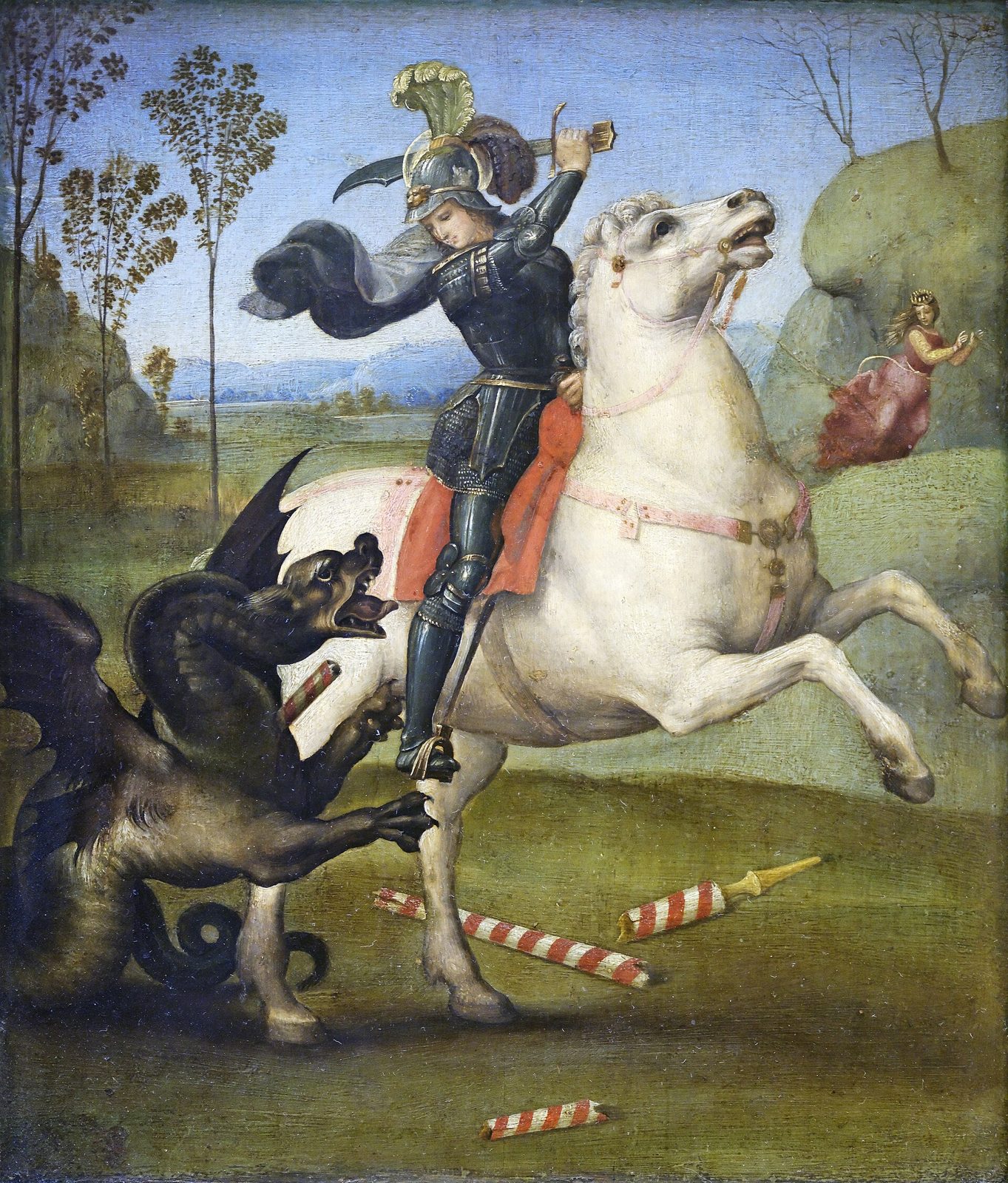
🎧 This work has audio narration — listen in the appTake a moment to really look at Raphael's "Saint George and the Dragon." Notice how Saint George, poised on his rearing white horse, grips his sword high, ready to strike. The tension in the scene is palpable, isn’t it? The dragon, fierce and coiled, lies beneath him, defeated yet defiant, with the remnants of George's broken lance scattered on the ground.
These details matter because they capture a pivotal moment of triumph over evil, a theme that resonates deeply in the human experience. The dynamic posture of the horse and the dramatic interplay of light and shadow highlight Raphael's mastery of movement and emotion, drawing you into the action.
Created around 1500, this painting is a testament to Raphael's early style, influenced by his time in Florence and the artistic legacy of his predecessors. It reflects the Renaissance ideals of heroism and virtue, embodied in the figure of Saint George, who represents the fight against darkness.
As you stand here, think about the stories this artwork tells. What does the battle between Saint George and the dragon symbolize for you?
Raffaello Sanzio da Urbino, known as Raphael, was an Italian painter and architect of the High Renaissance, born in Urbino in 1483. Orphaned by age eleven, he managed his family's workshop and trained under Pietro Perugino, establishing himself as a master by 1500. His move to Rome in 1508 marked the beginning of a prolific period, where he received significant commissions, including the renowned frescoes in the Vatican's Raphael Rooms. His art is celebrated for its clarity, harmonious composition, and embodiment of Neoplatonic ideals. Raphael's influence was profound, shaping the trajectory of Western art and serving as a model for academies until the 19th century. His legacy, characterized by serenity and grace, was later revived in the 18th and 19th centuries, contrasting with the dramatic styles of his rival Michelangelo. Despite his early death at 37, Raphael's extensive body of work and innovative techniques left an indelible mark on the art world, influencing generations of artists and extending into contemporary culture.
Initially, it was part of a diptych with another painting, 'Saint Michael,' both of which were housed in the Mazarin Collection. Louis XIV acquired them in 1661, and they eventually found their home in the Louvre in 1683. The painting is often linked to the Duke of Urbino, who may have commissioned it, although the exact details remain somewhat murky. Giovanni Lomazzo, an art theorist of the time, mentioned a Saint George by Raphael, suggesting it was painted on a small chessboard, but this claim has not been verified.
As you examine 'Saint George and the Dragon,' pay attention to the dynamic composition that Raphael employs. The painting is structured along powerful diagonals, guiding your eye through the scene. Notice how the tension is built through the rearing horse and the poised sword, creating a sense of imminent action. The color palette is striking; the vibrant reds symbolize the Passion of Christ, while the greens provide a hopeful contrast, enhancing the emotional depth of the narrative. The brushwork is both delicate and vigorous, reflecting the energy of the moment. The interplay of light and shadow adds a three-dimensional quality, making the figures leap off the canvas. This meticulous handling of paint not only showcases Raphael's technical skill but also immerses you in the drama of the scene.
One intriguing detail about 'Saint George and the Dragon' is that it was originally thought to be painted on a small chessboard, a claim made by Giovanni Lomazzo. However, this has not been substantiated by modern examinations, which have not revealed any such features.
After being part of the Mazarin Collection, the painting was acquired by Louis XIV and eventually found its permanent home in the Louvre in 1683, showcasing the royal interest in art during that period.
The horse in the painting resembles one of the horses from Monte Cavallo at the Quirinal Palace, suggesting Raphael's exposure to classical influences, possibly through drawings by Leonardo's pupils, which may have inspired his depiction.