The Judgment of Solomon
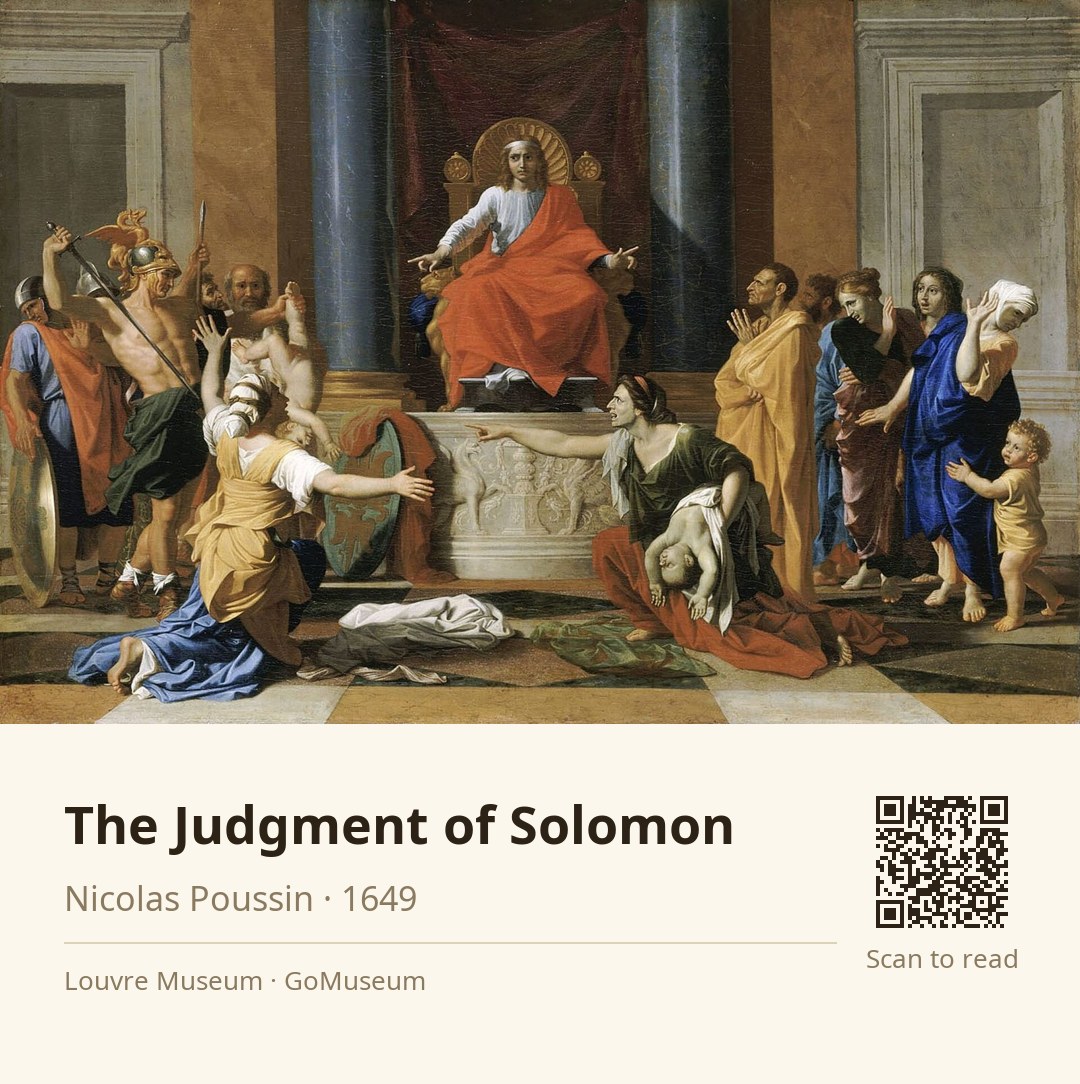
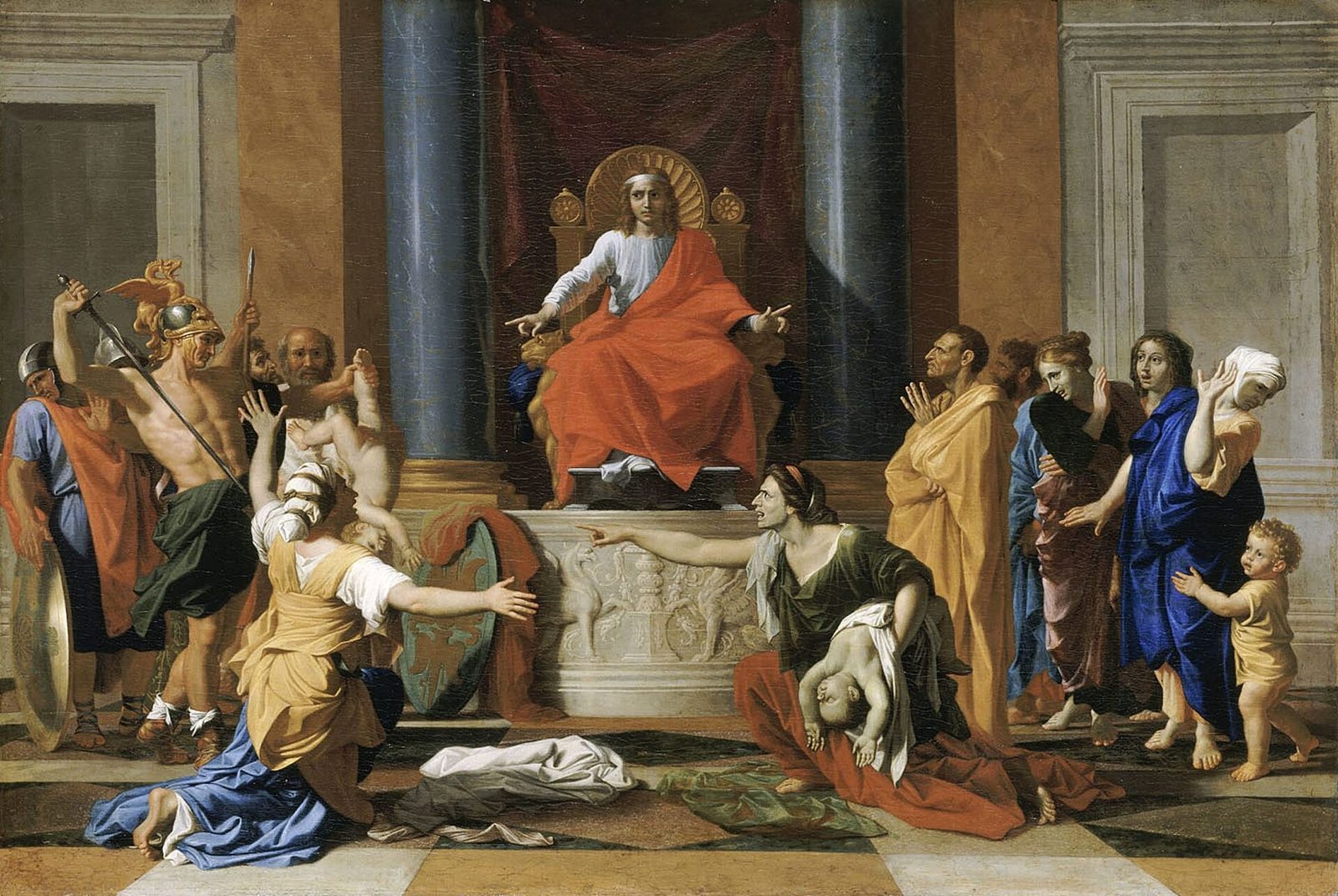
🎧 This work has audio narration — listen in the appTake a moment to really absorb the scene before you in "The Judgment of Solomon" by Nicolas Poussin. Notice how the figures are arranged: Solomon, elevated on his throne, commands the space, while the two mothers, desperate and emotional, pull at our heartstrings. Look closely at their expressions—one is filled with anguish, the other, cold and indifferent.
These details matter because they encapsulate the essence of the story: the fierce love of a mother versus the apathy of someone who doesn’t truly care. Poussin captures a pivotal moment from the Bible, where Solomon's wisdom shines through a dramatic test of motherhood. This isn’t just a painting; it’s a visual debate on justice and sacrifice, a moment that resonates through time.
Created in 1649 during Poussin's stay in Rome, this masterpiece reflects the artist's deep engagement with classical themes and his admiration for Raphael, who also tackled this subject. Poussin’s work is often celebrated for its clarity and order, and here, you can see how he uses composition to guide your eye and emotions.
As you stand here, think about what it means to make a sacrifice for love. How would you react if faced with such a heart-wrenching decision? Let that question linger as you take in the powerful narrative unfolding in front of you.
Nicolas Poussin, born in June 1594 near Les Andelys, was a pivotal figure in the classical French Baroque movement, spending most of his career in Rome. His early life was marked by a passion for art that led him to Paris at eighteen, despite his parents' opposition. In Paris, he struggled initially, but his exposure to royal collections ignited his admiration for Italian masters, particularly Raphael. This influence shaped his distinctive style, characterized by clarity, order, and a preference for line over color.
Poussin's artistic journey took him to Rome in 1624, where he developed a reputation for his religious and mythological works, often commissioned by a select group of collectors. His notable pieces include "The Death of Germanicus" and "The Massacre of the Innocents." Although he briefly returned to France as First Painter to Louis XIII, he found the court's demands stifling and returned to Rome, where he continued to evolve, integrating landscapes into his compositions.
His legacy is profound; Poussin's emphasis on classical themes and structure influenced generations of artists, including Jacques-Louis David and Paul Cézanne. He remains a cornerstone of classical painting, with around 260 attributed works and nearly 400 drawings, solidifying his place in art history until his death in 1665.
Nicolas Poussin's 'The Judgment of Solomon' was commissioned in the late 1640s by Jean Pointel, a banker from Lyon and a close friend of the artist. Poussin painted it during his stay in Rome from 1647 to 1649, completing it in 1649. The work was sent to Pointel in Paris shortly after its completion. Following Pointel's death in 1660, the painting changed hands several times, eventually being sold to Louis XIV in 1685 for 5,000 livres. Initially displayed in a cabinet at the royal collection, it found its way to the Château de Versailles around 1710. In the wake of the French Revolution, the painting was seized and became part of the Louvre's inaugural collection when it opened to the public in 1793.
Completed in 1649, this masterpiece not only reflects Poussin's deep admiration for Raphael but also set a standard for narrative clarity and emotional depth in painting. Its influence rippled through the 17th century and beyond, inspiring artists like Jacques-Louis David and Ingres, who sought to emulate Poussin's structured compositions and moral gravitas. The painting's rigorous order and dramatic storytelling helped solidify Poussin's reputation as a leading figure of the French Baroque, making it a cornerstone of the French School. Remember, this work isn't just about Solomon's wisdom; it's a testament to the power of art to convey complex human emotions and ideals, shaping the trajectory of Western art for generations.
Did you know that when Poussin completed 'The Judgment of Solomon' in 1649, he considered it his best work? This was no small claim, especially coming from an artist who had a reputation for excellence. The painting was commissioned by Jean Pointel, a banker who was not just a patron but also a close friend of Poussin. Their relationship was so strong that Pointel even became the executor of Poussin's will. Imagine the pressure Poussin felt to deliver something extraordinary, knowing that his friend was banking not just on the artwork, but on their friendship as well!
Jean Pointel was not only a close friend but also a crucial patron for Poussin, commissioning multiple works from him and providing financial support that allowed the artist to focus on his craft during a productive period in Rome.
During his stay in Rome, Poussin developed a distinctive style characterized by clarity, logic, and order, heavily influenced by the works of Raphael, which he admired and studied extensively.
While painting 'The Judgment of Solomon,' Poussin dealt with the difficulties of maintaining communication with his patrons in France due to the political turmoil of the Fronde, which affected his ability to secure commissions.