Portrait of a Princess
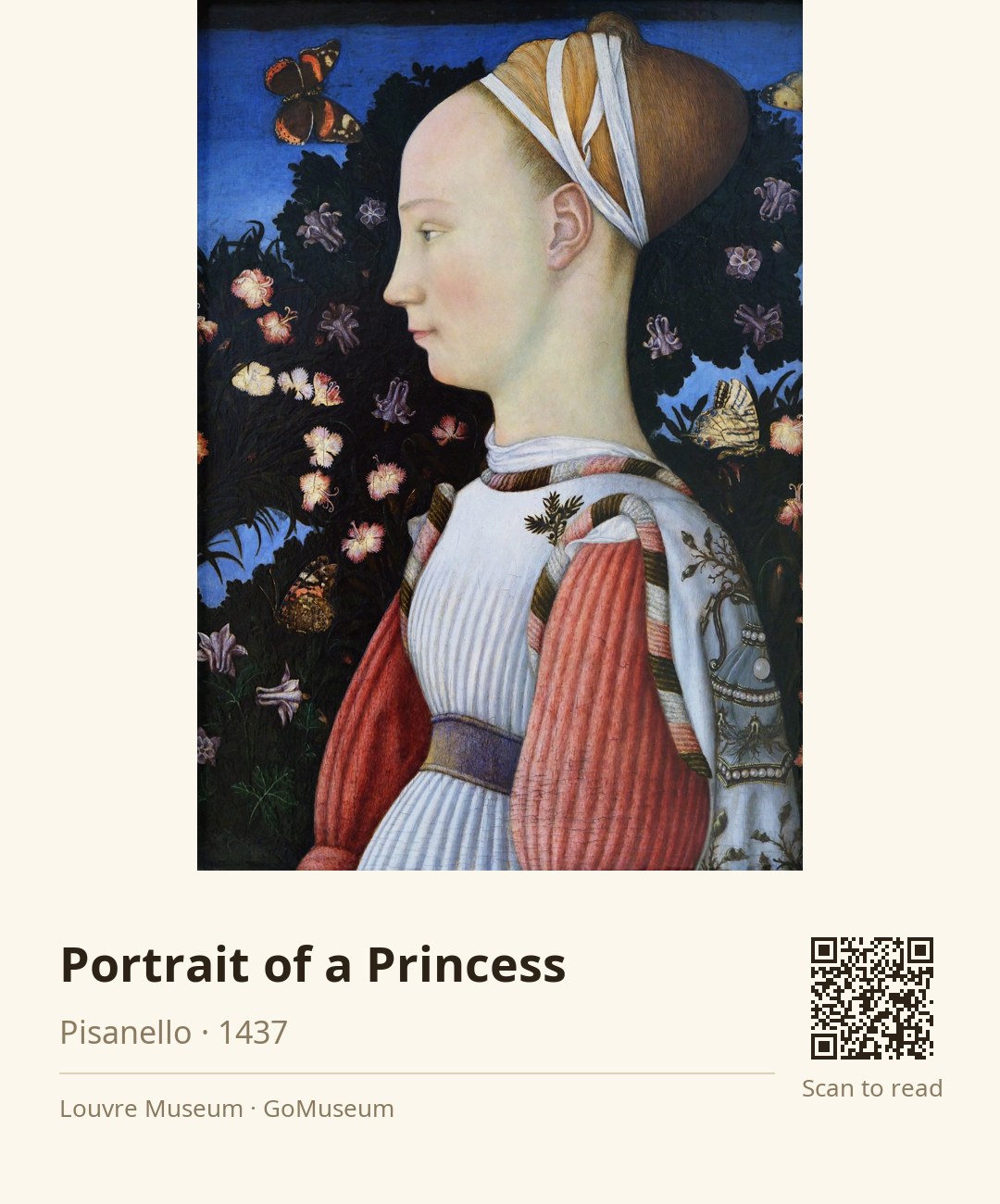
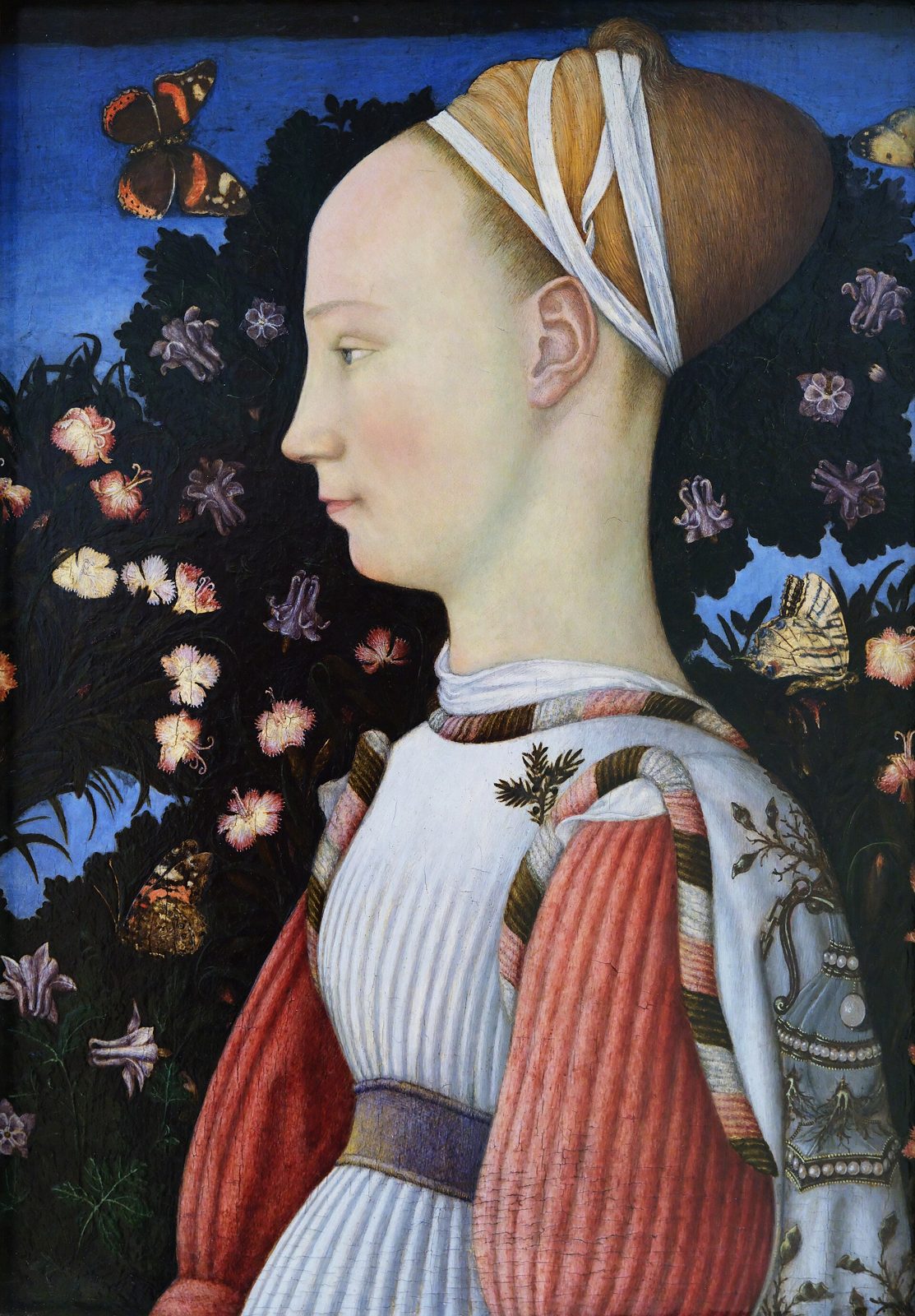
🎧 This work has audio narration — listen in the appTake a moment to really look at the "Portrait of a Princess" by Pisanello. Notice how the young woman is captured in a delicate profile, her features sharp and defined against a lush backdrop of butterflies and columbine flowers. See that butterfly resting near her brow? It’s not just a pretty detail; it symbolizes the soul, a nod to the Renaissance belief in the connection between beauty and spirituality.
The embroidery on her sleeve hints at her identity, possibly linking her to a princess of this noble lineage. Pisanello was known for his exquisite portraits and medals, and this work showcases his ability to blend elegance with deep symbolism.
As you stand here, think about the mystery surrounding the identity of this young woman. Historians have speculated about who she might be—could she be Ginevra d'Este, or perhaps Margherita Gonzaga? Each theory adds layers to her story, making you wonder about the life she led and the legacy she left behind. What do you think her story is?
Pisanello, born Antonio di Puccio Pisano around 1380-1395 in Pisa or Verona, was a pivotal figure in early Italian Renaissance art. Renowned for his exquisite frescoes, portraits, and pioneering medallic work, he became a celebrated artist among contemporaries, earning comparisons to greats like Cimabue and Phidias. His career flourished in the courts of Venice, the Vatican, and various Italian city-states, where he was esteemed by the Gonzaga and Este families.
Trained under Gentile da Fabriano, Pisanello developed a refined style characterized by intricate detail and vibrant color. His drawings, often seen as standalone masterpieces rather than preparatory sketches, showcase a keen observation of nature and fashion. Despite the loss of many of his works, his surviving pieces, particularly in medallic art, reveal a deep understanding of form and beauty.
Pisanello's influence waned as the Renaissance evolved, yet he remained a crucial link between Gothic and early Renaissance styles. His legacy endures through the few surviving drawings and medals, which continue to inspire admiration for their elegance and precision.
The 'Portrait of a Princess' first emerged in 1860 when it was sold to Felix Bamberg, the German Consul in Paris. By 1893, it found a new home at the Louvre, purchased from Charles Picard for a hefty 30,000 francs. While the artist was quickly identified as Pisanello, the identity of the young woman remains shrouded in mystery. Many believe she is linked to the House of Este, as indicated by the embroidery on her sleeve, featuring the family's two-handled vase. This connection has led to speculation about her identity, with names like Ginevra d'Este and Margherita Gonzaga frequently mentioned. The portrait's delicate profile and lush background of butterflies and flowers were typical of the time, but the uncertainty surrounding the sitter adds an intriguing layer to its history.
The brushwork is meticulous, creating a sharp profile that stands out against a richly detailed backdrop. Notice how the artist layers the paint—thin, translucent layers for the skin give the princess an ethereal quality, while the thicker application of paint in the foliage creates depth and texture. The vibrant colors, particularly the reds and greens, are striking, drawing your eye to the intricate details of her attire. The composition is carefully structured, with the princess's profile positioned against the dark greens of the background, enhancing her luminous presence. This contrast not only highlights her features but also evokes a sense of intimacy, as if she is emerging from a dream.
One fascinating tidbit about the 'Portrait of a Princess' is its mysterious identity. While many assume it depicts a member of the Este family, the exact princess remains unknown. The embroidery on her sleeve, featuring a two-handled vase, hints at her noble lineage, yet art historians have proposed several candidates, including Ginevra d'Este, who had a tragic fate, and Margherita Gonzaga, who also had ties to the Este family. This uncertainty adds an intriguing layer to the painting, inviting you to ponder who this young woman truly was and what her story might have been.