Holy Family of Francis I
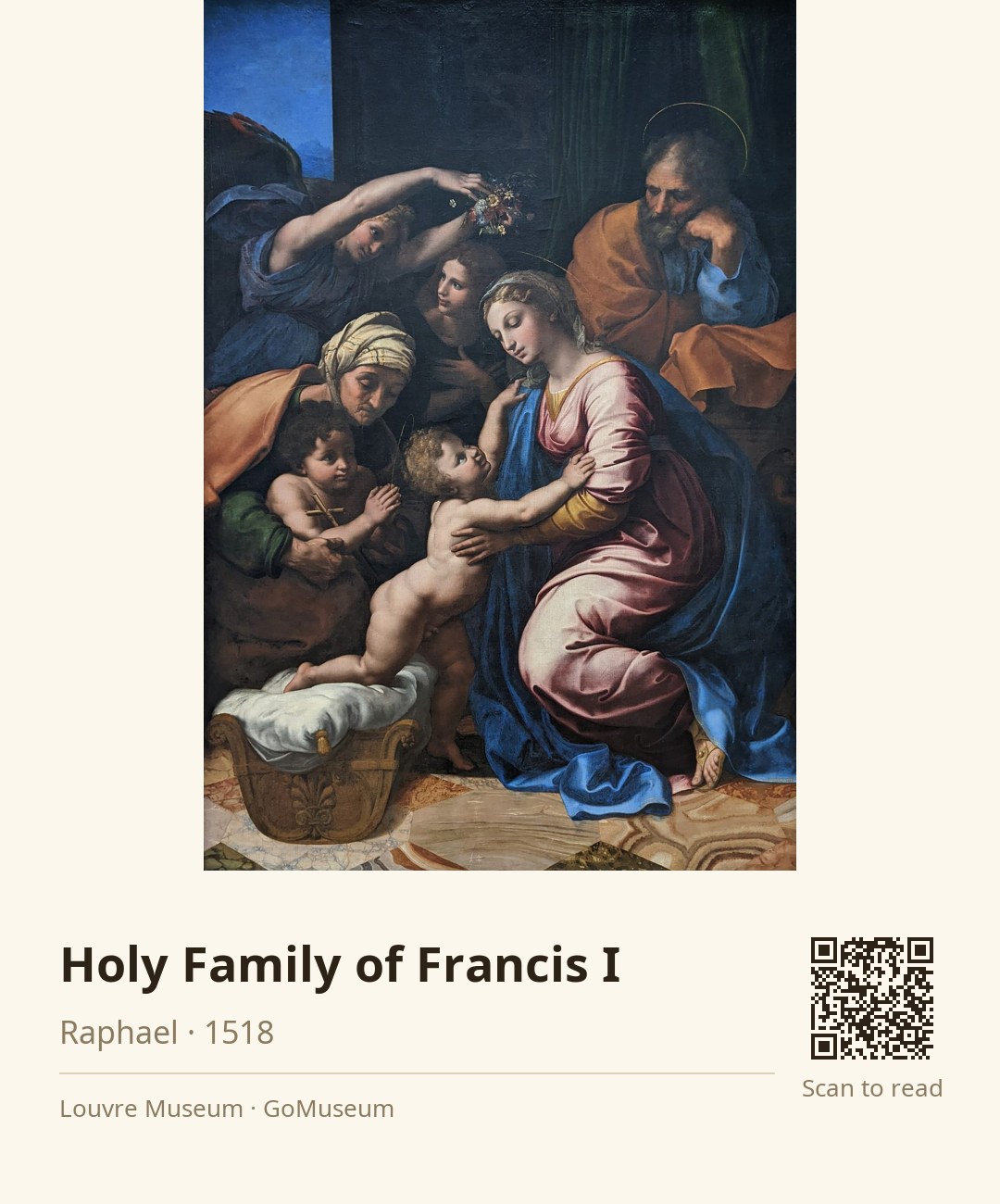
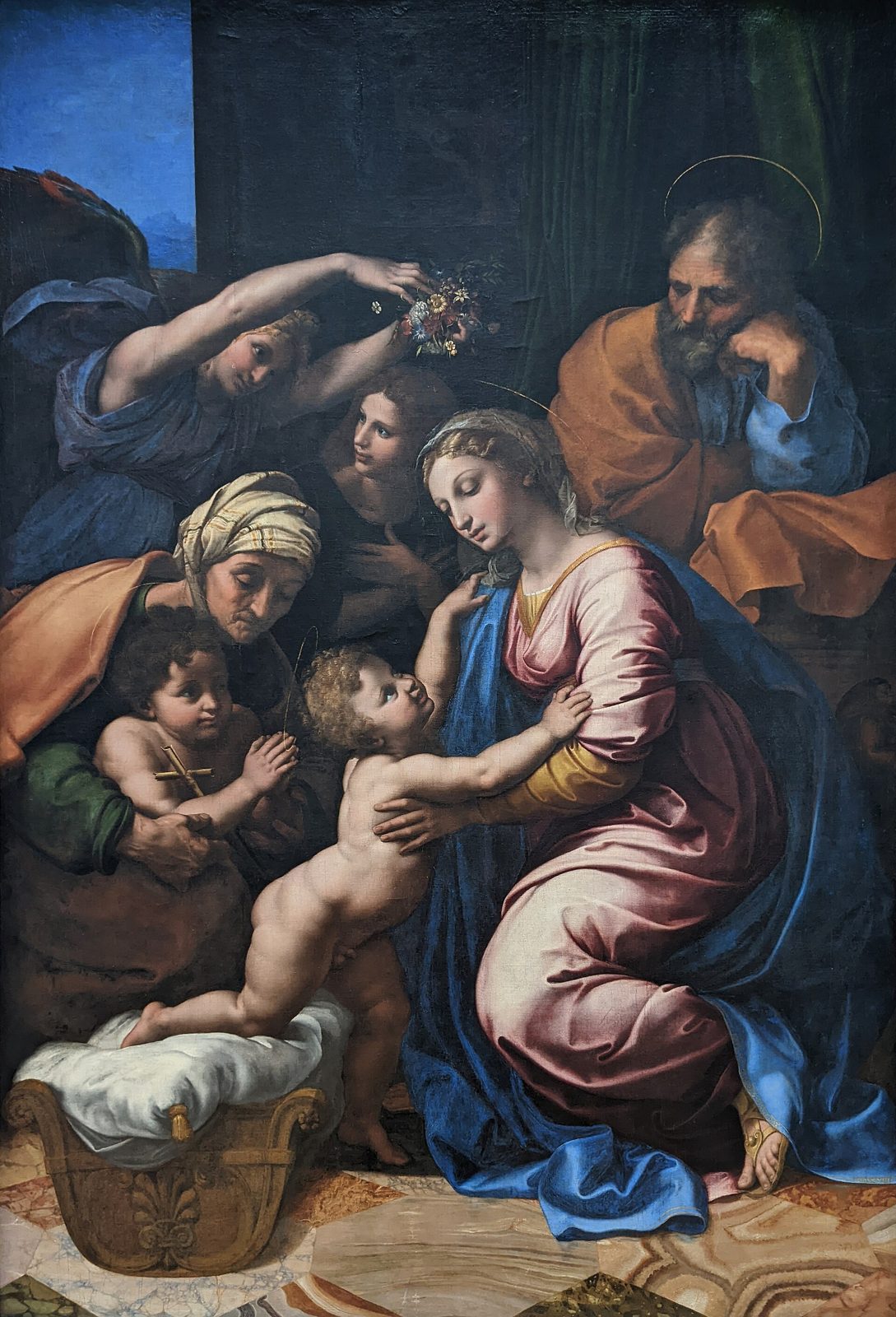
🎧 This work has audio narration — listen in the appTake a moment to really absorb the scene in front of you. This is Raphael's "Holy Family of Francis I," and it’s a masterclass in composition and emotion. Look closely at Mary, dressed in that striking red robe, cradling the infant Jesus. Notice how her foot is gently resting on the edge of the cradle, almost as if she’s ready to spring into action, embodying both tenderness and strength.
Now, shift your gaze to the angel hovering above her, delicately placing a floral crown on Mary’s head. This isn’t just a decorative touch; it symbolizes her recent motherhood, a nod to Claude, the wife of Francis I, for whom this painting was commissioned. It’s a reminder of the personal connections that art can forge across time and space.
Raphael painted this in 1518, during a period when he was blending influences from both Michelangelo's monumental figures and Leonardo's subtle luminosity. While he signed the piece, much of it was executed by his workshop, showcasing the collaborative nature of Renaissance art. This painting isn’t just a religious scene; it’s a celebration of family and the bonds that unite us.
As you stand here, think about the stories this artwork has witnessed over the centuries. What emotions does it evoke in you? What does family mean to you? Let those reflections linger as you continue your journey through the museum.
Raffaello Sanzio da Urbino, known as Raphael, was an Italian painter and architect of the High Renaissance, born in Urbino in 1483. Orphaned by age eleven, he managed his family's workshop and trained under Pietro Perugino, establishing himself as a master by 1500. His move to Rome in 1508 marked the beginning of a prolific period, where he received significant commissions, including the renowned frescoes in the Vatican's Raphael Rooms. His art is celebrated for its clarity, harmonious composition, and embodiment of Neoplatonic ideals. Raphael's influence was profound, shaping the trajectory of Western art and serving as a model for academies until the 19th century. His legacy, characterized by serenity and grace, was later revived in the 18th and 19th centuries, contrasting with the dramatic styles of his rival Michelangelo. Despite his early death at 37, Raphael's extensive body of work and innovative techniques left an indelible mark on the art world, influencing generations of artists and extending into contemporary culture.
In 1518, Raphael was commissioned by Pope Leo X to create this stunning piece as a gift for Claude, the wife of Francis I of France. This painting, known as the 'Holy Family of Francis I,' was intended to celebrate the recent motherhood of Claude, which is symbolized by the angel placing a floral crown on Mary's head. It was a time when Raphael was at the height of his powers, blending influences from both Michelangelo and Leonardo da Vinci. Although Raphael signed the work, much of it was executed by his workshop assistants, showcasing the collaborative nature of Renaissance art. The painting was eventually housed in the Louvre, where it continues to captivate viewers with its emotional depth and masterful composition.
As you gaze at the 'Holy Family of Francis I,' take a moment to appreciate Raphael's brushwork. The figures are rendered with a sense of monumental grandeur, a nod to Michelangelo's influence, while the soft luminosity of the colors reflects Leonardo's mastery. Notice how the composition draws your eye toward Mary and the infant Jesus, who are centrally positioned, creating a focal point that feels both intimate and expansive. The use of light enhances the emotional resonance; it bathes the figures in a warm glow, suggesting a divine presence. The careful arrangement of the characters, with Joseph's contemplative pose and the dynamic angel above, creates a narrative tension that invites you to ponder the relationships depicted. The scale of the painting, larger than life, further amplifies its impact, making you feel as if you are witnessing a sacred moment.
Commissioned by Pope Leo X, it was a gift to the French queen Claude, showcasing Raphael's mastery in creating monumental figures and harmonious compositions. This painting not only reflects the artist's unique style but also influenced generations of artists who sought to balance emotional depth with classical beauty. Its impact can be seen in the way it shaped religious art, setting a standard for the portrayal of sacred subjects that resonated well into the Neoclassical period and beyond. Remember, this piece is not just a painting; it's a bridge connecting the past to the future of art.
One intriguing tidbit about the 'Holy Family of Francis I' is that while Raphael is credited with the painting, art historians believe that significant portions, including the intricate floral arrangements and some figures, were likely executed by his talented workshop assistants, such as Giovanni da Udine and Giulio Romano. This collaborative effort reflects the Renaissance practice of teamwork in art production, where a master artist would oversee and guide a group of skilled artisans.
The painting was commissioned by Pope Leo X as a gift for Claude, the wife of Francis I of France, highlighting the diplomatic ties and the importance of art in fostering relationships between powerful figures during the Renaissance.
The angel placing a floral crown on Mary's head serves as a subtle reference to Claude's recent motherhood, symbolizing her role and status, which adds a layer of personal significance to the artwork beyond its religious themes.