The Immaculate Conception of Los Venerables
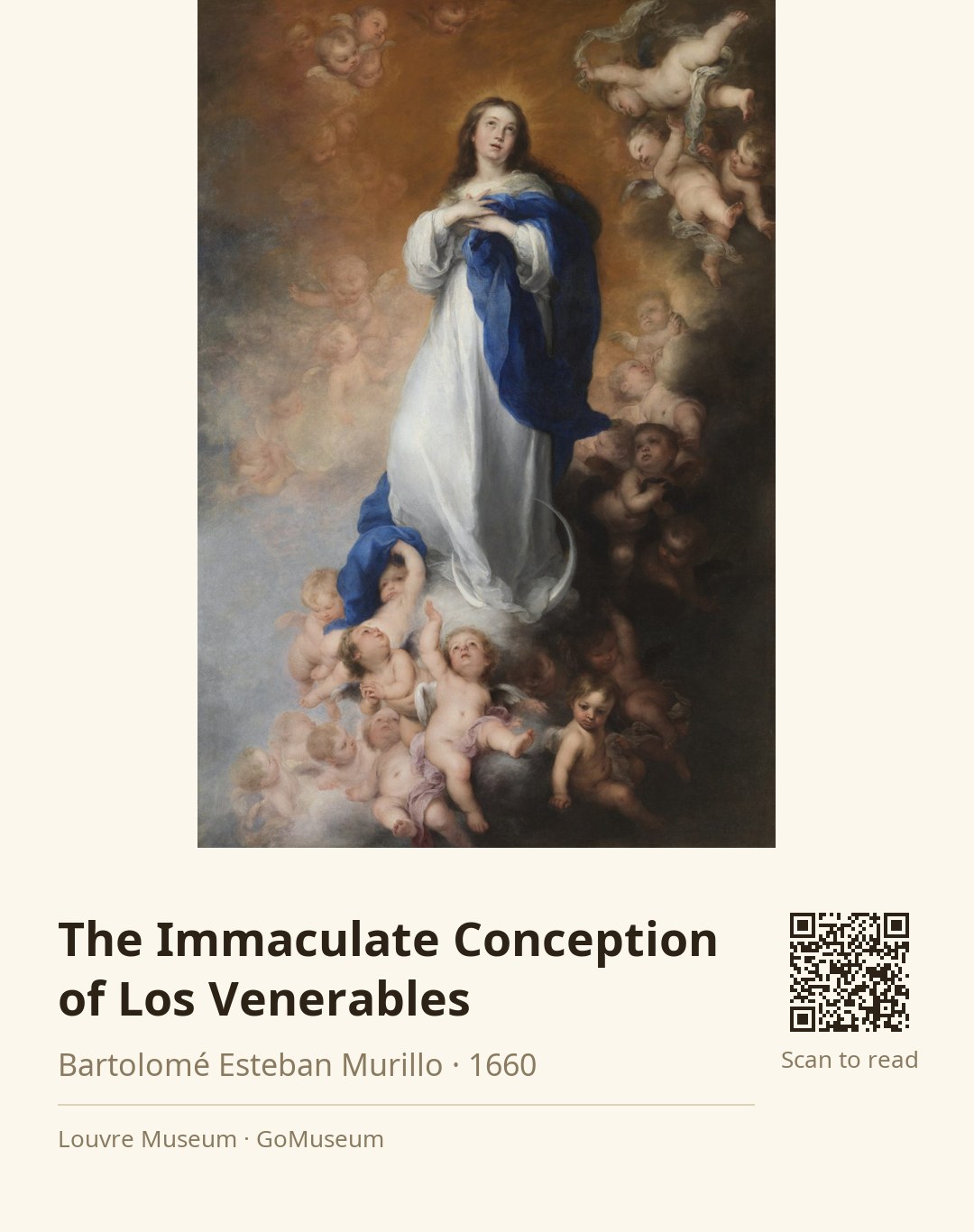
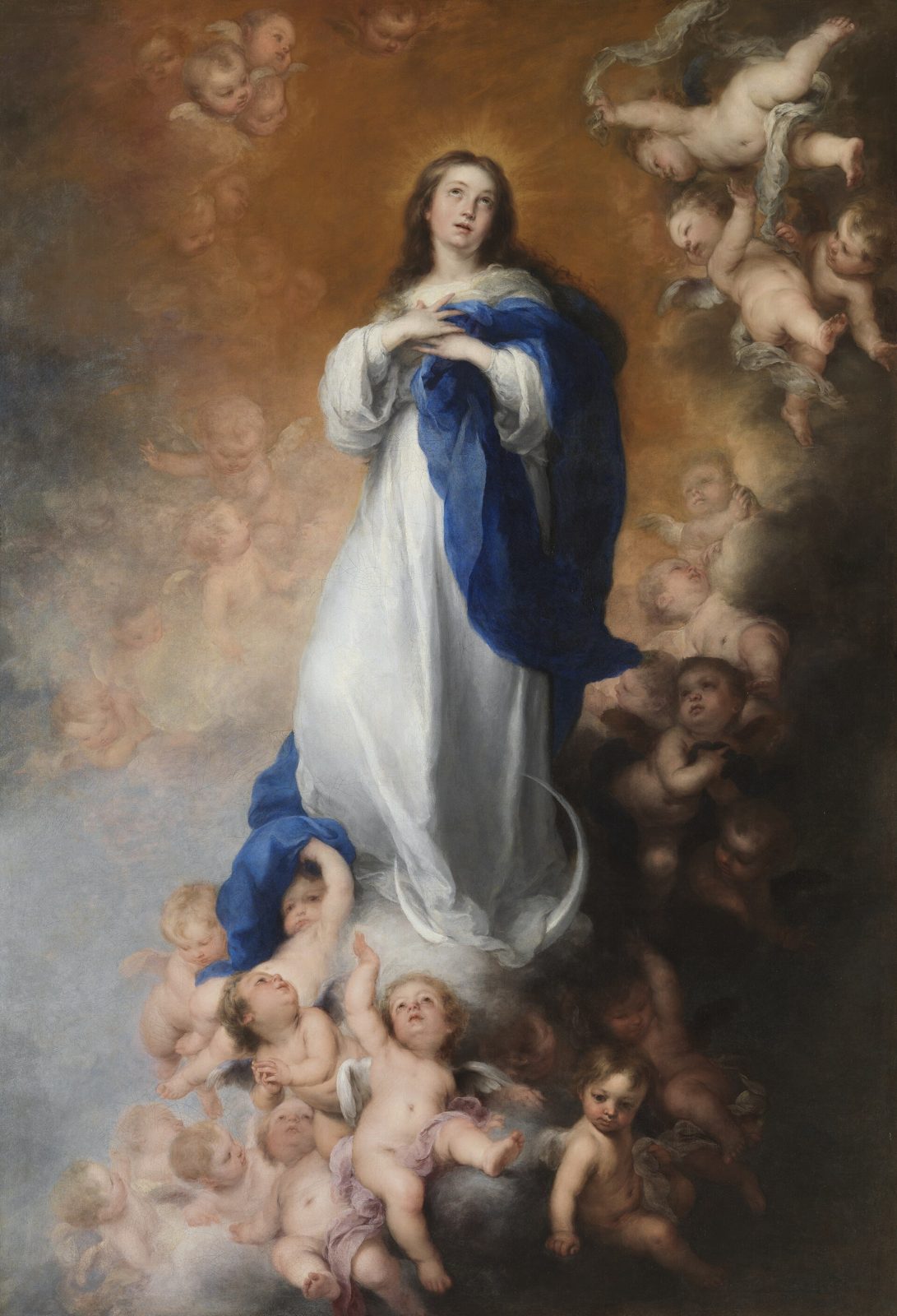
🎧 This work has audio narration — listen in the appTake a moment to really look at Murillo's "The Immaculate Conception of Los Venerables." Notice how the Virgin Mary stands gracefully on a delicate crescent moon, her white robe flowing like a gentle breeze, while her blue mantle adds a touch of celestial elegance. Her hands are crossed over her heart, and her gaze is lifted towards the heavens, inviting you to share in her moment of divine connection.
These details matter because they embody the essence of purity and grace that Murillo sought to convey. The crescent moon symbolizes her immaculate nature, while the upward movement of the composition, enhanced by the light, creates a sense of triumph and ascension. It’s as if Mary is not just a figure in a painting, but a beacon of hope and purity, connecting the earthly with the divine.
Commissioned by Justino de Neve for the Hospital de los Venerables in Seville, this painting reflects the growing devotion to the Immaculate Conception in 17th-century Spain, a belief that would eventually be declared an official dogma of the Catholic Church in 1854. Murillo painted numerous versions of this theme, but this one stands out for its vibrant energy and uplifting spirit.
As you take in the scene, think about what purity means to you. How does this image resonate in your own life?
Bartolomé Esteban Murillo was a prominent Spanish Baroque painter, born in Seville in late December 1617. Orphaned at a young age, he was raised by his sister and her husband, which fostered a close-knit family environment. Murillo began his artistic training under his uncle, Juan del Castillo, where he developed a realist style influenced by the tenebrism of Francisco de Zurbarán and the naturalism of Caravaggio. He married Beatriz Cabrera in 1645 and had ten children, though only five survived.
Murillo is celebrated for his religious works, particularly those commissioned by Franciscan convents, but he also gained fame for his genre paintings depicting the lives of the poor, including children and street urchins. His ability to capture the essence of everyday life set him apart from his contemporaries. He established an influential workshop in Seville and founded the Academy of Fine Arts, aiming to elevate the standards of artistic training.
Despite never leaving Seville, Murillo became a leading figure in the Spanish Golden Age, alongside Diego Velázquez and Francisco de Zurbarán. His legacy endures through his extensive body of work, which includes notable pieces in major museums like the Louvre and the Prado. Murillo died in 1682 after a fall while painting, leaving behind a rich artistic heritage that continues to resonate in the art world.
De Neve, who served as the ecclesiastical president of the Hospital de los Venerables, intended this piece for the hospital's chapel, a place dedicated to aged priests. The painting was not just a personal endeavor; it reflected the rising devotion to the Immaculate Conception in Spain, a belief that would gain official recognition by the Catholic Church in 1854. However, its journey took a dramatic turn during the Peninsular War when it was looted by Marshal Jean-de-Dieu Soult in 1813 and transported to France. The painting remained in Soult's possession until his death in 1851 and was later sold to the Louvre in 1852 for a staggering 615,300 francs, a record sum for a painting at that time. It returned to Spain in 1941 as part of an exchange deal with the Vichy regime, and today, it resides in the Museo del Prado, Madrid.
As you gaze upon 'The Immaculate Conception of Los Venerables,' take a moment to appreciate Murillo's masterful technique. The painting measures an impressive 274 by 190 centimeters, allowing for a grand display of detail and emotion. Notice how Murillo employs a dynamic brushwork that creates a sense of movement, guiding your eyes from the bottom right to the top left. This upward trajectory is not just a compositional choice; it symbolizes Mary's ascension and purity. The light in the painting is particularly striking, illuminating the Virgin's flowing white robe and blue mantle, enhancing the ethereal quality of her figure. Murillo's choice to omit traditional symbols, like the Tower of David or palm trees, invites you to focus solely on Mary's divine presence. The crescent moon, delicately positioned, adds an element of grace while reinforcing her immaculate nature. The overall composition feels alive, as if Mary is about to step out of the canvas, embodying hope and purity.
By the late 17th century, belief in the Immaculate Conception was surging, and Murillo's interpretation became a cultural touchstone. His work not only solidified the Virgin Mary's role in Catholic iconography but also influenced countless artists who followed. The way he captured Mary's purity and grace, with that upward movement in the composition, set a new standard for how religious figures could be portrayed. So, when you look at this piece, remember: it’s not just about the beauty; it’s about how it changed the conversation around faith and art in a deeply Catholic Spain.
One fascinating tidbit about 'The Immaculate Conception of Los Venerables' is its dramatic journey through history. During the Peninsular War in 1813, the painting was looted by Marshal Jean-de-Dieu Soult, who took it back to France. Interestingly, Soult left behind the ornate frame that originally housed the painting, which still remains at the Los Venerables Hospital in Seville. Imagine that frame, a silent witness to the chaos of war, while the painting itself was whisked away to a foreign land, only to return decades later amid a complex exchange of artworks between Spain and France!
The original frame of 'The Immaculate Conception of Los Venerables' was left behind by Marshal Soult when he looted the painting during the Peninsular War, and it remains in the Hospital de los Venerables to this day.