Portrait of the Artist Holding a Thistle
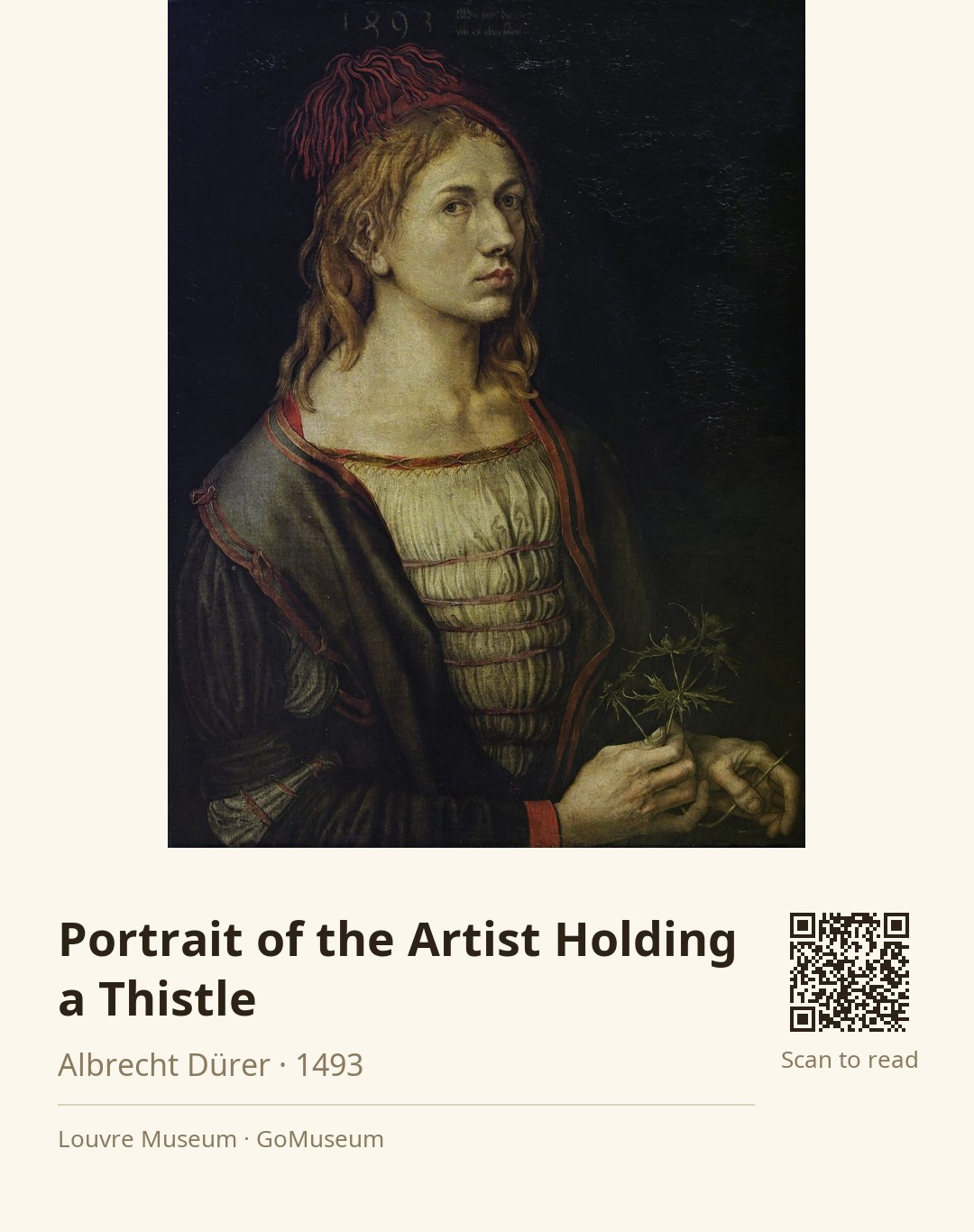
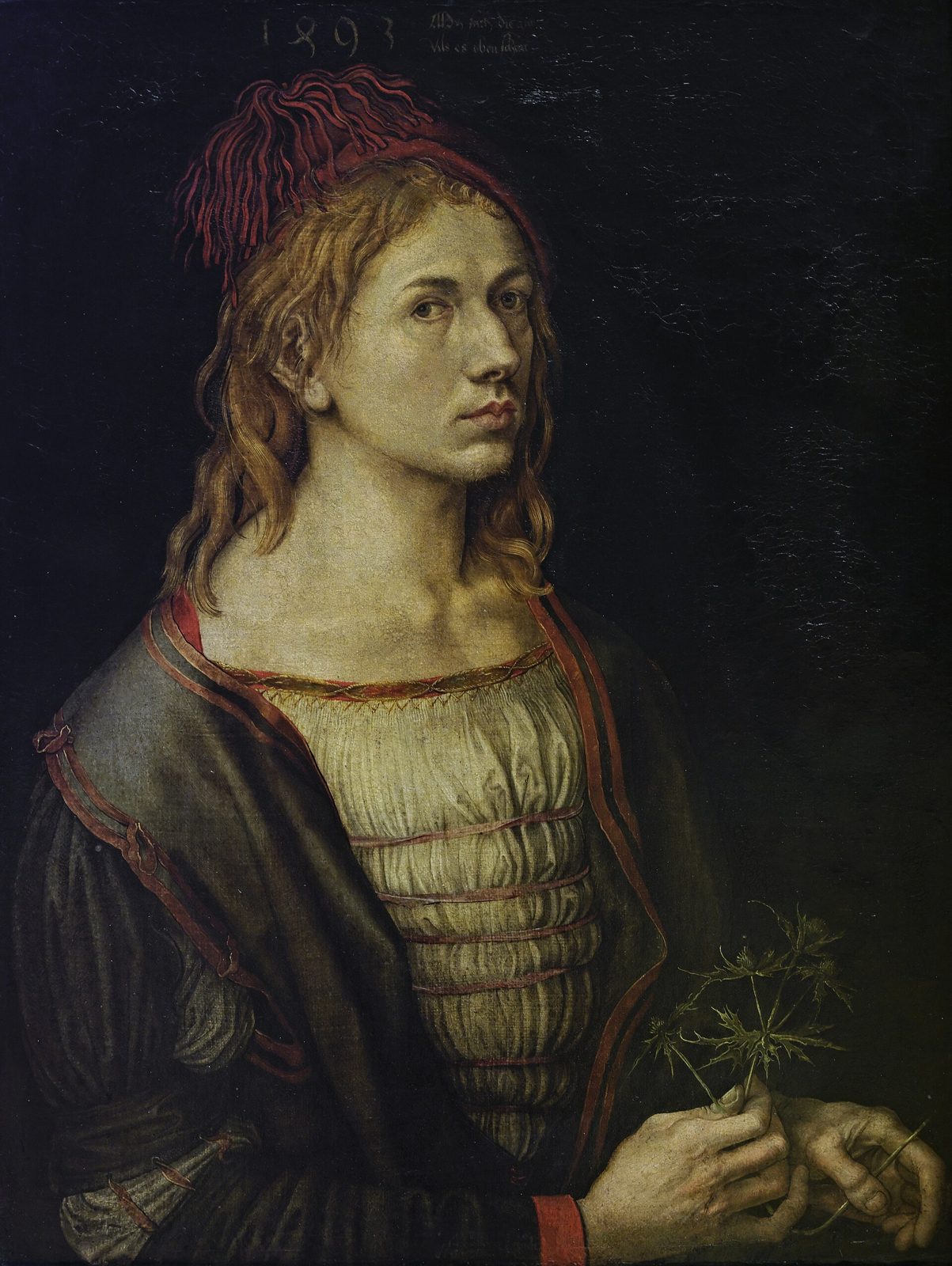
🎧 This work has audio narration — listen in the appTake a moment to really look at Dürer’s self-portrait. Notice how he holds that thistle, its sharp edges contrasting with the softness of his expression. This isn’t just any flower; it symbolizes fidelity, hinting at his upcoming marriage.
Now, focus on his gaze. Dürer looks directly at you, his expression a mix of seriousness and introspection. This isn’t merely a snapshot; it’s a window into his soul, capturing the weight of his thoughts and the significance of this moment in his life. At just 22, he’s already reflecting on love and commitment, which is pretty profound for someone so young.
Painted in 1493, this work marks one of the earliest self-portraits by a Northern artist, setting a precedent for future generations. Dürer was at a pivotal point in his life, transitioning from apprentice to master, and this portrait serves as both a personal and professional declaration.
As you stand here, think about the thistle’s dual meaning: a symbol of love and a reminder of life’s complexities. What do you think Dürer was feeling as he painted this? What stories might he have been telling himself about his future?
Albrecht Dürer, born on May 21, 1471, in Nuremberg, was a pivotal figure of the German Renaissance, renowned for his contributions as a painter, printmaker, and theorist. His artistic journey began early, showing exceptional talent in drawing, which led him to apprentice under Michael Wolgemut. By his twenties, Dürer gained recognition across Europe, particularly for his innovative woodcuts that transformed the medium. His engravings, characterized by meticulous detail and tonal range, further established his reputation.
Dürer's interactions with leading Italian artists, including Raphael and Leonardo da Vinci, enriched his work, allowing him to integrate classical motifs and the human form into Northern art. His theoretical writings on perspective and proportions reflect his deep engagement with the principles of mathematics in art. Dürer's legacy is marked by his ability to bridge the gap between Northern and Southern European artistic traditions, making him a central figure in art history. His works, including iconic pieces like "Melencolia I" and "Knight, Death, and the Devil," continue to influence artists and captivate audiences today. Dürer passed away on April 6, 1528, leaving behind a vast and impactful body of work.
In 1493, Albrecht Dürer was just 22 years old, freshly emerged from his apprenticeship and on the brink of a new chapter in his life. He was in Strasbourg, where he painted this self-portrait, which is not only one of his earliest but also one of the first self-portraits by a Northern artist. The thistle he holds, a symbol of fidelity, hints at his upcoming marriage to Agnes Frey in 1494. This work is often interpreted as a betrothal portrait, capturing a moment of personal significance. The painting was later acquired by the Louvre in 1922, after passing through various hands, including that of Nicolas de Valleroy, whose collection was seized post-World War I.
Dürer’s technique in this self-portrait is strikingly innovative for its time. The oil paint, applied on parchment and then pasted onto canvas, allows for a depth of color and detail that brings his expression to life. Notice the way he uses light to sculpt his features, creating a three-dimensional effect that draws you in. The brushwork feels both meticulous and free, a reflection of Dürer’s mastery. The thistle, with its sharp edges, contrasts beautifully with the softness of his expression, symbolizing the complexities of love and fidelity. The composition is carefully structured, with Dürer’s direct gaze anchoring the viewer’s attention, while the delicate details of the thistle add a layer of intrigue. This interplay of softness and sharpness enhances the emotional depth of the piece, making it resonate with viewers even today.
Interestingly, Dürer was known for his philosophical musings, often reflecting on his own identity and existence through his art. This self-portrait is particularly notable because it includes an inscription that translates to 'My affairs follow the course allotted to them on high,' indicating his belief in a divine plan guiding his life. This blend of personal reflection and artistic expression was quite rare for the time, making this work a fascinating glimpse into the mind of a young artist grappling with profound themes.
The thistle, specifically identified as Eryngium amethystinum, is not only a symbol of fidelity but also has medicinal properties and was regarded as an aphrodisiac during Dürer's time, adding layers of meaning to the portrait.
Dürer included an inscription in the painting that reflects his belief in a divine plan guiding his life, suggesting that he viewed his artistic journey and personal choices as part of a larger, predetermined course.