Madonna of Loreto
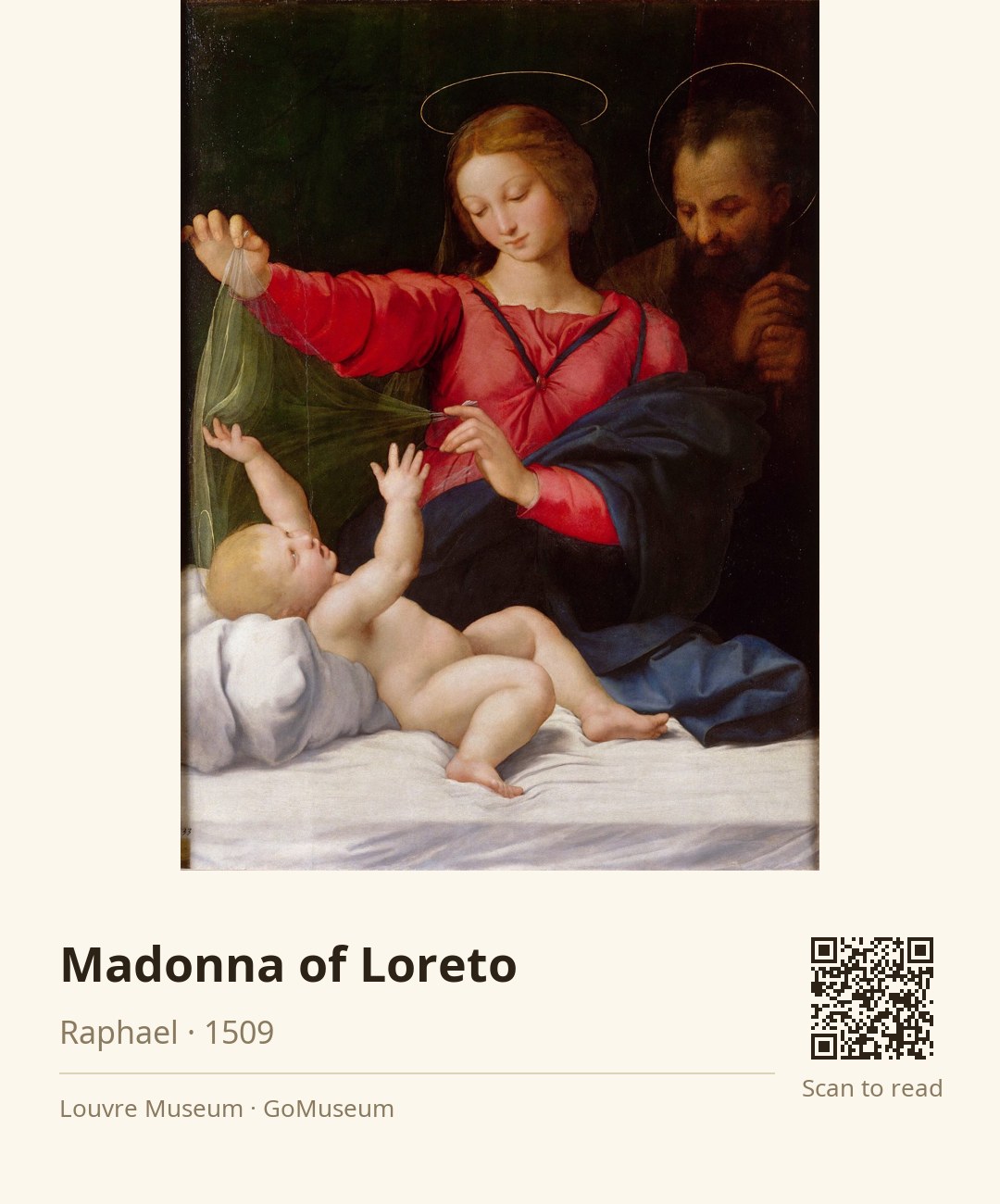
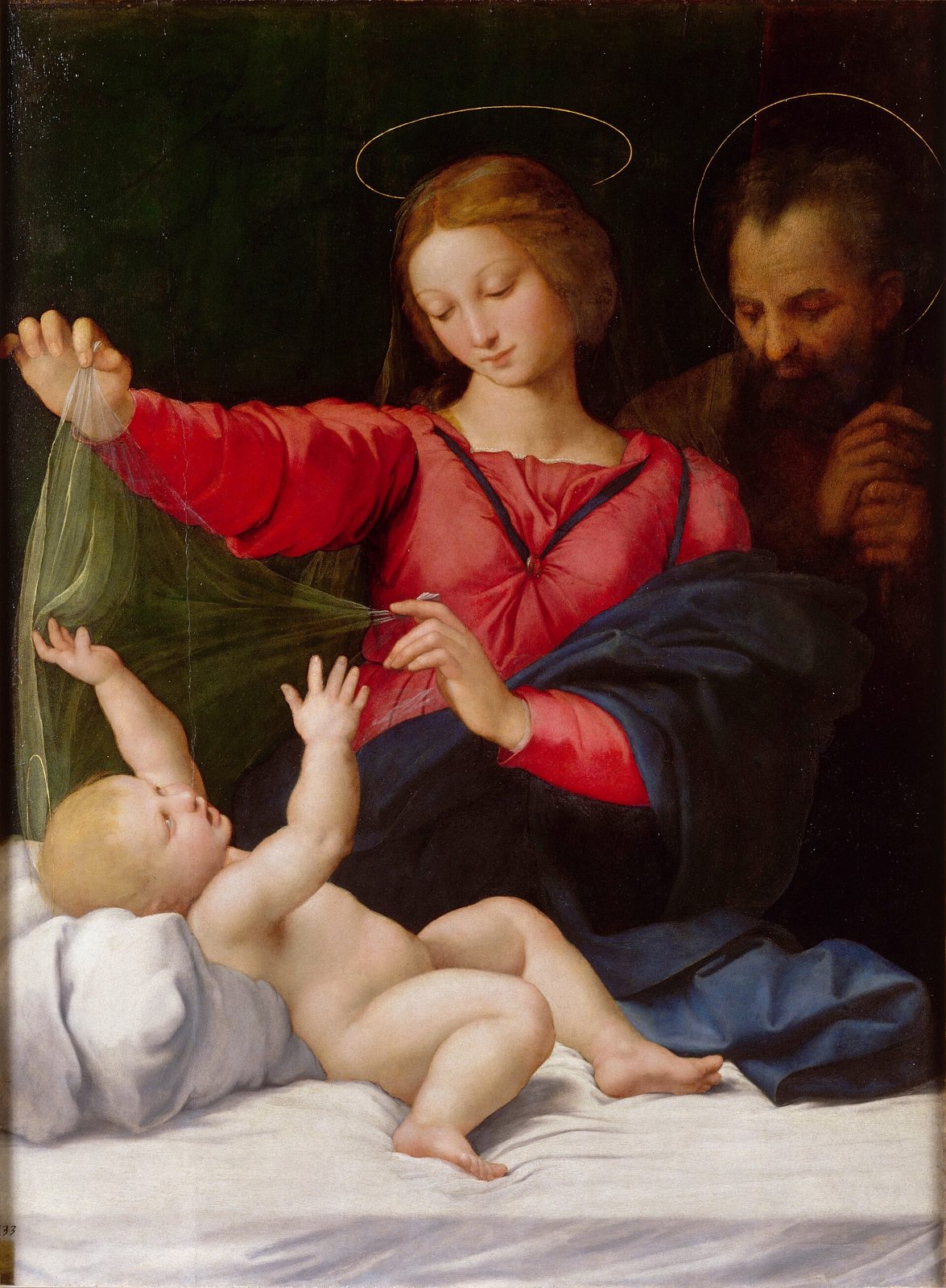
🎧 This work has audio narration — listen in the appTake a moment to really absorb the warmth radiating from Raphael's "Madonna of Loreto." Notice how the Virgin Mary gently engages with the Child, who playfully tugs at her veil. This intimate moment captures a tender connection between mother and son, inviting you into their world.
Now, look closely at Saint Joseph, lurking in the shadows with a melancholic expression. His presence adds a layer of depth, hinting at the future trials that await the Holy Family. This contrast between the joy of the moment and the somber undertones speaks volumes about the complexities of motherhood and prophecy.
Created around 1509, this painting showcases Raphael's mastery in blending emotion with divine themes, a hallmark of the High Renaissance. It’s fascinating to think that this piece has been adored for centuries, despite its confusing history of ownership and the many copies that exist.
As you stand here, consider this: what do you think Raphael wanted us to feel about the relationship between Mary and Jesus?
Raffaello Sanzio da Urbino, known as Raphael, was an Italian painter and architect of the High Renaissance, born in Urbino in 1483. Orphaned by age eleven, he managed his family's workshop and trained under Pietro Perugino, establishing himself as a master by 1500. His move to Rome in 1508 marked the beginning of a prolific period, where he received significant commissions, including the renowned frescoes in the Vatican's Raphael Rooms. His art is celebrated for its clarity, harmonious composition, and embodiment of Neoplatonic ideals. Raphael's influence was profound, shaping the trajectory of Western art and serving as a model for academies until the 19th century. His legacy, characterized by serenity and grace, was later revived in the 18th and 19th centuries, contrasting with the dramatic styles of his rival Michelangelo. Despite his early death at 37, Raphael's extensive body of work and innovative techniques left an indelible mark on the art world, influencing generations of artists and extending into contemporary culture.
The history of Raphael's "Madonna of Loreto" is a tale of twists and turns. Originally commissioned for the Church of Santa Maria del Popolo, it was likely ordered by the influential banker Agostino Chigi, who wanted it for his personal chapel. This painting, alongside Raphael's Portrait of Pope Julius II, was displayed prominently in the church, creating a powerful visual dialogue. Over the centuries, the painting's journey has been tumultuous, with its ownership obscured by a haze of misinformation and numerous copies. It was once thought to be the original at the Basilica della Santa Casa in Loreto, hence its name, but that was a mix-up; the actual painting is housed in the Musée Condé in Chantilly, France. The painting's provenance is complex, with its location lost for periods and its significance shifting as it passed through various collections, including that of the Borghese family.
When you look at "Madonna of Loreto," pay attention to Raphael's brushwork and the way he handles light and color. The soft, almost ethereal quality of the Virgin Mary's skin contrasts beautifully with the rich, deep hues of her garments. Notice how the light seems to cascade over her, illuminating her face and creating a sense of warmth that draws you in. The composition is masterfully structured; the triangular arrangement of the figures creates a sense of stability, while the playful interaction between the Child and Mary adds a dynamic element. The melancholy of Saint Joseph, painted in shadow, serves as a poignant counterbalance to the vibrancy of the mother-child relationship. This interplay of light and shadow not only enhances the emotional depth but also reflects Raphael's understanding of human experience, making the viewer feel both the joy and the weight of their divine connection.
This work, celebrated for its tender portrayal of the Holy Family, influenced countless artists who sought to capture the same intimacy and divine grace. Raphael’s masterful use of composition and color set a standard that would shape religious art for generations. Its legacy is seen in the many copies that emerged, each a testament to its enduring appeal. The painting's journey—from the Church of Santa Maria del Popolo to the Musée Condé—reflects the tumultuous history of art ownership and appreciation, making it a symbol of how art transcends time and place. Remember, this piece isn't just about the figures depicted; it's about the emotional connection it fosters, a connection that continues to inspire artists and viewers alike.
One surprising aspect of the "Madonna of Loreto" is its name, which is a bit of a misnomer. While many believe it refers to the original painting housed at the Basilica della Santa Casa in Loreto, that version is actually a copy. This confusion arose because the painting was once thought to be the original, leading to its enduring title.
X-ray analysis showed that Saint Joseph was originally painted over a window that was previously located over the Madonna's shoulder, indicating Raphael made significant changes during the creation process.
The painting is called 'Madonna of Loreto' because it was once thought to be the original housed at the Basilica della Santa Casa in Loreto, but that version is actually a copy, leading to a misnomer.