Tree of crows
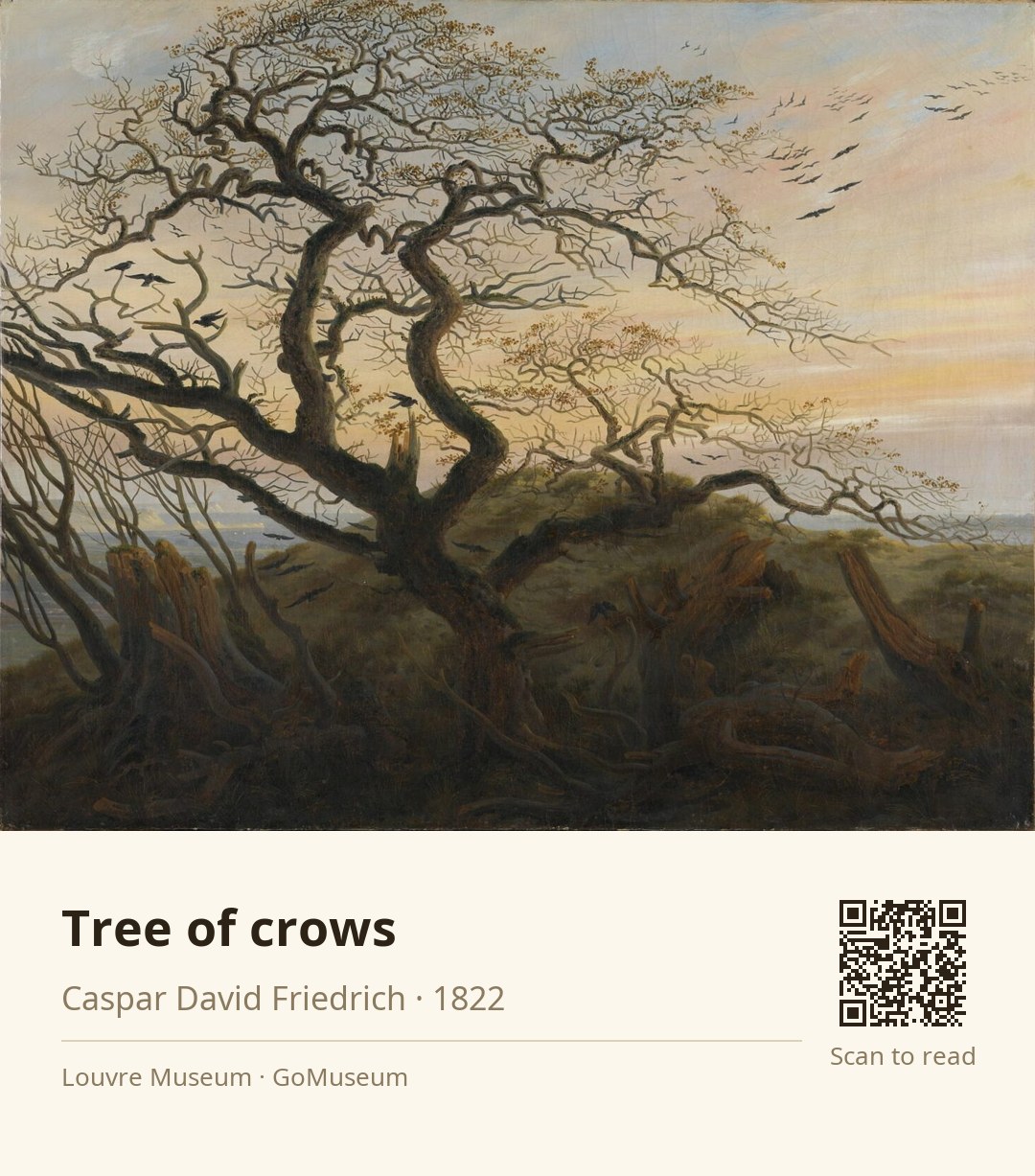
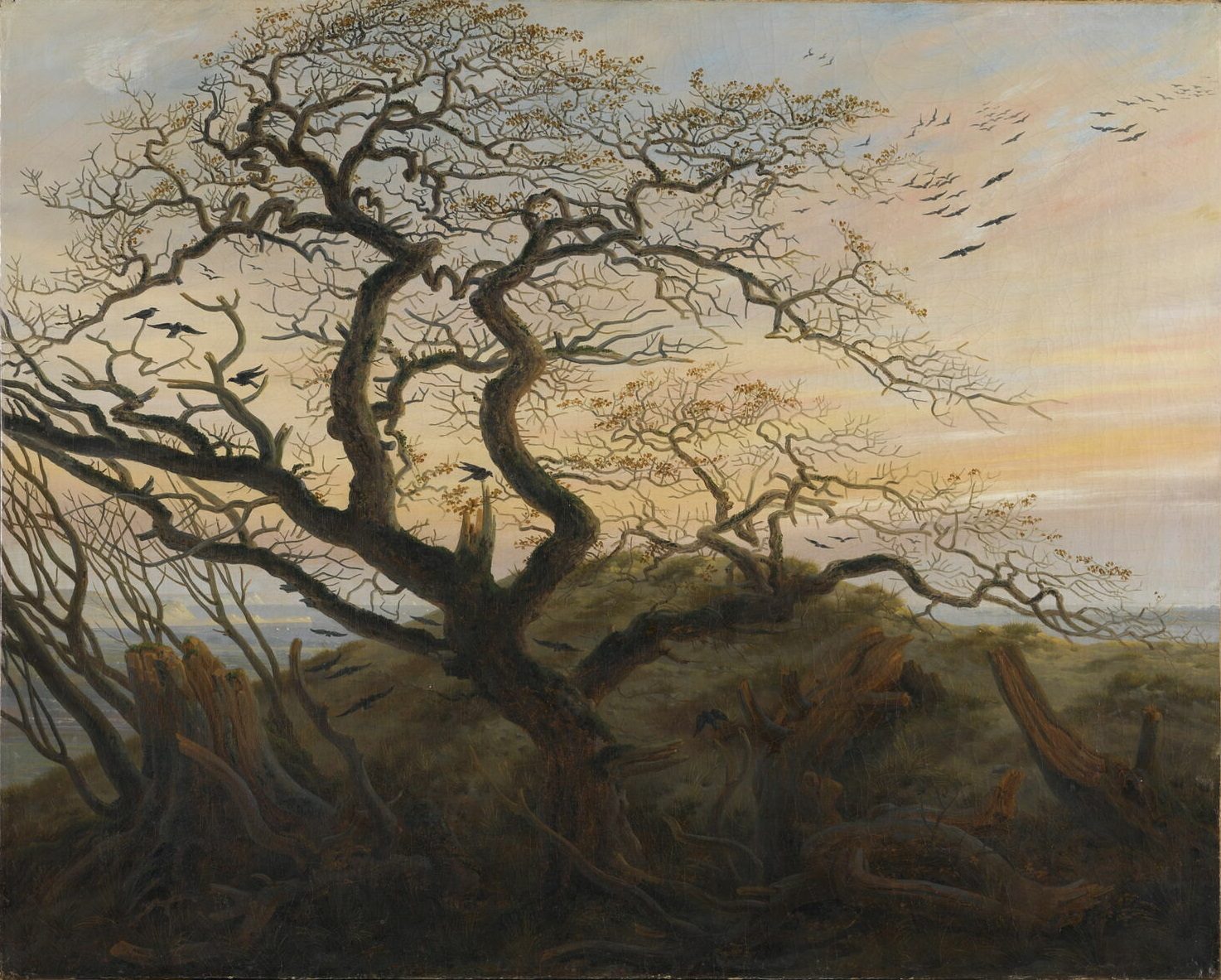
🎧 This work has audio narration — listen in the appTake a moment to really absorb the scene before you in Caspar David Friedrich's "Tree of Crows." Notice how that twisted oak tree dominates the canvas, its gnarled branches reaching out like desperate hands against the evening sky. Look closely at the two crows perched atop it, and the dark mass of their flock descending toward the tree. These details are not just for show; they pulse with meaning. The oak, stripped of its leaves, symbolizes death and decay, while the crows, often associated with omens, add a haunting presence, suggesting a deeper narrative of mortality.
Friedrich painted this in 1822, during a time when Romanticism was flourishing, and artists were exploring the emotional connections between nature and the human experience. This painting reflects that struggle between life and death, with the dark foreground representing the harsh realities of existence, while the soft, pastel clouds above hint at hope and transcendence.
As you stand here, consider how Friedrich's own life experiences with loss and grief influenced his art. What do you think he was trying to convey about our relationship with nature and the inevitability of death? Let that question linger as you take in the beauty and melancholy of this powerful piece.
Caspar David Friedrich was a pivotal figure in German Romanticism, born on September 5, 1774, in Greifswald. His early life was marked by tragedy, losing several family members, which profoundly influenced his artistic vision. Friedrich's work is characterized by its emotional depth and spiritual connection to nature, often depicting solitary figures against vast landscapes, evoking contemplation and introspection. He studied in Copenhagen, where he was inspired by the interplay of light and shadow in nature, leading him to create iconic works that resonate with themes of the sublime and the metaphysical.
Settling in Dresden, Friedrich gained early acclaim, with contemporaries recognizing his unique ability to convey the "tragedy of landscape." However, his popularity waned in later years as Germany moved towards modernity, and he died in relative obscurity in 1840. A resurgence of interest in his work began in the early 20th century, influencing Expressionists and later movements. Despite a complex legacy, Friedrich is now celebrated as a master of Romantic landscape painting, embodying the struggle between humanity and nature, and remains a cultural icon in Germany.
Caspar David Friedrich's 'Tree of Crows' was painted in 1822 and is a striking example of his Romantic style. The painting was acquired by the Louvre in 1975, marking the museum's first acquisition of Friedrich's work. This piece has been described as one of his most compelling, capturing the essence of his exploration of nature and mortality. Interestingly, an inscription on the back of the canvas refers to a Hünengrab, or dolmen, suggesting a connection to ancient burial practices.
In 'Tree of Crows,' Friedrich employs a dramatic composition that draws your eye to the twisted oak tree, which dominates the canvas. The gnarled branches stretch outwards, almost as if reaching for something beyond the frame, creating a sense of urgency and desperation. Notice how the tree's shape resembles a rhombus, a deliberate choice that adds to its imposing presence. The contrast between the dark, chaotic foreground—filled with hacked trunks and stumps—and the serene, pastel clouds above enhances the emotional tension. The brushwork feels restless, with the rough texture of the bark contrasting sharply against the smooth, ethereal quality of the sky. This juxtaposition not only symbolizes the struggle between life and death but also invites you to contemplate the deeper meanings of existence.
One fascinating anecdote about 'Tree of Crows' is that it was painted based on a sketch Friedrich created in 1809. This early drawing already contained the essence of the twisted oak, but Friedrich later expanded its branches and altered its form to create a more dramatic effect in the final painting. This evolution showcases his meticulous approach to capturing the emotional weight of his subjects.
An inscription on the back refers to a Hünengrab, or dolmen, suggesting a connection to ancient burial practices, which adds a layer of historical significance to the painting.
Friedrich based 'Tree of Crows' on a sketch he created in 1809, which already captured the essence of the twisted oak, but he later expanded and altered its branches for a more dramatic effect.