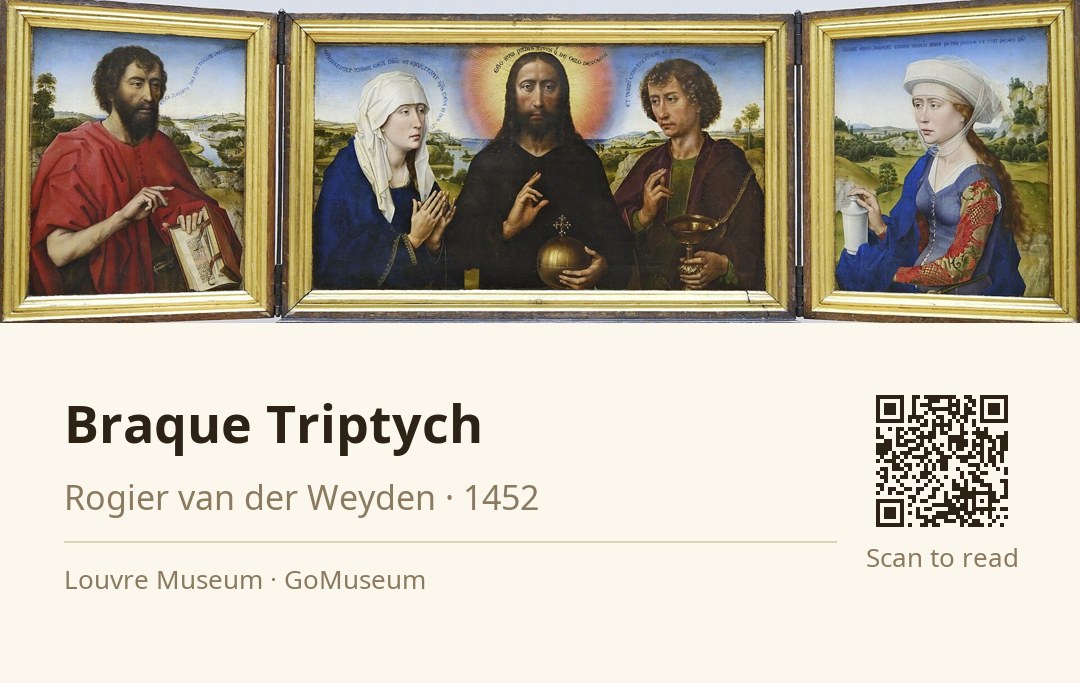
Braque Triptych
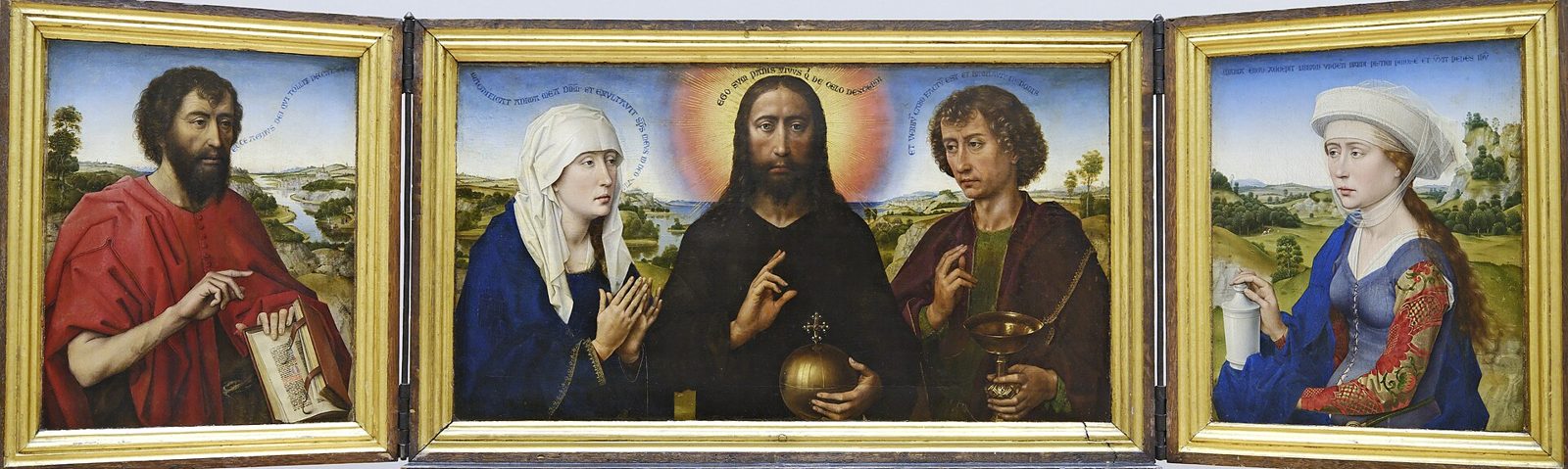
🎧 This work has audio narration — listen in the appAs you stand before the Braque Triptych, take a moment to really look at the expressions on the figures’ faces. Notice how John the Baptist on the left seems to beckon you with his outstretched hand, while the Virgin Mary in the center cradles Jesus with a tenderness that feels almost palpable. These details are not just artistic choices; they convey deep emotional connections and spiritual narratives that were essential to the private devotion of the couple it was created for.
This triptych, painted by Rogier van der Weyden in 1452, is unique because it was commissioned for private worship, likely by Catherine de Brabant in memory of her husband, Jehan Braque. The intimate nature of this piece invites you to reflect on love and loss, especially considering Catherine's lifelong devotion to Jehan, even after his untimely death.
The inscriptions floating above the figures are like whispers of scripture, connecting the viewer to the divine. They guide you through the story, creating a dialogue between the sacred and the personal. When the triptych is closed, it reveals a stark reminder of mortality—a skull and cross, a memento mori that speaks to the inevitability of death, urging you to contemplate your own life.
So, as you take in this artwork, think about the love that inspired it and the conversations it invites. What thoughts or feelings does it stir in you about the connections we hold dear, and the legacies we leave behind?
Rogier van der Weyden, born around 1399 in Tournai, was a pivotal figure in early Netherlandish painting. Initially known as Roger de le Pasture, he trained under Robert Campin before moving to Brussels in 1435, where he became the city's official painter. His career flourished as he received commissions from the Burgundian court and foreign aristocrats, leading to widespread acclaim across Europe. Van der Weyden's works, primarily religious altarpieces and portraits, are characterized by their emotional depth and meticulous detail, often idealizing the subjects' features while employing a rich palette that showcased his innovative approach to color.
Despite his popularity in the 15th century, his fame waned by the 17th century, and he was largely forgotten until the 18th century, when art historians began to recognize him alongside Jan van Eyck and Robert Campin as a master of the Flemish Primitives. His legacy is marked by a profound influence on Northern Renaissance art, particularly through his expressive naturalism and complex compositions. Van der Weyden's ability to convey human emotion and spirituality has cemented his place in art history as one of the most significant painters of his time. He passed away in Brussels in 1464, leaving behind a legacy of approximately forty surviving works that continue to captivate audiences today.
The Braque Triptych, painted in 1452, is a unique piece in Rogier van der Weyden's oeuvre, as it stands as the only surviving devotional work created for private worship rather than public display. Commissioned likely by Catherine de Brabant in memory of her husband, Jehan Braque, the triptych reflects a deeply personal narrative of love and loss. Jehan's sudden death shortly after their marriage left Catherine, who was significantly younger, with a profound sense of devotion that lasted a lifetime. This triptych was not merely an artistic endeavor; it was a heartfelt memorial. After Catherine's own passing nearly fifty years later, she requested to be buried alongside Jehan, underscoring the enduring bond they shared. Today, this poignant piece resides in the Musée du Louvre, encased in glass to protect its fragile oak panels, a testament to its historical significance and the intimate story it tells.
As you gaze at the Braque Triptych, pay attention to the intricate brushwork and the way van der Weyden handles light and color. The figures are rendered with a remarkable naturalism, their expressions imbued with emotion that draws you in. Notice how the center panel, almost twice the width of the side panels, creates a focal point that commands your attention. The flowing inscriptions above the figures serve not only as dialogue but also as a visual guide, leading your eye across the triptych. The deliberate symmetry of the hand gestures—John the Baptist and Jesus both raise their hands in a traditional teaching pose—creates a harmonious rhythm across the panels. Yet, the Magdalene's raised hand interrupts this flow, adding a layer of tension and complexity to the narrative. The use of color is equally striking; van der Weyden employs a rich palette, ensuring that each hue feels distinct yet cohesive, enhancing the emotional depth of the scene.
The Braque Triptych, created by Rogier van der Weyden around 1452, stands as a pivotal work in Early Netherlandish painting, marking a shift towards more intimate, private devotional art. Unlike many altarpieces of its time, which were designed for public worship, this triptych was commissioned for personal reflection, likely by Catherine de Brabant in memory of her late husband. Van der Weyden's innovative use of floating inscriptions and the intricate interplay of figures not only captivated his contemporaries but also set a standard for narrative clarity and emotional resonance that would echo through the Renaissance and beyond. Remember, this triptych is not just a painting; it's a heartfelt memorial that transformed how art could serve personal devotion.
One intriguing aspect of the Braque Triptych is its exterior, which features a memento mori—a skull and cross—alongside Latin inscriptions. This vanitas motif serves as a stark reminder of mortality, but what's particularly fascinating is the inscription attributed to the skull, which speaks directly to the viewer: "See, you who are so proud and avaricious, my body was once beautiful but now is food for worms." This direct address not only engages the viewer but also reflects the broader cultural preoccupation with death and the afterlife during the period.
The exterior features a memento mori, specifically a skull and cross, with an inscription that directly addresses the viewer, reminding them of their own mortality and the fleeting nature of beauty and life.
Unlike public altarpieces, the Braque Triptych was designed for intimate personal reflection, which is evident in its emotional expressions and the specific inscriptions that resonate with the personal loss experienced by Catherine de Brabant.
The inscriptions are carefully selected from scripture, and their placement creates a narrative flow across the panels, enhancing the storytelling by connecting the figures' expressions and gestures to the larger themes of sacrifice and devotion.