Saint Michael Vanquishing Satan
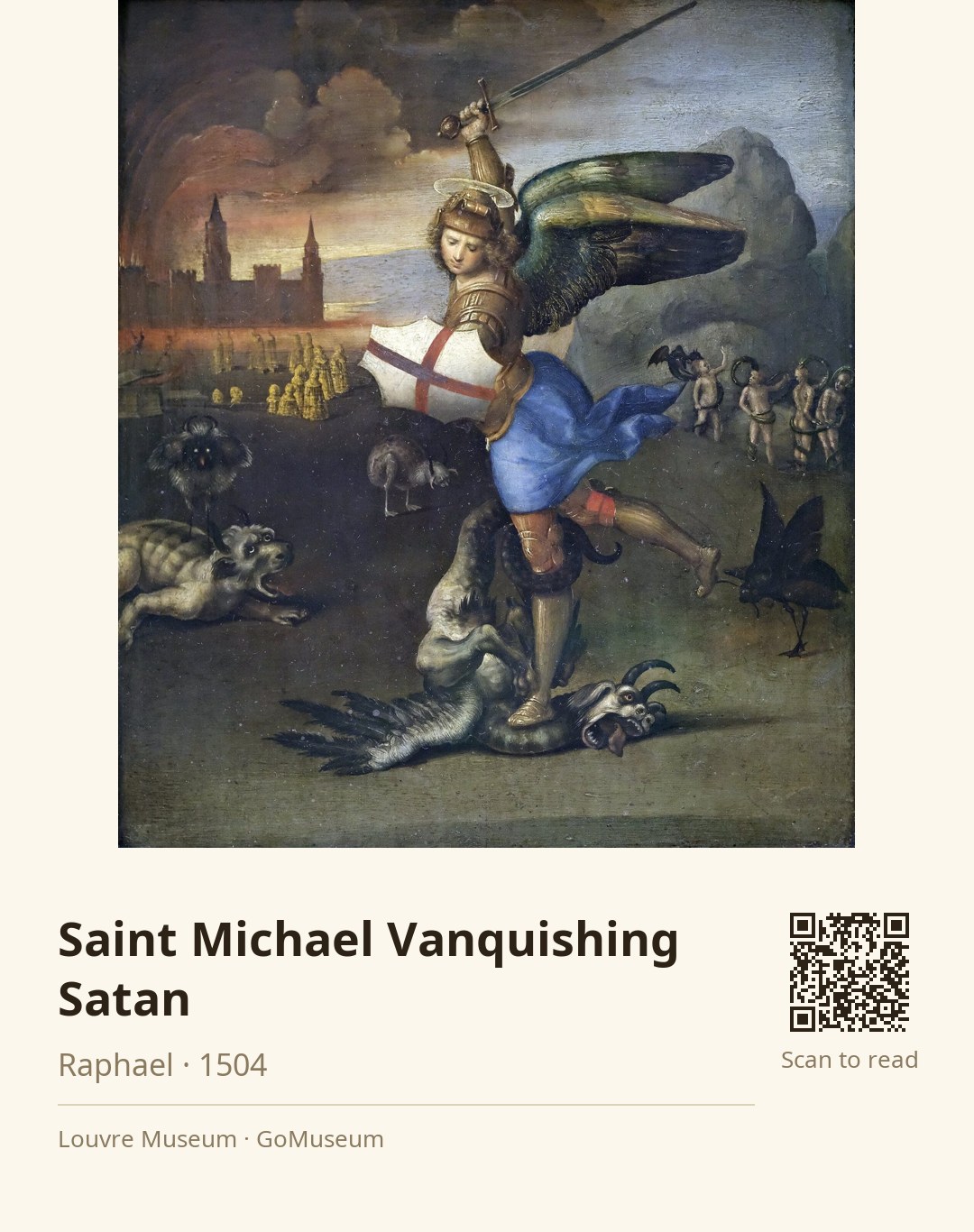
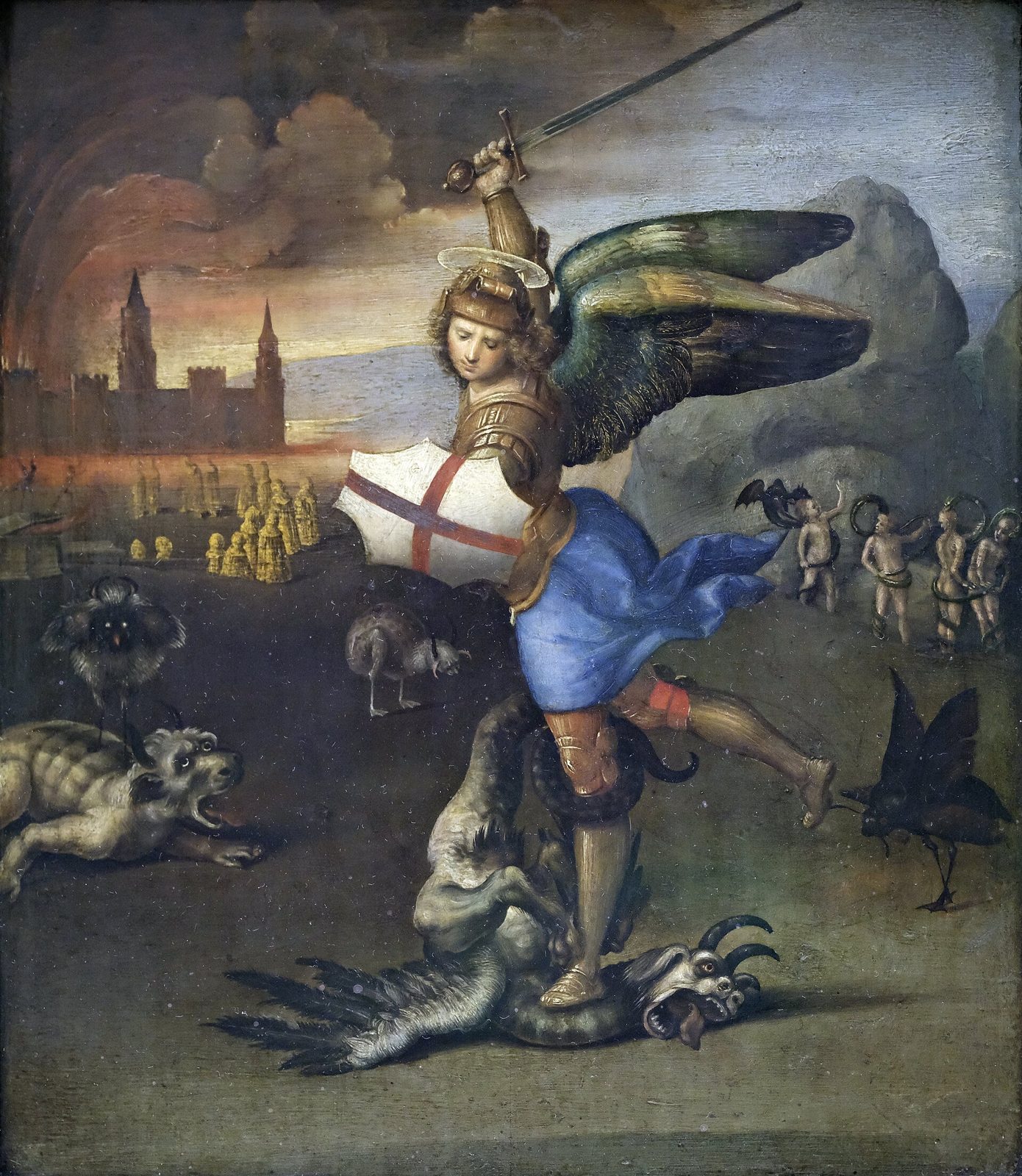
🎧 This work has audio narration — listen in the appTake a moment to really look at Raphael's "Saint Michael Vanquishing Satan." Notice how the Archangel Michael stands defiantly, poised to strike, his sword raised high above the writhing figure of Satan beneath him. The tension in his body, balanced on one leg, captures the very essence of battle, doesn’t it?
Now, focus on the intricate details of Michael’s armor and the vibrant green of his wings, which shimmer with a golden tint. These choices aren’t just for show; they symbolize divine strength and purity, contrasting sharply with the dark, chaotic background filled with tormented souls. This isn’t just a fight; it’s a representation of good triumphing over evil, a theme that resonates deeply in both art and life.
Created in 1504 for the Duke of Urbino, this painting reflects Raphael's early mastery and his connection to the cultural currents of his time, possibly influenced by Dante’s vivid descriptions of hell.
As you stand here, consider what battles you face in your own life. How does the image of Michael inspire you to confront your own challenges?
Raffaello Sanzio da Urbino, known as Raphael, was an Italian painter and architect of the High Renaissance, born in Urbino in 1483. Orphaned by age eleven, he managed his family's workshop and trained under Pietro Perugino, establishing himself as a master by 1500. His move to Rome in 1508 marked the beginning of a prolific period, where he received significant commissions, including the renowned frescoes in the Vatican's Raphael Rooms. His art is celebrated for its clarity, harmonious composition, and embodiment of Neoplatonic ideals. Raphael's influence was profound, shaping the trajectory of Western art and serving as a model for academies until the 19th century. His legacy, characterized by serenity and grace, was later revived in the 18th and 19th centuries, contrasting with the dramatic styles of his rival Michelangelo. Despite his early death at 37, Raphael's extensive body of work and innovative techniques left an indelible mark on the art world, influencing generations of artists and extending into contemporary culture.
Raphael's 'Saint Michael Vanquishing Satan' was created in 1504 for Guidobaldo da Montefeltro, the Duke of Urbino. This piece was likely commissioned to express gratitude to King Louis XII of France for bestowing the Order of Saint Michael upon Francesco Maria I della Rovere, the Duke's nephew. The painting was originally executed on the back of a draughtboard, showcasing its unique origins. By 1548, it was already hanging in the Palace of Fontainebleau, indicating its early recognition. Interestingly, art historian Julia Cartwright suggested that Raphael's work may reflect the influence of Timoteo Viti, particularly in the gold tinting of Michael's wings. The tormented souls in the background hint at Raphael's engagement with Dante's 'Inferno,' depicting punishments that resonate with Dante's vivid imagery. Just over a decade later, Raphael would revisit this theme with a larger work for Pope Leo X, further cementing his exploration of martial subjects.
In 'Saint Michael Vanquishing Satan,' Raphael employs a dynamic composition that draws the viewer's eye to the central figure of Michael, poised in a dramatic stance. The brushwork is vigorous, especially in the swirling forms of the demons and the chaotic background, creating a palpable tension. Notice how the vibrant green of Michael's wings, highlighted with gold, contrasts against the dark, hellish landscape. This choice not only enhances Michael's divine presence but also serves to symbolize purity and strength. The use of light is masterful; it illuminates Michael while casting shadows over the suffering souls, emphasizing the battle between good and evil. The painting's scale, though modest, is packed with detail, inviting you to explore the intricacies of the figures and their expressions, which reflect a range of emotions from defiance to despair.
Just over a decade after creating this piece, Raphael revisited the theme of Saint Michael in a larger work for Pope Leo X, indicating that this early exploration laid the groundwork for his continued engagement with martial subjects.
The painting was likely commissioned to express gratitude to King Louis XII of France for bestowing the Order of Saint Michael upon Francesco Maria I della Rovere, the Duke's nephew, highlighting its political and social significance.