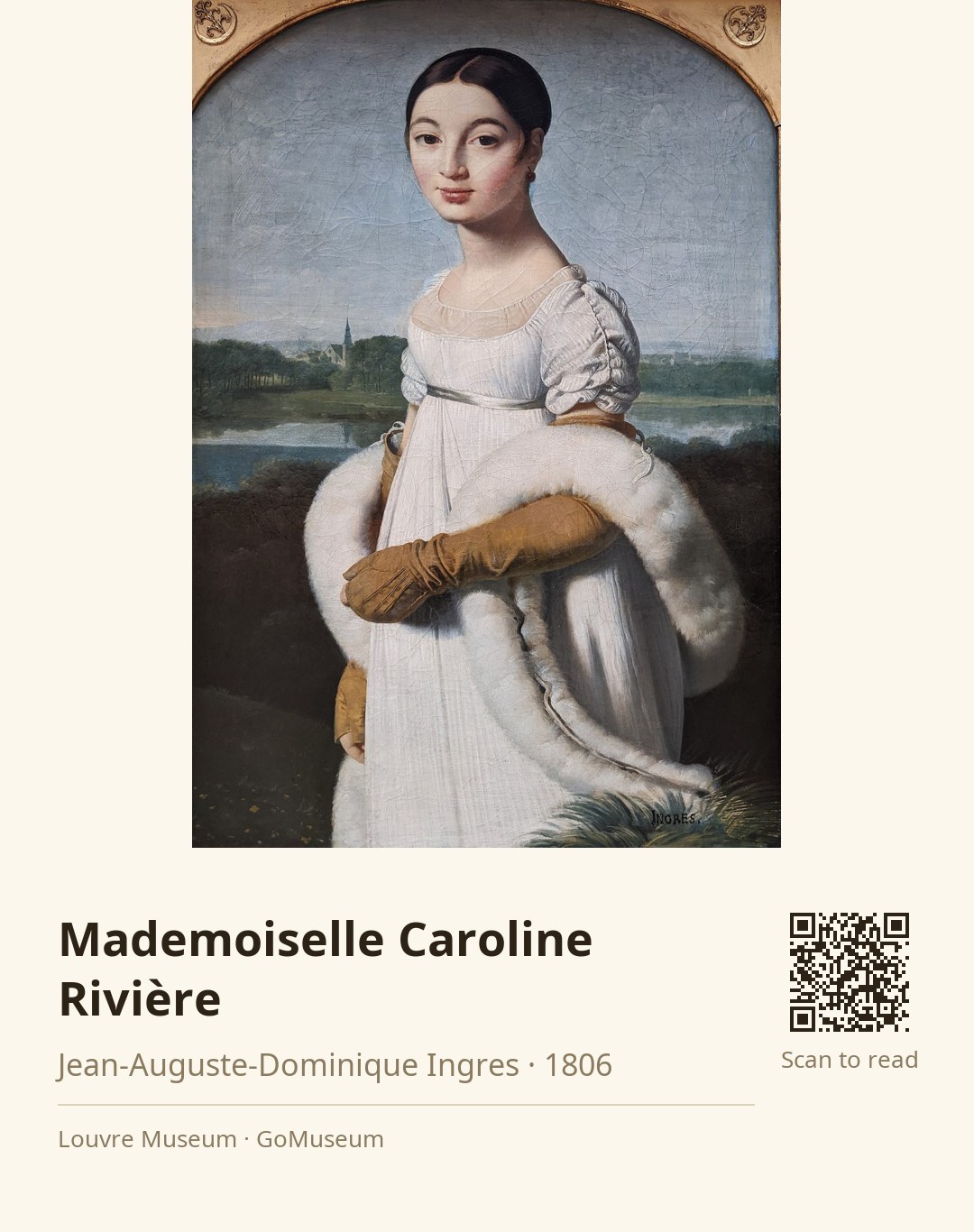
Mademoiselle Caroline Rivière
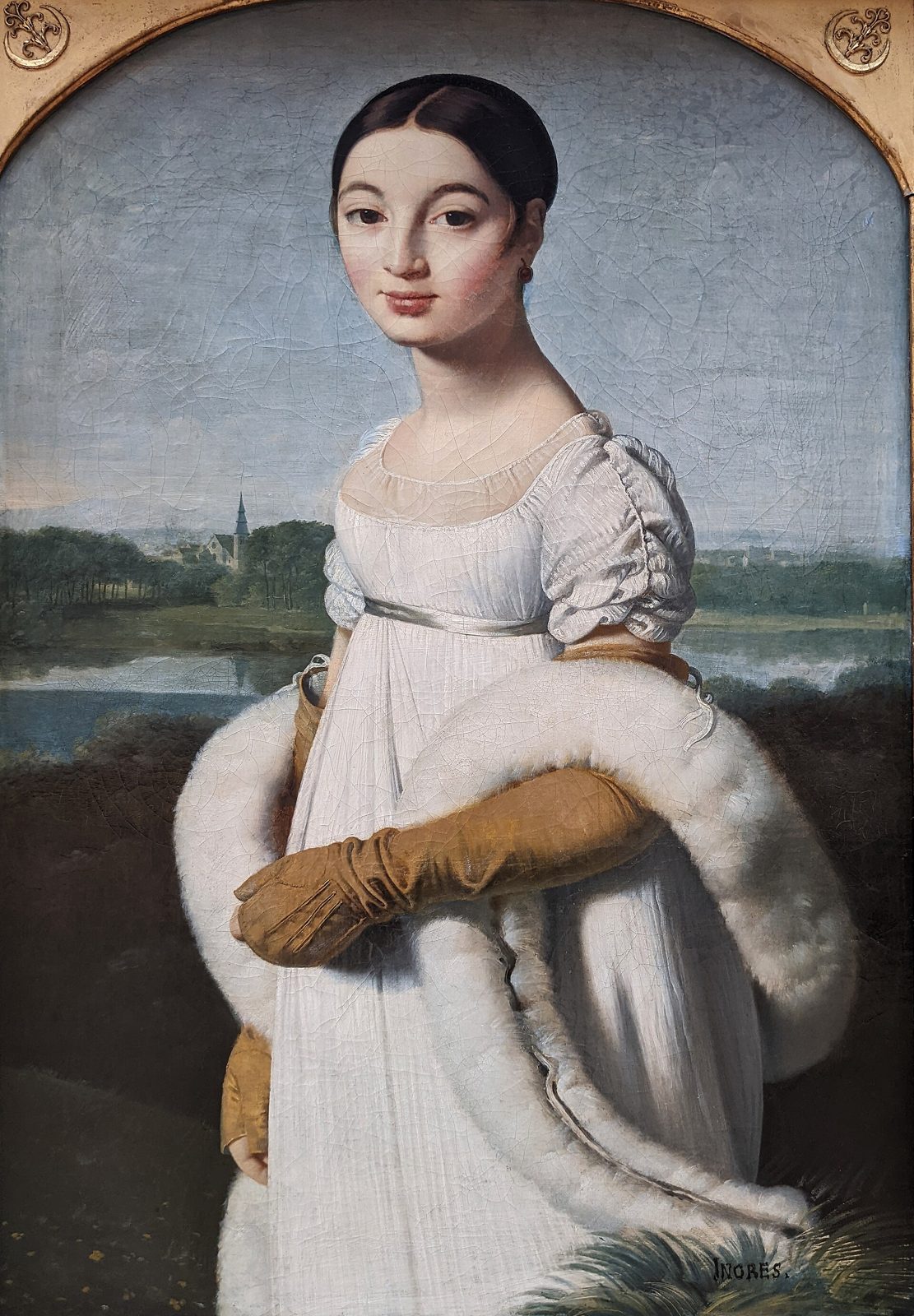
🎧 This work has audio narration — listen in the appTake a moment to really look at Mademoiselle Caroline Rivière. Notice how her delicate figure stands out against that serene white-blue landscape. The way Ingres has painted her dress, pure and bright, almost glows, drawing your eye to her youthful innocence.
Now, focus on her elongated neck and the slight awkwardness in her pose. These details aren’t just stylistic choices; they capture the essence of her youth and the hesitance that often accompanies it.
This painting was created in 1806, during a time when Ingres was still establishing his reputation, primarily through commissions from wealthy patrons like Caroline’s father, a court official under Napoleon. Critics at the time found it too “Gothic” and reminiscent of earlier styles, but today, it’s celebrated as a high point in his career, bridging the gap between figurative and landscape art.
As you stand here, think about the fleeting nature of youth and beauty. What emotions does this portrait stir in you?
Jean-Auguste-Dominique Ingres was a pivotal figure in French Neoclassicism, born on August 29, 1780, in Montauban. He was the son of a versatile artist, which nurtured his early artistic inclinations. Ingres studied under Jacques-Louis David in Paris, where he developed a commitment to academic traditions, aspiring to elevate history painting above all genres. His early career was marked by struggles, as critics dismissed his style as archaic, yet he persevered, achieving recognition with works like "The Vow of Louis XIII" in 1824.
His portraits, characterized by expressive distortions, became his most celebrated contributions, influencing modern artists such as Matisse and Picasso. Ingres's time in Italy, from 1806 to 1824, was crucial; he immersed himself in the study of Renaissance masters, which shaped his distinctive style. Despite facing criticism for his meticulous approach, he remained steadfast in his vision of beauty, emphasizing drawing over color.
Later in life, he returned to Paris, where he continued to create significant works, including "The Turkish Bath." Ingres's legacy endures as a bridge between classical traditions and modern art, embodying the tension between adherence to established norms and the evolving landscape of artistic expression. He passed away on January 14, 1867, leaving behind a profound impact on the art world.
In 1806, Jean-Auguste-Dominique Ingres painted the portrait of Mademoiselle Caroline Rivière, commissioned by her father, Philibert Rivière, a prominent court official under Napoleon. This was the third and final portrait of the Rivière family that Ingres created that year, alongside those of Caroline's mother and father. The painting was exhibited at the Salon of 1806, where it faced criticism for its perceived Gothic style and resemblance to the Early Netherlandish painters, who were just beginning to be appreciated again. Critics noted the precision of line and the enamel-like finish, which they found archaic. Despite the lukewarm reception at the time, the portrait has since been recognized as a significant work in Ingres's career, showcasing his transition from a focus on historical subjects to a more emotional portrayal of individuals. Tragically, Caroline passed away just a year after the portrait was completed, adding a layer of poignancy to the work. Today, it resides in the Louvre, having been bequeathed there in 1870 by Caroline's sister-in-law.
Take a closer look at Ingres's technique in this portrait. The brushwork is meticulous, with each stroke contributing to the crisp silhouette of Caroline against the soft, serene background. Notice how the colors play a vital role; the bright hues of her dress contrast beautifully with the muted white-blue landscape, creating a sense of freshness that mirrors her youth. The composition is structured yet fluid, with the shallow perspective of the background enhancing the feeling of depth without overwhelming the figure. Ingres's choice to elongate Caroline's neck and emphasize her delicate features speaks to his desire to capture an idealized beauty, even if it sacrifices anatomical accuracy. The slight awkwardness in her pose adds a layer of vulnerability, suggesting the hesitance of youth. This blend of precision and emotional nuance is what makes the painting resonate so deeply, drawing viewers into Caroline's world.
Interestingly, during a 2013 exhibition at the Louvre, Mademoiselle Caroline Rivière was reimagined in the style of pop icon Lady Gaga, showcasing the painting's enduring influence and its ability to resonate across different cultural contexts. This modern twist highlights how Ingres's work continues to inspire and provoke thought, even centuries after it was created.
When Mademoiselle Caroline Rivière was first exhibited at the Salon of 1806, it faced criticism for its perceived Gothic style and resemblance to Early Netherlandish painters, which some found archaic and unappealing.
At the time he painted Caroline's portrait, Ingres was still establishing his career and was heavily reliant on commissions from wealthy patrons, which included Caroline's father, Philibert Rivière, reflecting the social dynamics of art patronage in that era.
The shallow perspective of the serene white-blue landscape behind Caroline not only enhances the crisp silhouette of her figure but also evokes a sense of tranquility that contrasts with the poignant reality of her untimely death just a year later.