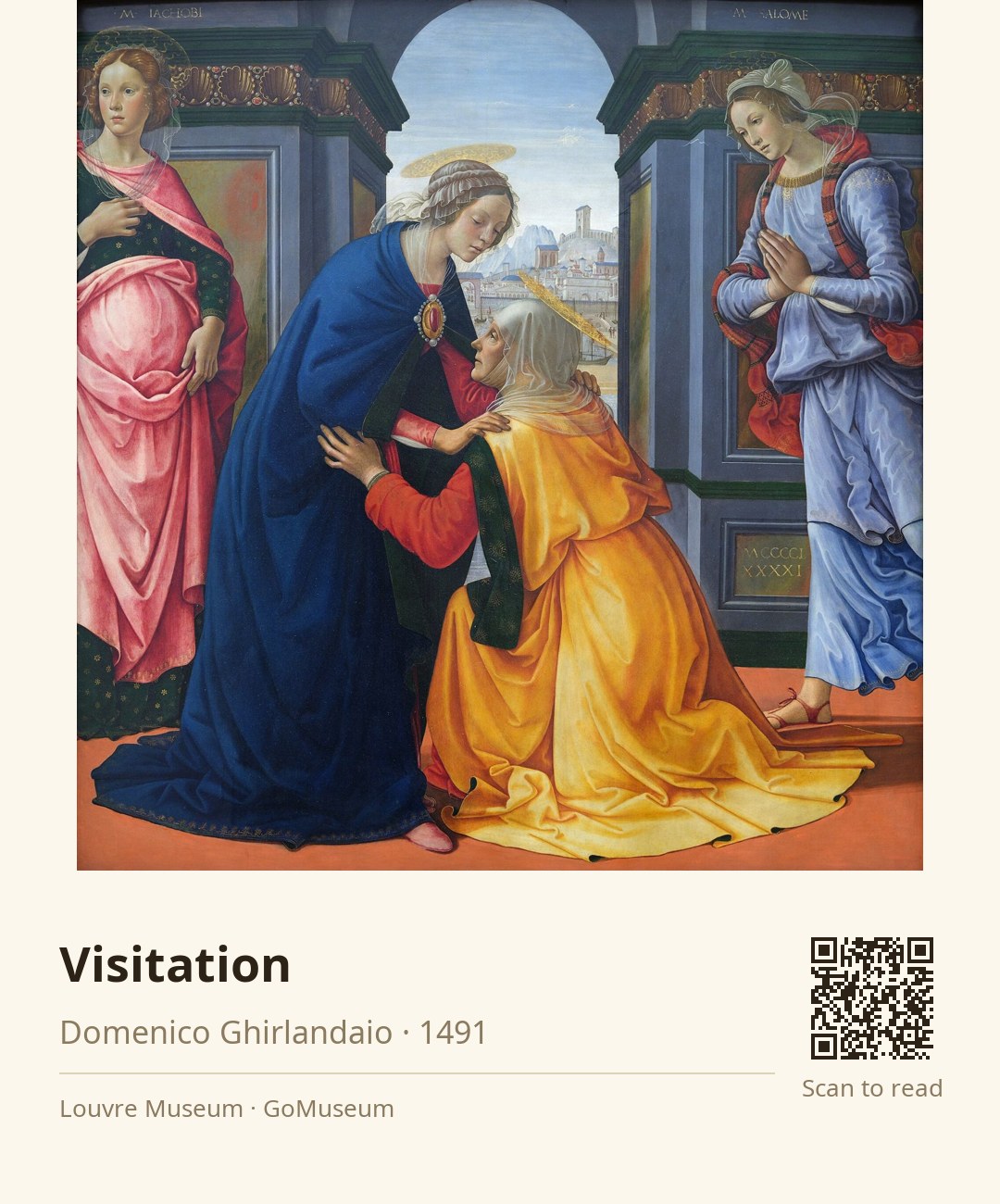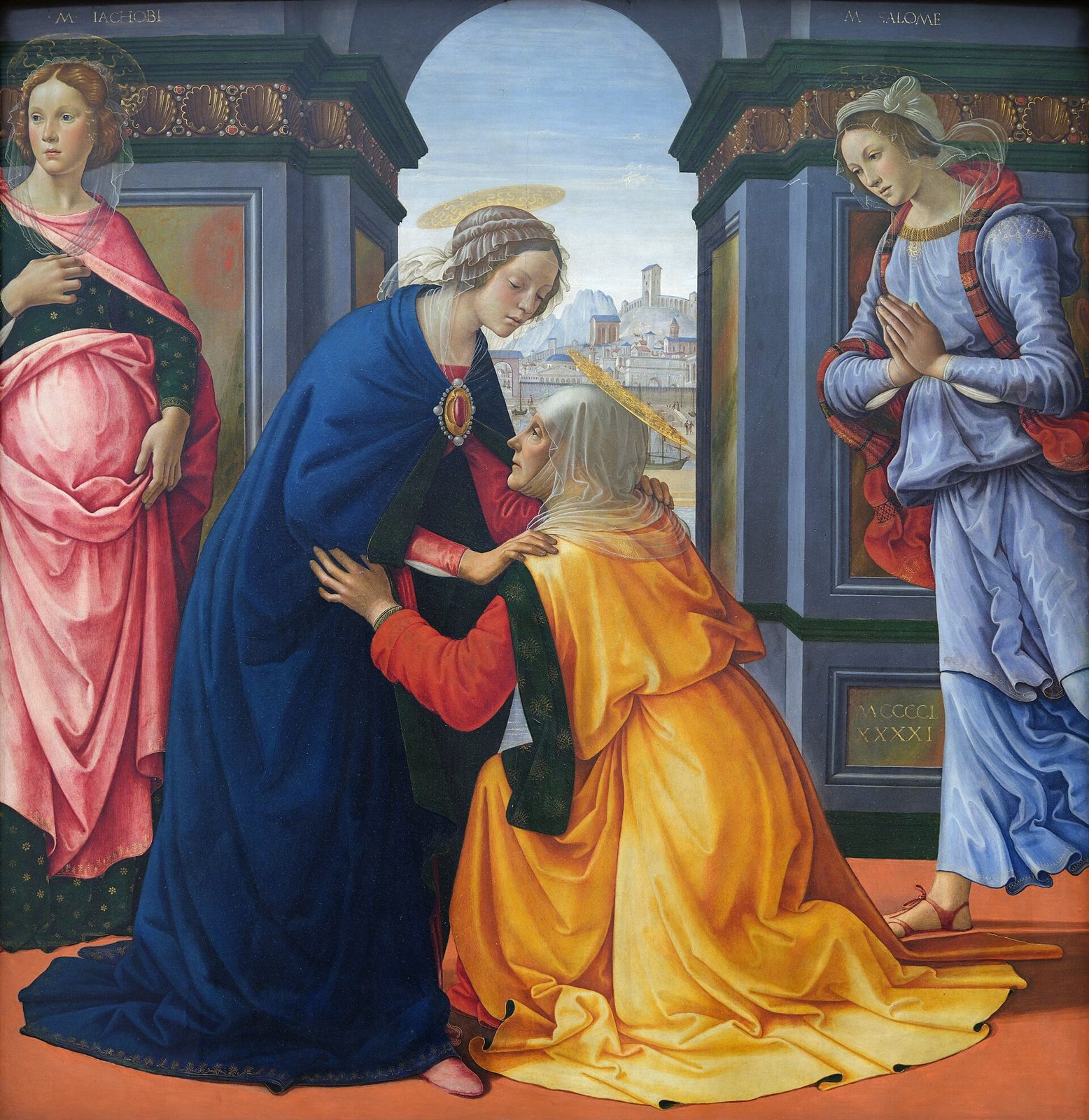
Take a moment to really soak in the scene before you in Ghirlandaio’s "Visitation." Notice how Elizabeth, draped in that striking yellow vest, kneels in reverence to Mary, who stands gracefully with her light veil. It’s a moment of connection captured in time, isn’t it?
What’s fascinating here is the way Ghirlandaio plays with light—look closely at how it dances across their garments, reflecting the artist's deep study of light effects from Flemish works. This isn’t just about aesthetics; it symbolizes the divine presence in their meeting, illuminating their sacred bond.
The two women flanking Mary—Mary of James and Mary Salome—are not just bystanders; they represent the community of women who stood by Mary during her journey, especially during the crucifixion, hinting at the trials to come.
As you stand here, think about the emotions this moment evokes. What do you feel when you see these two women connecting? What stories do you think their expressions might tell?
Domenico Ghirlandaio, born on June 2, 1448, in Florence, was a prominent Italian Renaissance painter known for his frescoes and portraits that captured the essence of contemporary life. As the eldest of six children in a family of silk merchants, he initially trained as a goldsmith under his father before shifting to painting. His nickname, "Ghirlandaio," derived from his father's craft of creating garlands, reflects his early artistic inclinations.
Ghirlandaio established a successful workshop that included notable apprentices like Michelangelo and his own brothers. His ability to blend religious narratives with the likenesses of contemporary figures earned him significant commissions, including frescoes in the Sistine Chapel and the Sassetti Chapel. His works are characterized by meticulous detail and vibrant storytelling, showcasing his mastery of perspective and composition.
Ghirlandaio's legacy lies in his role as a key figure in the Florentine Renaissance, influencing future generations of artists. He passed away on January 11, 1494, but his contributions to art, particularly in fresco painting, continue to be celebrated today.
Domenico Ghirlandaio's 'Visitation' was commissioned in 1491 by Lorenzo Tornabuoni for the church of Santa Maria Maddalena de' Pazzi in Florence. This painting captures a pivotal moment from the Gospel of Luke, where Mary visits her cousin Elizabeth. After its completion, the painting found its home in the Louvre Museum, Paris, where it has remained since 1812.
As you gaze at 'Visitation,' pay attention to Ghirlandaio's masterful brushwork. The way he layers paint creates a rich texture, especially in the garments of Mary and Elizabeth. Notice the light—it's not just illuminating the figures but also reflecting their emotional states. The classical arch in the background frames the scene, drawing your eye to the interaction between the two women. The use of color is striking; the vibrant yellow of Elizabeth's vest contrasts beautifully with Mary's soft veil, symbolizing their unique roles. Ghirlandaio's attention to detail, like the pearls and shells on the frieze, adds depth, inviting you to explore the painting's narrative layers. The composition feels balanced yet dynamic, with the figures arranged to create a sense of movement and connection.
Did you know that Ghirlandaio's 'Visitation' was commissioned by Lorenzo Tornabuoni, a prominent figure in Florence? Tornabuoni was not just a patron; he was part of the powerful Medici family network. This painting was intended for a chapel that would later become known as Santa Maria Maddalena de' Pazzi. The choice of subject—the meeting of Mary and Elizabeth—was deeply significant, reflecting the importance of familial connections and divine motherhood in Renaissance culture. It’s fascinating to think how this artwork was not only a religious statement but also a social one, connecting the Tornabuoni family to the sacred narratives of their time.
The frieze is decorated with pearls and shells, which are symbolic allusions to Mary's purity, adding a layer of meaning to the overall composition.
Although these women are not present in the Gospel's Visitation account, their inclusion hints at their future roles during the crucifixion, emphasizing the theme of support and community among women in pivotal moments.