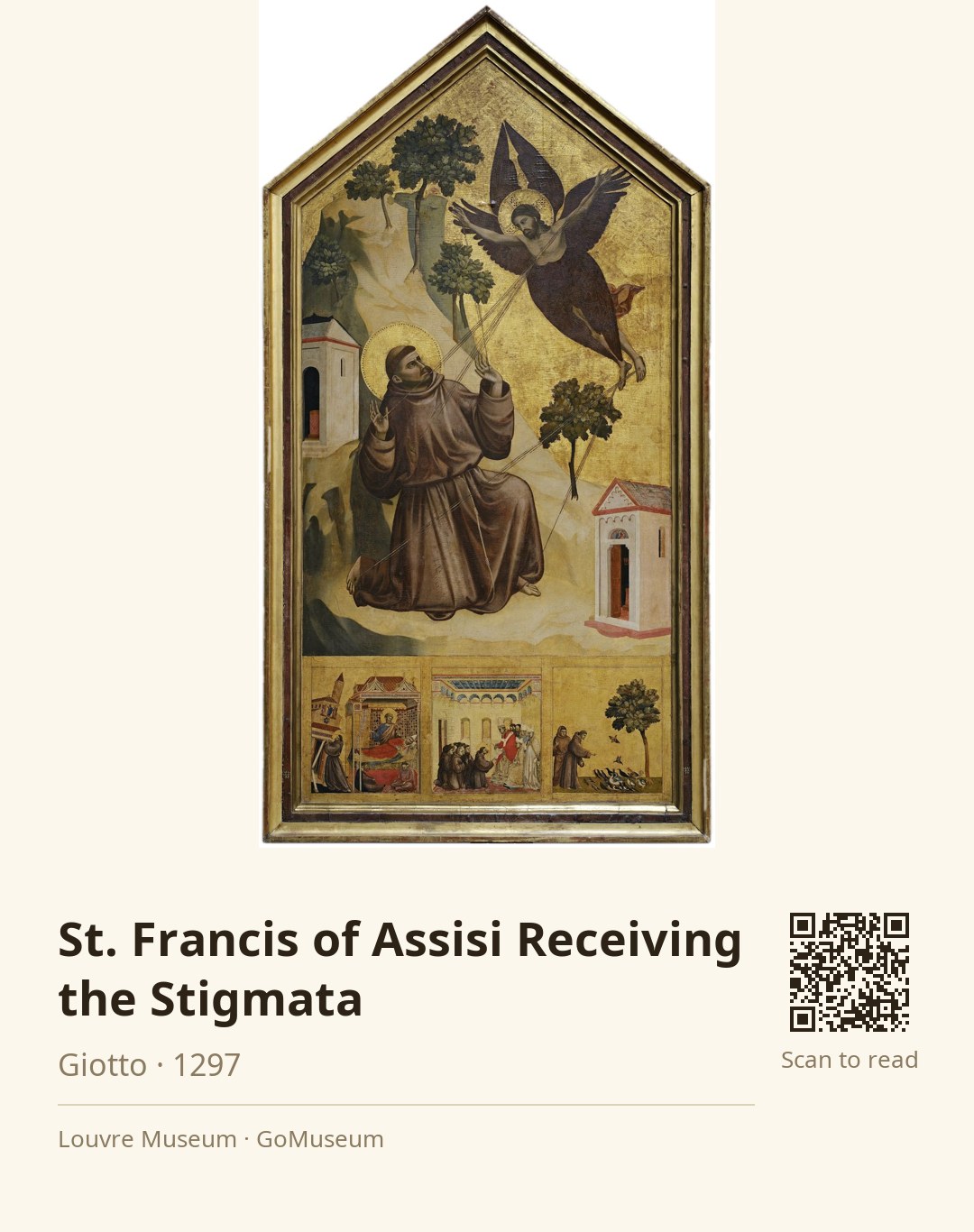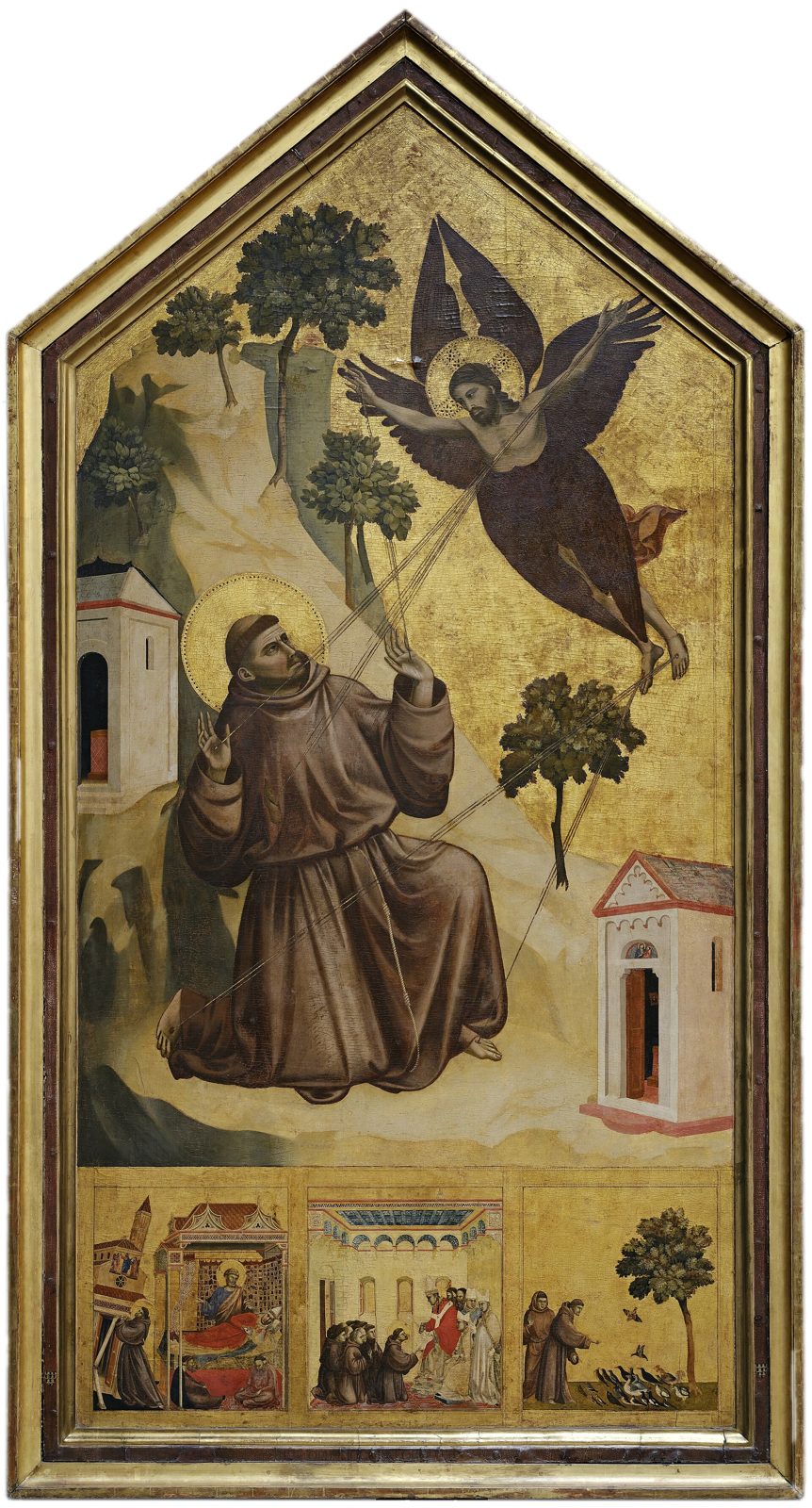
St. Francis of Assisi Receiving the Stigmata
🎧 This work has audio narration — listen in the appTake a moment to really look at Giotto's "St. Francis of Assisi Receiving the Stigmata." Notice how St. Francis is depicted in a moment of profound spiritual intensity, his face illuminated by a striking interplay of light and shadow. The golden background enhances this divine encounter, making it feel almost otherworldly.
Now, focus on the details of his expression and posture. Giotto captures not just the physical act of receiving the stigmata, but the emotional weight of the moment. This was revolutionary for its time, moving away from the flat, expressionless figures of Byzantine art to portray a scene filled with genuine emotion and action.
He was one of the first to break free from the rigid styles of the past, paving the way for the more humanistic approach of the Renaissance.
As you stand here, think about the impact of this moment on the viewer. How does it make you feel? What thoughts does it provoke about faith and sacrifice? Giotto invites us to connect with St. Francis not just as a saint, but as a deeply human figure experiencing a transformative moment.
Giotto di Bondone, born around 1267 in Florence, was a pivotal Italian painter and architect whose work marked the transition from the Gothic to the Proto-Renaissance. Renowned for his lifelike figures and innovative use of space, Giotto broke away from the Byzantine style, laying the groundwork for modern painting. His most celebrated achievement, the frescoes in the Scrovegni Chapel in Padua, completed around 1305, depict the Life of the Virgin and Christ, showcasing his mastery of narrative and emotion.
Giotto's early life was characterized by humble beginnings; he was discovered by the painter Cimabue while drawing sheep on a rock. This encounter led to his apprenticeship and a lifelong dedication to art. His personality was described as merry and intelligent, traits that endeared him to many. Giotto's influence extended beyond his lifetime, inspiring generations of artists and giving rise to "Giottesque" schools of painting.
Despite the controversies surrounding his biography, including debates over his birthplace and training, Giotto's legacy as a master of early Renaissance art remains undisputed. His innovative techniques and humanistic approach to subjects helped redefine the role of the artist, positioning him as a central figure in art history.
Francis of Assisi Receiving the Stigmata' was painted around 1297 for the Church of Saint Francis in Pisa, a significant commission reflecting the Franciscan order's growing influence. Giorgio Vasari, the Renaissance art historian, noted its presence in the transept chapel of the church, highlighting its importance even in the 16th century. The work was signed, affirming its attribution to Giotto, and it showcases a pivotal moment in art history as it marks a departure from the rigid Byzantine style. In 1813, during the Napoleonic looting of Italy, the painting was taken to the Louvre, where it remains today. Despite some initial controversy over its attribution, it is now widely accepted as a masterpiece of Giotto, who was instrumental in ushering in a new era of humanistic representation in art.
As you gaze at the painting, notice how Giotto employs a striking use of chiaroscuro, the contrast of light and shadow, to breathe life into St. Francis's face. This technique not only emphasizes his emotional intensity but also creates a sense of three-dimensionality that was revolutionary for its time. The composition is carefully structured, with St. Francis positioned centrally against a shimmering gold background that enhances the divine nature of the scene. The triangular cusp at the top draws your eye upward, reinforcing the spiritual ascent of the saint. The landscape, while somewhat generic, shows Giotto's early attempts at perspective, hinting at the depth that would later flourish in Renaissance art. The brushwork feels both deliberate and fluid, capturing the moment of action as St. Francis receives the stigmata, a departure from the static figures of earlier traditions.
Francis of Assisi Receiving the Stigmata' marks a pivotal moment in art history, signaling a shift from the rigid, formulaic styles of the Byzantine tradition to a more human-centered approach. This painting not only captures a dramatic moment of divine encounter but also showcases Giotto's innovative use of chiaroscuro, giving depth and emotion to his figures. His work inspired countless artists, laying the groundwork for the Renaissance by emphasizing realism and emotional expression. It's a testament to how art can evolve, reflecting the changing perspectives of humanity's place in the universe.
Francis of Assisi Receiving the Stigmata' is its journey to the Louvre. After being painted for the Church of Saint Francis in Pisa, the artwork was seized during Napoleon's campaign in Italy. It became part of the Louvre's collection in 1813, but what’s intriguing is how it was one of the few pieces that remained in France after the restitution of artworks. Imagine the conversations it must have sparked among art lovers and historians as it transitioned from a local church to a world-renowned museum!
In the left and right corners of the painting, the heraldry of the Ughi or Cinquini family is visible, suggesting a connection to the patronage of the work and the influence of local families in commissioning art during this period.
The painting was taken to the Louvre in 1813 during the Napoleonic looting of Italy, which highlights the turbulent political climate of the time and the widespread appropriation of art across Europe, particularly from Italy.