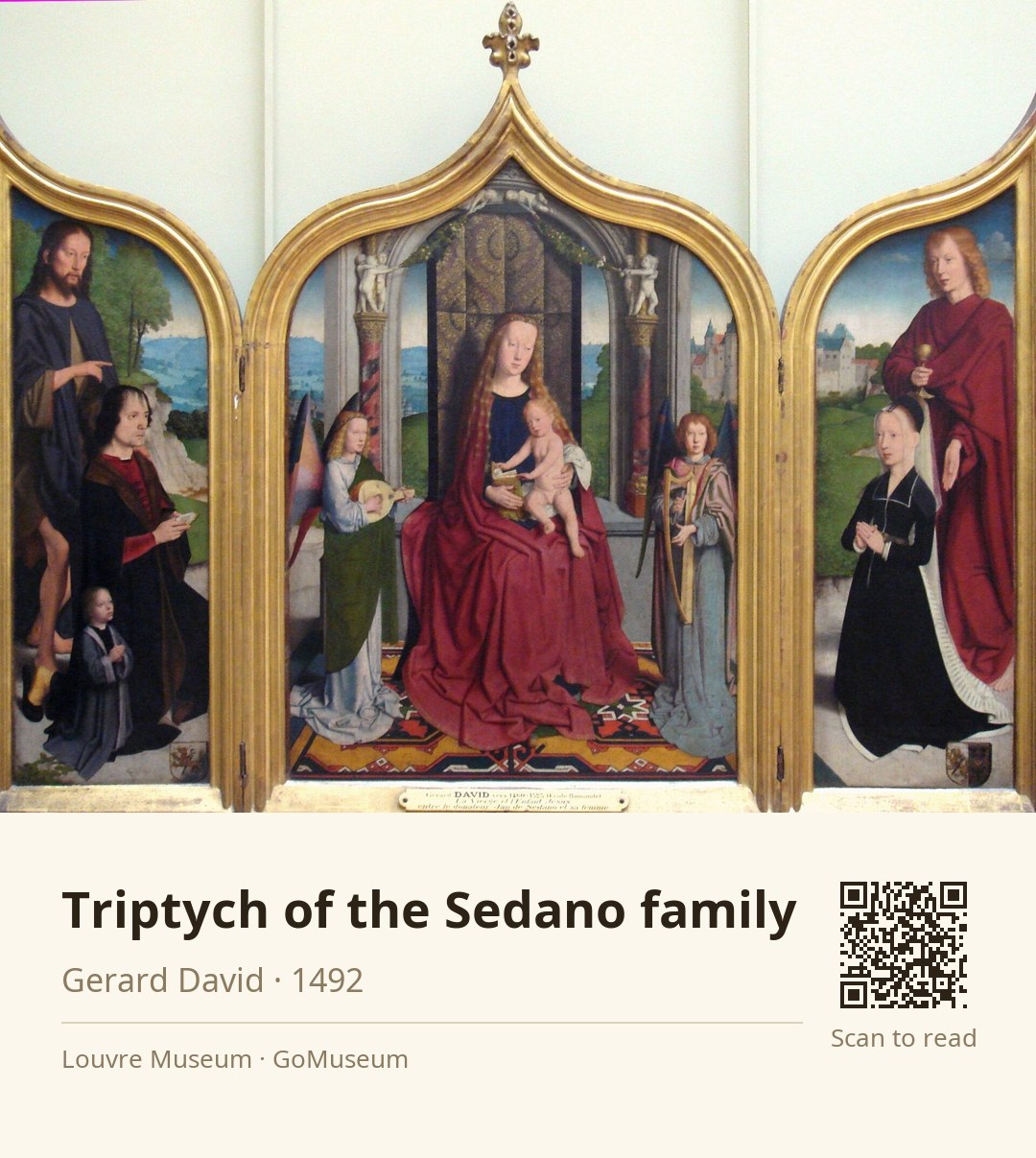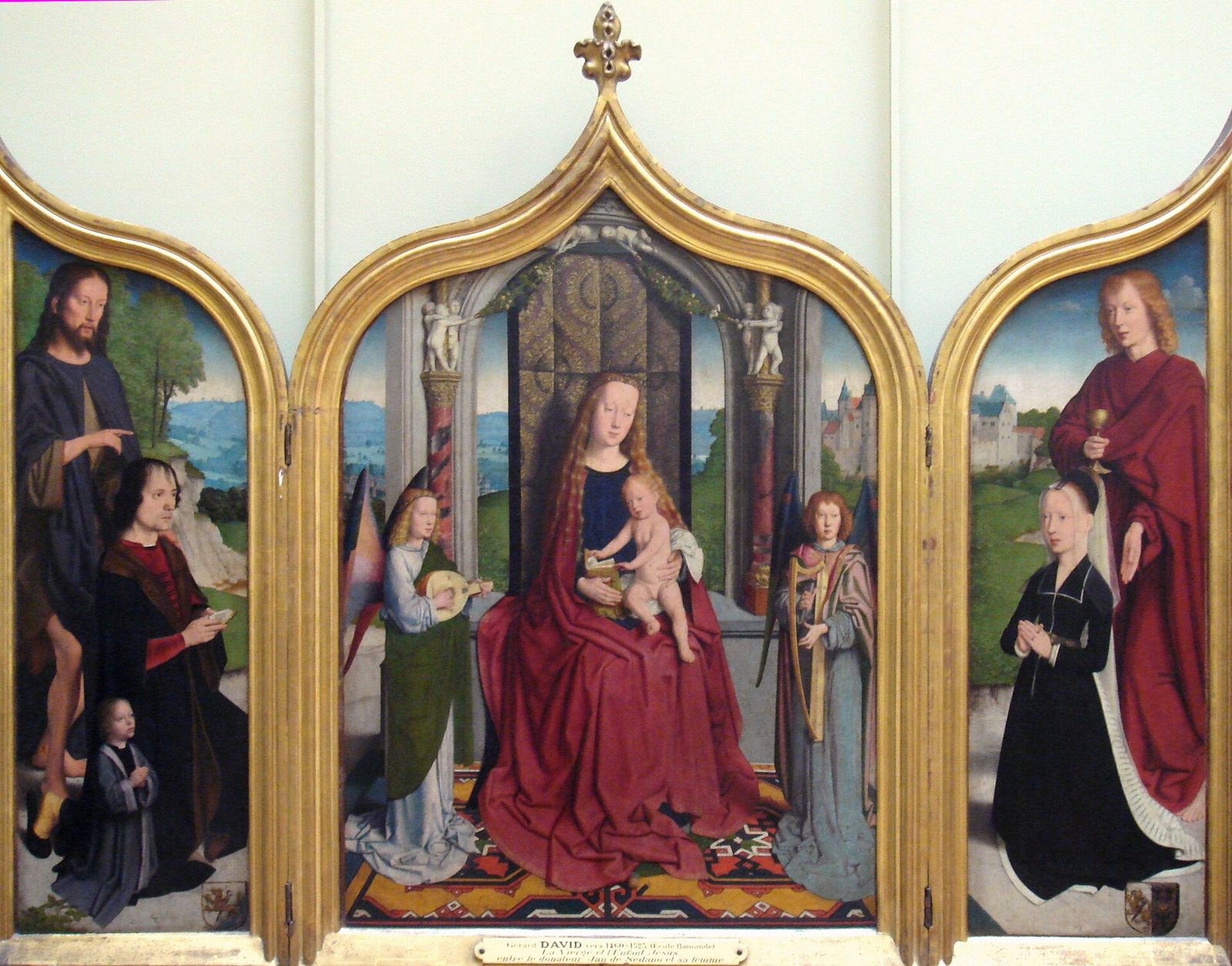
Triptych of the Sedano family
🎧 This work has audio narration — listen in the appTake a moment to really look at the Triptych of the Sedano family. Notice how the Virgin Mary is depicted in a lush, enclosed garden, a symbol of purity and divine grace. Look closely at the intricate oriental carpet beneath her feet; its vibrant colors and patterns draw you into the scene, grounding the heavenly figures in a tactile reality.
These details matter because they reveal Gerard David's masterful ability to blend the sacred with the everyday. The carpet, a luxurious element, not only enhances the richness of the painting but also connects the divine to the material world, inviting viewers to contemplate their own spirituality within their earthly lives.
David was influenced by the great masters of his time, aiming to position himself among them through this intricate composition.
As you stand here, think about the layers of meaning in this artwork. What does the contrast between the serene interior and the sinful exterior, represented by Adam and Eve on the closed wings, say about the human condition? Let that question linger as you take in the beauty of this remarkable piece.
Gerard David, born around 1460 in Oudewater, was a prominent Early Netherlandish painter and manuscript illuminator. His life remains largely undocumented, but he became a master in the Antwerp guild by 1515 and operated workshops in both Antwerp and Bruges. Influenced by the Italian Renaissance during his time in Italy, David developed a distinctive style characterized by vibrant colors and a serene atmosphere, often depicting religious scenes. His works reflect a blend of traditional themes with innovative landscape elements, showcasing his skill in light and shadow.
David rose to prominence after Hans Memling's death in 1494, becoming Bruges' leading painter and guild dean by 1501. His marriage to Cornelia Cnoop, daughter of a goldsmith guild dean, solidified his status in the community. Despite his success, his reputation waned in the 17th century, only to be revived in the 19th century through exhibitions that highlighted his contributions to Flemish art. His best-known works include altarpieces like "The Virgin among the Virgins" and "The Marriage of St Catherine." Today, he is recognized as a master colorist who navigated the transition from medieval to Renaissance art, leaving a lasting impact on the history of painting.
The Triptych of the Sedano family was commissioned by Jean de Sedano, a Castilian merchant, around 1492, during a flourishing period for altarpiece demand in Europe. The triptych was well-received, noted for its intricate details and innovative framing, particularly the lush garden surrounding the Virgin Mary. After changing hands several times, it was acquired by the Louvre in 1890, where it continues to be a highlight of their collection. Art historian Maryan Ainsworth has pointed out that the dense imagery reflects a blend of notable Netherlandish art features, indicating David's response to the artistic trends of his era.
As you gaze at the Triptych, notice the meticulous brushwork that brings life to the figures. David's technique involves layering oil paint, allowing for a rich depth of color and a soft blending that creates an almost ethereal quality. The light in the painting is masterfully handled, casting gentle shadows that enhance the three-dimensionality of the figures. The composition is carefully structured, with the Virgin Mary at the center, flanked by saints and donors, creating a harmonious balance. The vibrant oriental carpet beneath Mary's feet is not just decorative; it draws the eye and anchors the heavenly scene in a tactile reality. This interplay of color and form invites you to linger, to feel the serenity and the weight of the sacred space.
Its intricate design and rich color palette not only reflect David's mastery but also his ambition to align himself with the greats like Jan van Eyck and Hans Memling. This triptych was created during a period of heightened demand for such works across Europe, marking a transition in religious art that combined personal devotion with elaborate artistry. Its innovative framing and the detailed rendering of the oriental carpet beneath Mary’s feet exemplify a shift towards more decorative and narrative depth in altarpieces. Remember, this work is not just a family portrait; it’s a statement of artistic identity and a bridge between medieval traditions and the emerging Renaissance sensibilities.
Interestingly, Jean de Sedano, the patron of this triptych, was not only a merchant but also a member of the Confraternity of the Holy Blood, a sect dedicated to the veneration of a relic from Jerusalem. This connection adds a layer of personal devotion to the artwork, as it was created for someone deeply engaged in the spiritual practices of the time.
The oriental carpet beneath the Virgin Mary's feet not only adds a luxurious element to the scene but also symbolizes the connection between the divine and the earthly, grounding the heavenly figures in a tactile reality that invites viewers to engage with the artwork on a personal level.
David's style evolved significantly after 1500, incorporating more subtle modeling, delicate contours, and chiaroscuro effects, reflecting influences from the Italian Renaissance and showcasing his technical mastery in later works.