Aurora and Cephalus
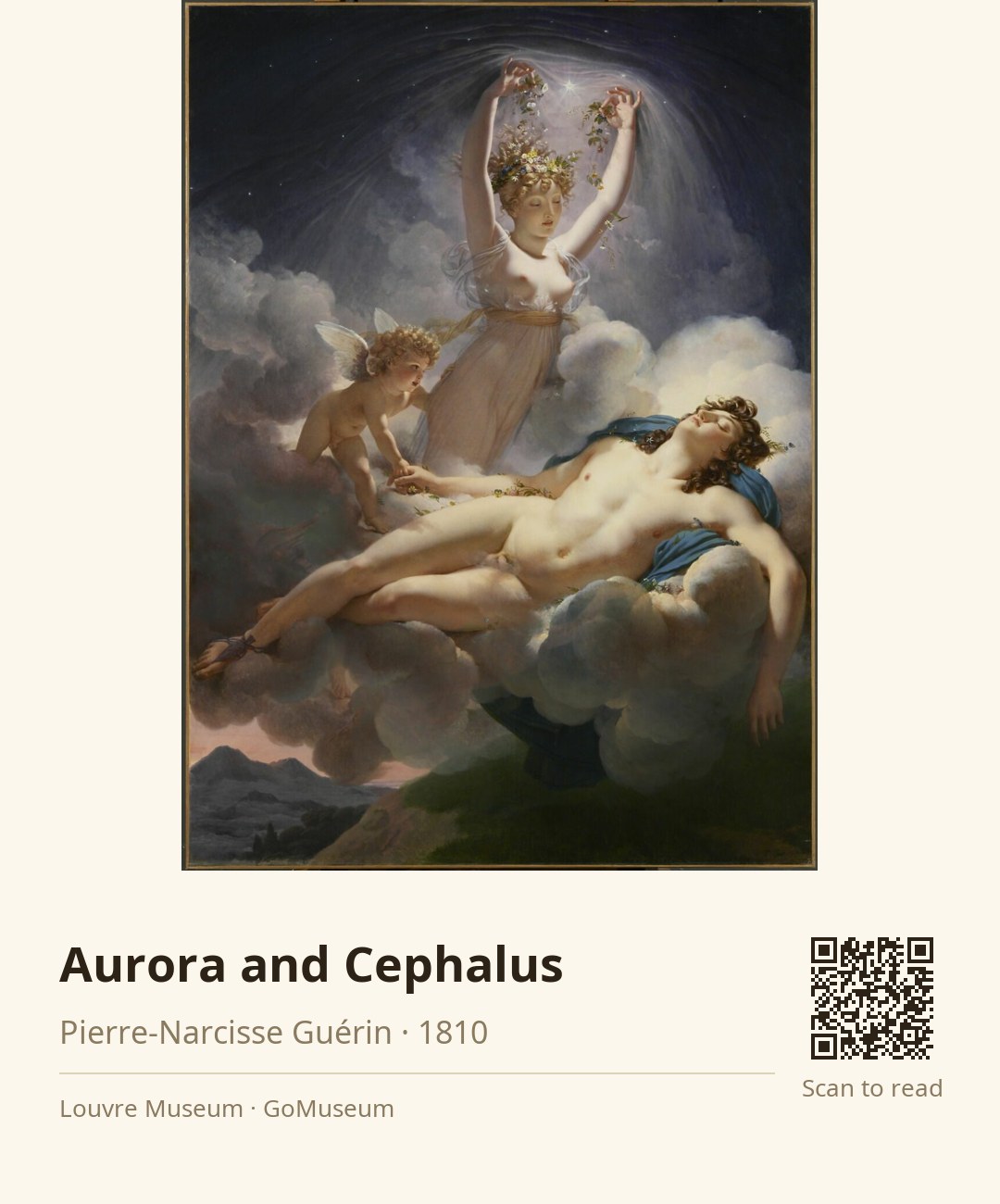
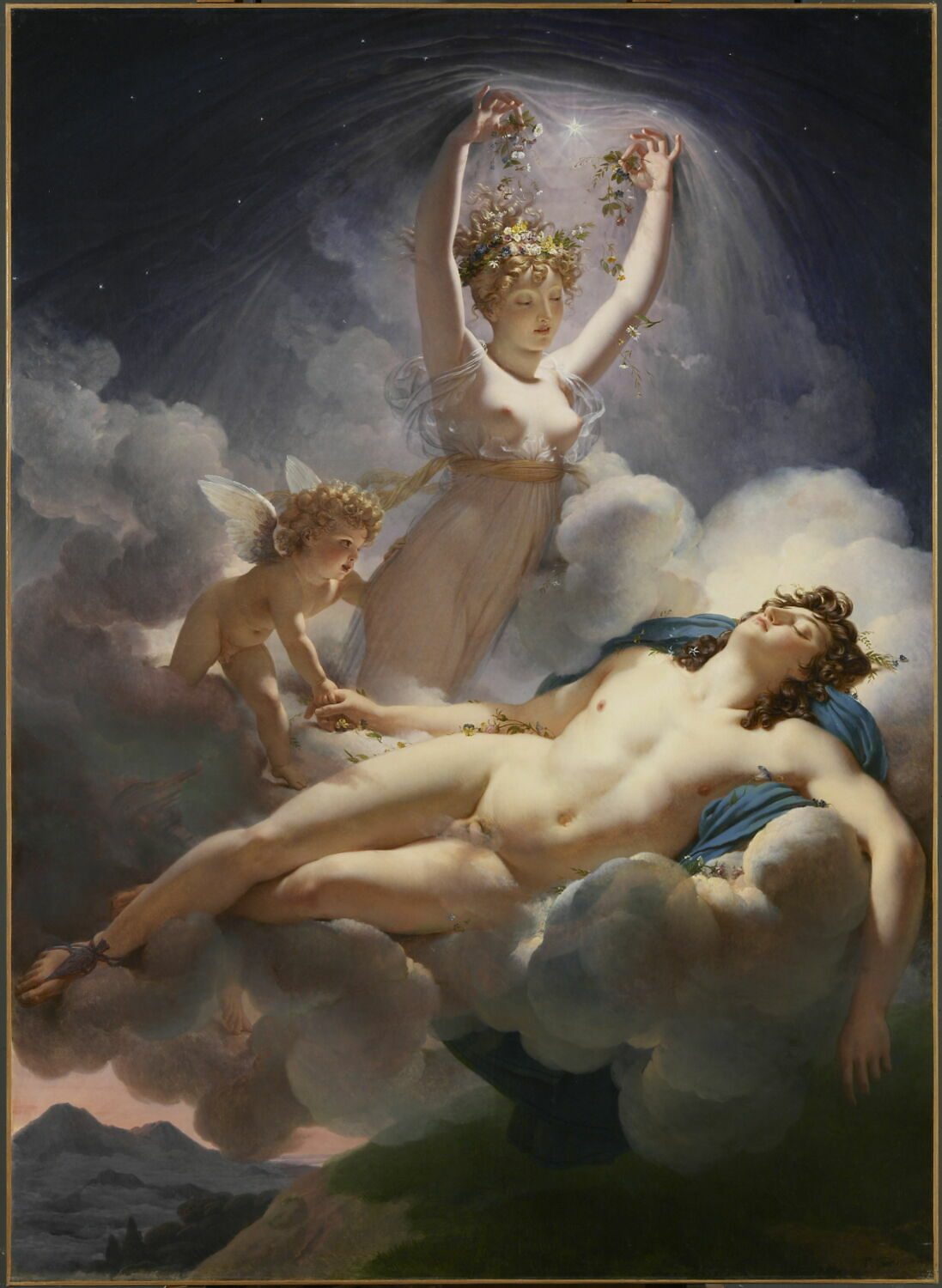
🎧 This work has audio narration — listen in the appTake a moment to gaze at the enchanting scene before you in "Aurora and Cephalus." Notice how Aurora, the goddess of dawn, raises her arms, lifting a veil of stars that symbolizes the night. Her delicate, transparent dress flows around her, revealing her form as she showers flowers over the sleeping Cephalus, who rests on a cloud.
These details are not just for show; they capture a moment of divine seduction and longing, a theme that resonates deeply in classical mythology. Aurora's act of unveiling the dawn signifies new beginnings, while the flowers symbolize beauty and love, hinting at the complex emotions entwined in their story.
Created in 1810 by Pierre-Narcisse Guérin, this painting draws from Ovid's "Metamorphoses," where Aurora's passion leads to both enchantment and turmoil. Guérin's style, marked by melodrama, reflects the romantic ideals of his time, making this piece a captivating blend of myth and emotion.
As you stand here, think about the timeless nature of love and desire. What stories do you see unfolding in this moment?
Pierre-Narcisse Guérin, born on March 13, 1774, in Paris, was a prominent French neoclassical painter whose career flourished during the tumultuous periods of the French Revolution and the Napoleonic era. As a pupil of Jean-Baptiste Regnault, Guérin won the prestigious grand prix de Rome in 1796, which propelled him into the artistic limelight. His early work, "The Return of Marcus Sextus," exhibited in 1799, resonated deeply with audiences, reflecting the emotional turmoil of the time.
Guérin's style evolved to meet the tastes of the First Empire, characterized by dramatic and dignified compositions. His notable works include "Phaedra and Hippolytus" and "Andromache and Pyrrhus," both of which garnered significant acclaim. He became a respected figure in the art community, receiving the Legion of Honour and later being appointed to the Académie des Beaux-Arts.
Despite health challenges that hindered his later work, Guérin's influence extended through his pupils, including notable artists like Eugène Delacroix and Théodore Géricault. He served as the director of the French Academy in Rome and continued to impact the art world until his death on July 6, 1833. Guérin's legacy endures, marking him as a pivotal figure in the transition of French art from neoclassicism to romanticism.
This painting, commissioned for the Salon, was displayed in Paris, where it initially received a lukewarm reception. The artwork draws from the rich tapestry of Ovid's 'Metamorphoses,' specifically the passionate tale of Aurora, the goddess of dawn, and her desire for Cephalus. Interestingly, a second version of this painting was created in 1811 and is now housed in the Pushkin Museum in Moscow, showcasing Guérin's enduring engagement with this mythological narrative.
As you look closely at 'Aurora and Cephalus,' pay attention to the way Guérin handles light and color. The soft, ethereal glow of Aurora's figure contrasts beautifully with the deeper hues of the night sky, creating a sense of depth and atmosphere. Notice the delicate brushwork that brings a sense of movement to her flowing dress and the falling flowers. This technique not only enhances the romantic quality of the scene but also evokes the fleeting nature of dawn itself. The composition is carefully structured, with Aurora's raised arms drawing your eye upward, while Cephalus reclines on a cloud, inviting a sense of tranquility. The vertical format of the canvas amplifies the height of the figures, emphasizing the divine nature of the encounter.
Critics were not impressed by this mythological scene, which might seem surprising given the vibrant colors and dramatic composition. It’s fascinating to think that a piece now celebrated in the Louvre was once met with indifference. This just goes to show how tastes can change over time, and what might be overlooked today could be a masterpiece tomorrow.
Guérin faced health challenges that affected his time in Rome and later influenced his artistic style, shifting towards a more sensuous approach after the Restoration, reflecting his personal struggles and the changing tastes of the art world.