La Belle Jardinière
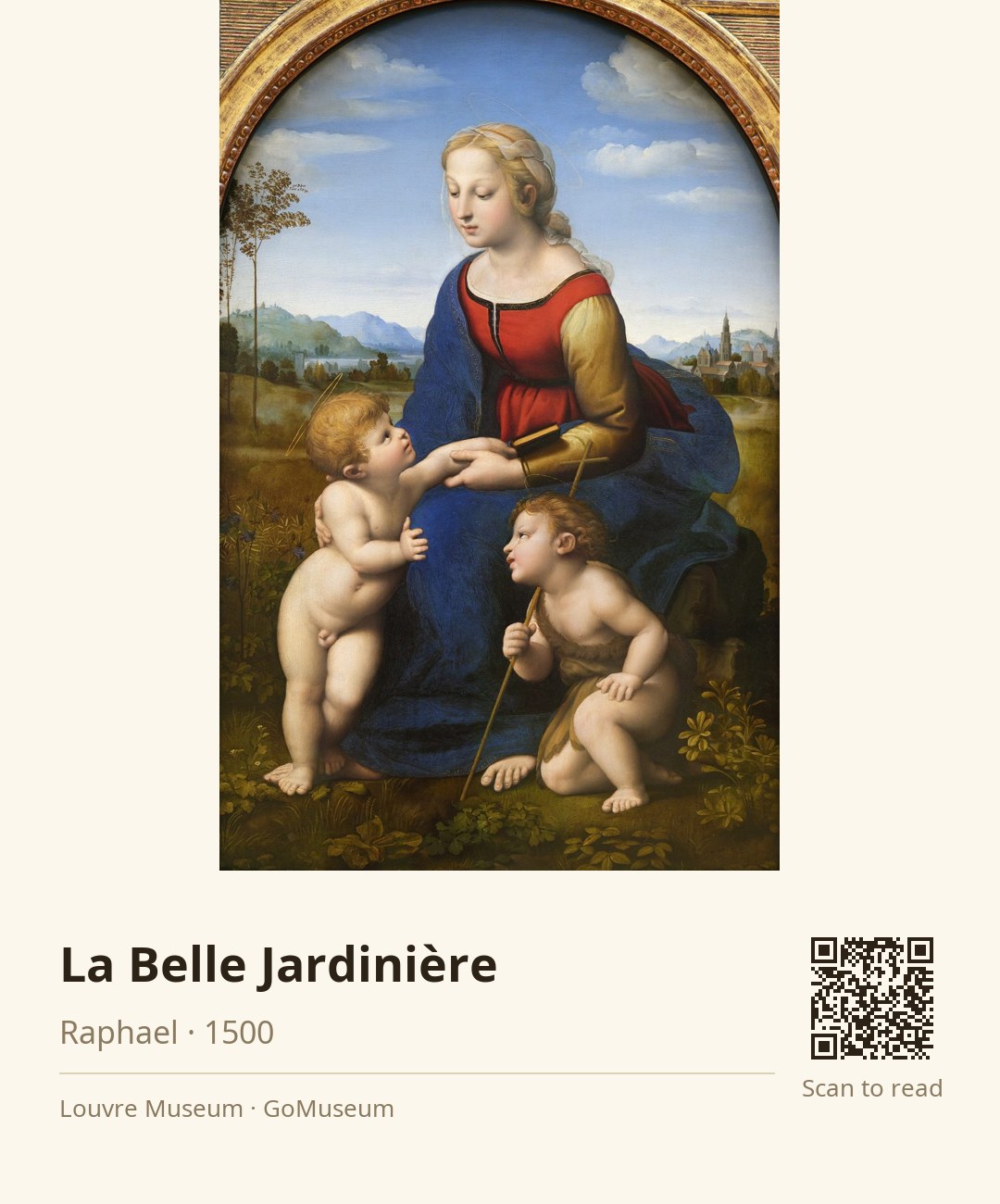
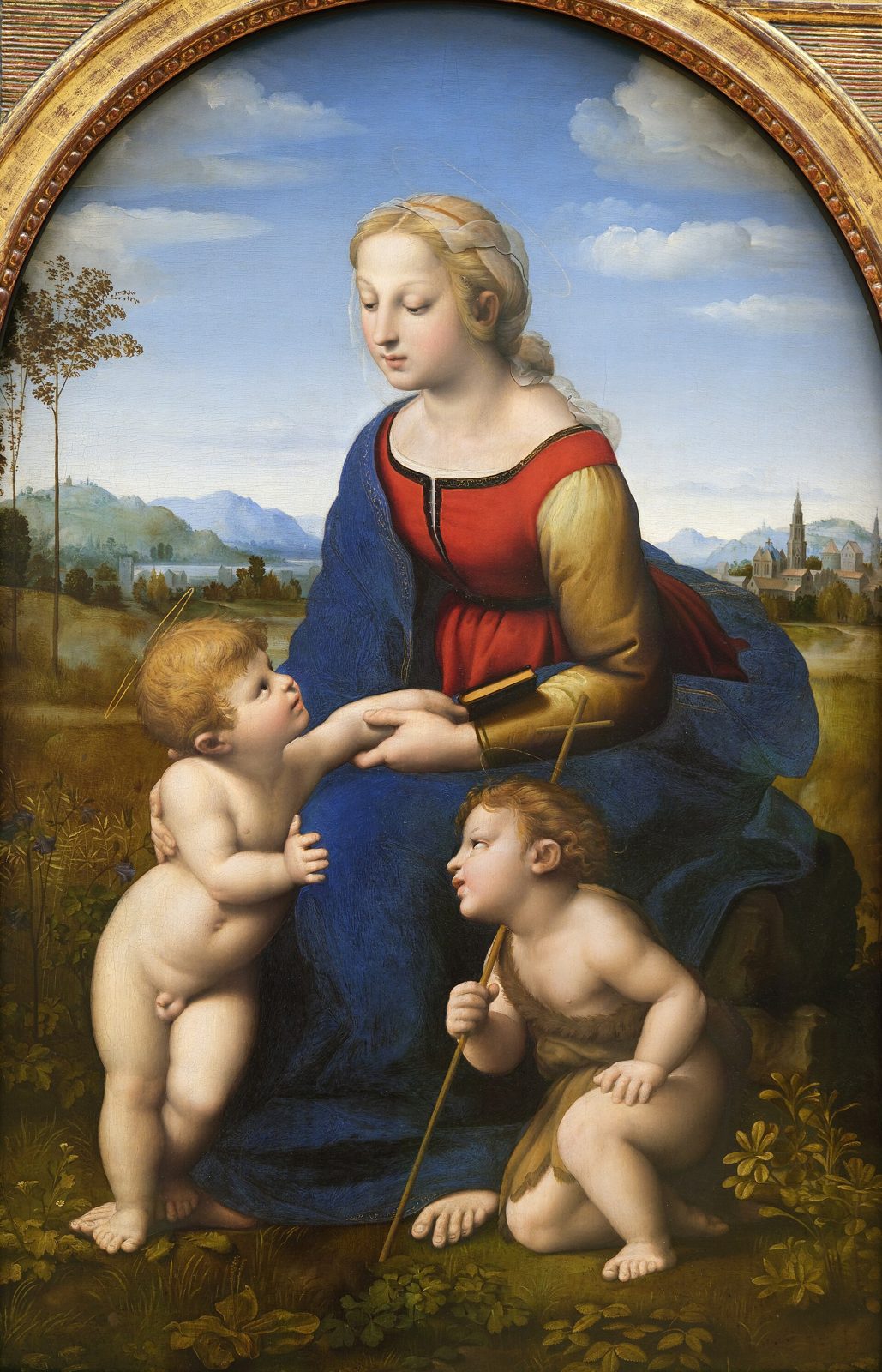
🎧 This work has audio narration — listen in the appTake a moment to really look at "La Belle Jardinière." Notice how Mary sits at the center, her serene expression radiating a protective warmth as she cradles the Christ child. Look closely at the way her arm gently wraps around him, creating a sense of intimacy that draws you in. This isn’t just a mother and child; it’s a moment frozen in time, capturing the essence of trust and love.
Now, consider the colors Raphael chose. The deep blue of Mary's robe contrasts beautifully with her vibrant red dress, symbolizing the duality of her role as both a nurturing mother and a figure of sacrifice. This careful use of color isn’t just for aesthetics; it reflects the complex emotions and themes of the painting, intertwining human experience with divine purpose.
The landscape behind them, a lush garden, enhances this sense of realism and invites viewers to step into their world. It's a testament to Raphael's ability to blend the sacred with the everyday, making the divine feel accessible.
As you stand here, think about the connection between Mary, Christ, and John the Baptist. Each figure plays a role in this narrative, a prefiguration of the events to come in Christ’s life. What emotions does this evoke for you? What stories do you see in their expressions? Let this painting linger in your mind as you explore further.
Raffaello Sanzio da Urbino, known as Raphael, was an Italian painter and architect of the High Renaissance, born in Urbino in 1483. Orphaned by age eleven, he managed his family's workshop and trained under Pietro Perugino, establishing himself as a master by 1500. His move to Rome in 1508 marked the beginning of a prolific period, where he received significant commissions, including the renowned frescoes in the Vatican's Raphael Rooms. His art is celebrated for its clarity, harmonious composition, and embodiment of Neoplatonic ideals. Raphael's influence was profound, shaping the trajectory of Western art and serving as a model for academies until the 19th century. His legacy, characterized by serenity and grace, was later revived in the 18th and 19th centuries, contrasting with the dramatic styles of his rival Michelangelo. Despite his early death at 37, Raphael's extensive body of work and innovative techniques left an indelible mark on the art world, influencing generations of artists and extending into contemporary culture.
La Belle Jardinière, painted around 1500, is a masterpiece by Raphael, one of the towering figures of the High Renaissance. Commissioned by the Sienese patrician Fabrizio Sergardi, it was intended to be a grand portrayal of the Madonna and Child, alongside Saint John the Baptist. However, Raphael left Florence before completing it, and the task fell to Ridolfo del Ghirlandaio, who notably finished the blue robe of Mary. This painting eventually made its way to Paris, where King Francis I acquired it, and it quickly became a sensation, inspiring countless copies and adaptations by other artists.
As you observe La Belle Jardinière, pay attention to the way Raphael employs a pyramidal composition, with Mary at the apex, creating a sense of stability and focus. The brushwork is soft yet deliberate, blending light and shadow to achieve a lifelike quality. Notice how the rich colors—especially the deep blue of Mary's robe against her vibrant red dress—serve to symbolize her dual role as both a nurturing mother and a figure of sacrifice. The sfumato technique, which Raphael mastered, adds a gentle haze to the figures, enhancing their emotional depth. The intimate positioning of Mary and Christ, with John's gaze directed towards them, fosters a connection that invites you into their world, making the divine feel approachable and real.
One intriguing detail about La Belle Jardinière is that it was once referred to in royal inventories as La Sainte Vierge en paysanne, or The Holy Virgin as a Peasant. This title reflects the painting's blend of the divine and the earthly, emphasizing the accessibility of Mary as a maternal figure, rather than a distant, idealized saint.
After Raphael left Florence, Ridolfo del Ghirlandaio finished La Belle Jardinière, particularly noted for completing the blue robe of Mary, which is a significant aspect of the painting's visual impact.
King Francis I acquired La Belle Jardinière and brought it to Paris, where it gained immense popularity and was widely copied by other artists, further cementing its status in art history.
In royal inventories, La Belle Jardinière was initially referred to as La Sainte Vierge en paysanne, highlighting its portrayal of Mary in a more relatable, earthly manner.