 Image: Unknown artistUnknown artist · Unknown artistUnknown artist · GFreihalter · GFreihalter
Harbaville Triptych
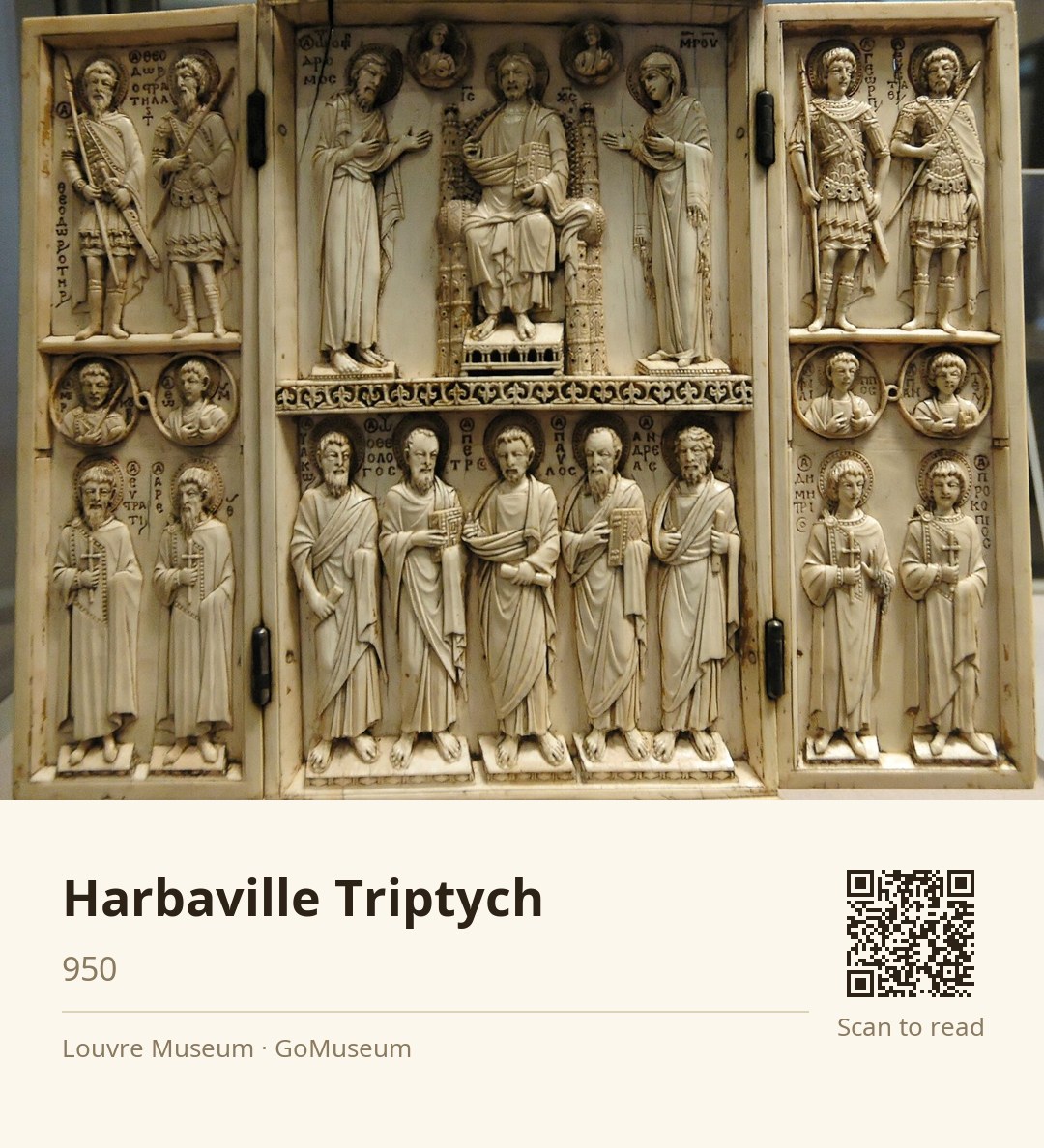
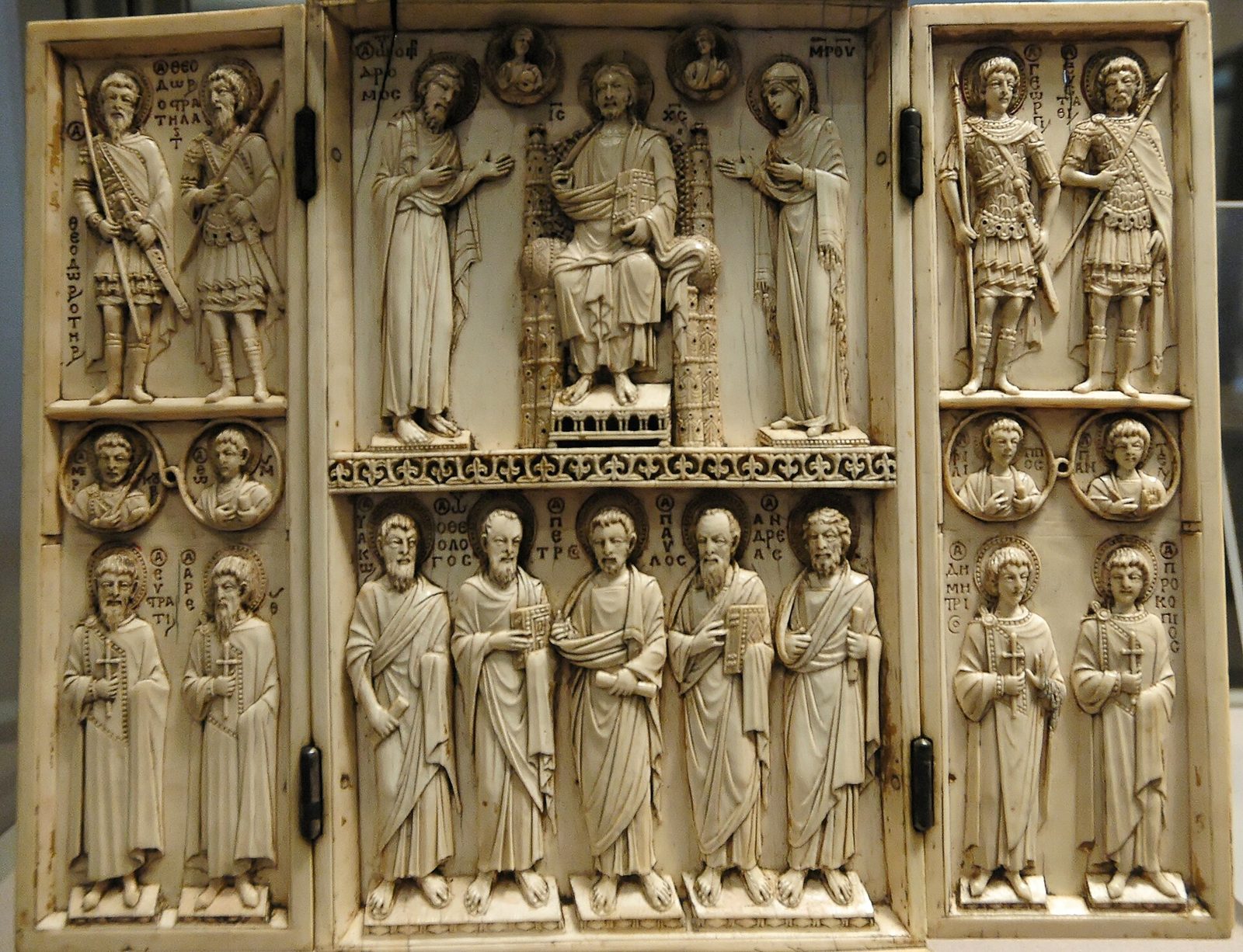
🎧 This work has audio narration — listen in the appTake a moment to really look at the Harbaville Triptych. Notice how the figures seem to almost breathe with life, their expressions captured in delicate ivory. Pay special attention to the intricate details of their garments—can you see the traces of color still clinging to the surface? These remnants hint at the vibrancy this piece once had, transforming it from a simple sculpture into a vivid narrative of faith and devotion.
Well, the Harbaville Triptych is not just a beautiful object; it’s a prime example of Byzantine artistry at its peak. Crafted around 950, it showcases the elegance and refinement of the Imperial Court’s workshop in Constantinople. The way the figures are arranged in a Deesis—Christ flanked by the Virgin Mary and John the Baptist—reflects the deep spiritual significance of the scene, inviting viewers into a moment of prayer and contemplation.
This piece belongs to the "Romanos group," known for its exquisite craftsmanship. It’s considered the finest of its kind, a testament to the skill of the artisans who shaped it. The triptych’s journey to the Louvre is equally fascinating, having passed through the hands of collectors before finding its home here in 1891.
As you stand here, think about the stories this triptych has witnessed over the centuries. What do you think it would say if it could speak?
As you look closely at the Harbaville Triptych, take a moment to appreciate the craftsmanship involved in its creation. Carved from ivory, this piece showcases the incredible skill of Byzantine artisans. Notice the smooth, polished surfaces that reflect light, giving the figures a lifelike quality. The intricate details of their garments, from the folds to the delicate patterns, reveal a meticulous attention to texture. Can you spot the traces of color still lingering on the figures? These remnants hint at the vibrant hues that once adorned the triptych, transforming it into a dazzling visual feast that would have captivated viewers in its time.
It is part of the esteemed 'Romanos group,' named after a related ivory plaque depicting Christ crowning an emperor. This group is recognized for its exquisite craftsmanship, closely tied to the Imperial Court in Constantinople. The triptych's early history is somewhat mysterious, but it is named after Louis-François Harbaville, an antiquarian who inherited it from his in-laws. It eventually made its way to the Louvre in 1891 after being purchased from Harbaville's grandsons. Imagine the hands that have touched this artwork over the centuries, each adding to its story.
This triptych, crafted in ivory, showcases the elegance and refinement characteristic of the Romanos group, a workshop closely tied to the Imperial Court of Constantinople. Its intricate carvings and delicate figures not only highlight the technical prowess of its creators but also set a benchmark for subsequent Byzantine art. Artists and artisans in later centuries looked to this work as a model of sophistication and beauty, influencing the development of religious iconography. The triptych’s survival and preservation allow us to glimpse the aesthetic values of its time, making it a crucial piece for understanding the evolution of Byzantine art and its enduring legacy.
Did you know that all sides of the Harbaville Triptych are fully carved? While the front showcases the Deesis scene, the outer sides feature additional saints, and the back is adorned with an elaborate decorative scheme. This level of detail is quite rare, making the triptych not just a visual delight but also a testament to the comprehensive skill of its creators.
The outer sides of the Harbaville Triptych are fully carved with additional saints, showcasing the artisans' dedication to detail and craftsmanship beyond the main Deesis scene.
It is named after Louis-François Harbaville, an antiquarian who inherited the piece from his in-laws, the Beugny de Pommeras family, linking its history to a specific lineage.
The Harbaville Triptych is regarded as the finest of the 'Romanos group' due to its exceptional elegance and delicacy, which are often absent in other ivories from the same period.