Self-portrait with a friend
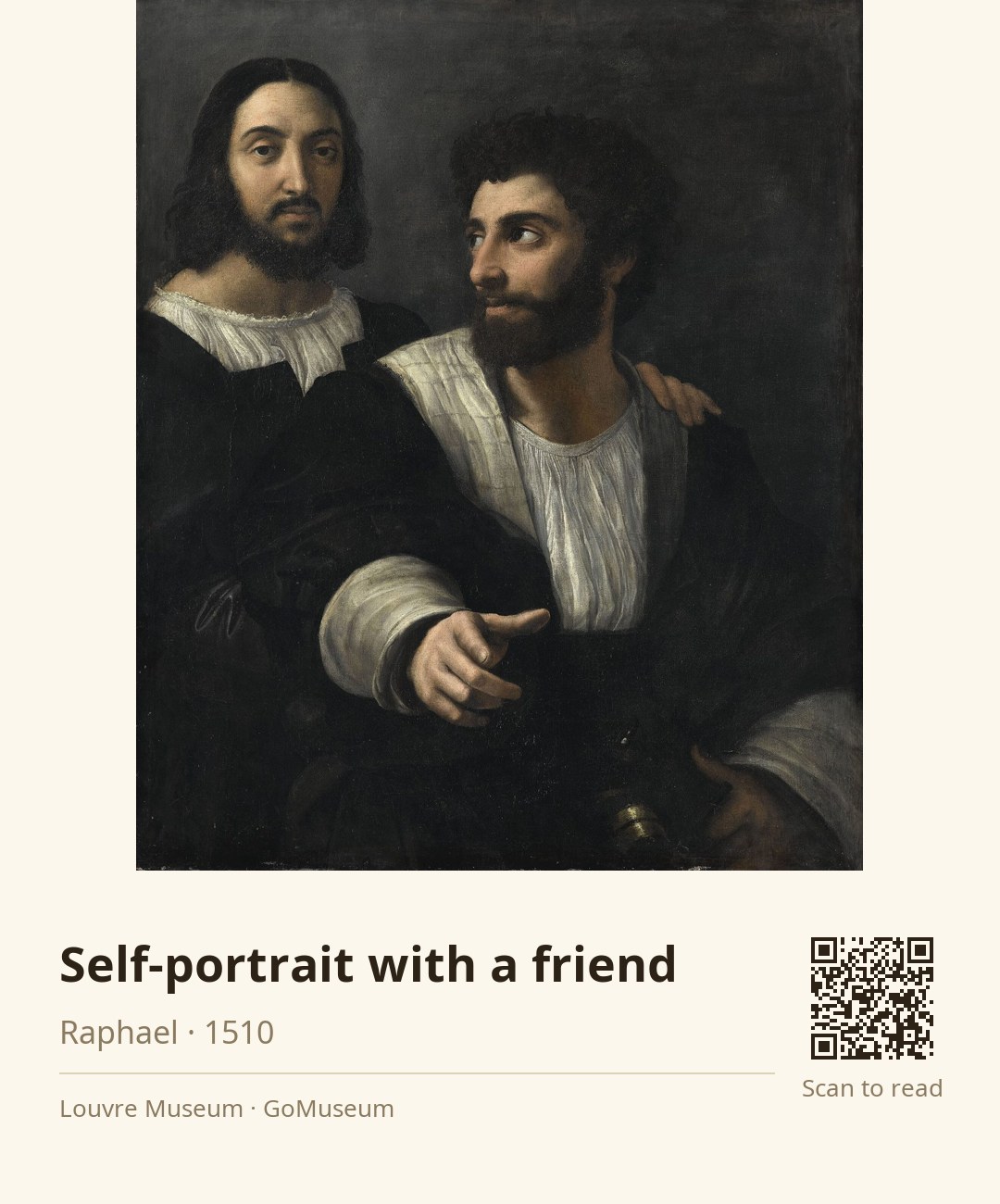
🎧 This work has audio narration — listen in the appTake a moment to really look at Raphael’s "Self-portrait with a Friend." Notice how the artist positions himself slightly behind his companion, yet his gaze directly meets yours. This subtle placement is more than just a compositional choice; it suggests a dynamic relationship between the two figures. The man in front, possibly a fencing master or a close friend, leans in slightly, pointing outward as if inviting you into their world.
Now, focus on the details of their attire. Both figures wear matching white shirts and dark cloaks, their beards and mustaches echoing each other.
As you stand here, think about the friendships that shape your own life. Who would you want to immortalize in a portrait like this?
Raffaello Sanzio da Urbino, known as Raphael, was an Italian painter and architect of the High Renaissance, born in Urbino in 1483. Orphaned by age eleven, he managed his family's workshop and trained under Pietro Perugino, establishing himself as a master by 1500. His move to Rome in 1508 marked the beginning of a prolific period, where he received significant commissions, including the renowned frescoes in the Vatican's Raphael Rooms. His art is celebrated for its clarity, harmonious composition, and embodiment of Neoplatonic ideals. Raphael's influence was profound, shaping the trajectory of Western art and serving as a model for academies until the 19th century. His legacy, characterized by serenity and grace, was later revived in the 18th and 19th centuries, contrasting with the dramatic styles of his rival Michelangelo. Despite his early death at 37, Raphael's extensive body of work and innovative techniques left an indelible mark on the art world, influencing generations of artists and extending into contemporary culture.
This painting, also known as 'Double Portrait,' is housed in the Louvre Museum in Paris. The identity of the figure alongside Raphael has sparked much debate among art historians. Traditionally thought to be his fencing master, modern interpretations suggest he could be a close friend or even a pupil, with names like Polidoro da Caravaggio and Giulio Romano being floated. Interestingly, a significant portion of the painting was likely executed by one of Raphael's students, showcasing the collaborative nature of his workshop. The painting entered the collection of Francis I of France and was attributed to Raphael as early as 1683 by Charles Le Brun, indicating its esteemed status even in the 17th century. It has since been part of various exhibitions, including a notable display at the Louvre-Lens starting in 2014.
As you gaze at this painting, pay attention to the dynamic composition. Raphael cleverly positions himself slightly behind his friend, yet his direct gaze engages you, creating an intimate connection. The dark background serves to highlight the figures, drawing your eye to their matching white shirts and dark cloaks. Notice how the brushwork feels almost restless, with soft transitions between light and shadow that breathe life into their expressions. The way the friend leans forward, pointing outward, invites you into their shared moment, suggesting a narrative beyond the canvas. The subtle mirroring of their beards and mustaches enhances their bond, while the positioning of their hands—Raphael's resting on his friend's shoulder—implies a deep camaraderie. This thoughtful arrangement not only showcases Raphael's skill but also reflects the Renaissance ideals of friendship and collaboration.
One intriguing aspect of Raphael's 'Self-portrait with a Friend' is the uncertainty surrounding the identity of the man beside him. While many art historians speculate that he could be Raphael's fencing master, the truth is he might actually be a close friend or even a pupil. This ambiguity invites you to ponder who this figure really is, adding a layer of mystery to the painting. Imagine the conversations they might have had, the laughter shared, or the lessons learned in the art of swordsmanship, all captured in this moment.
A significant portion of 'Self-portrait with a Friend' was likely executed by one of Raphael's pupils, highlighting the collaborative nature of his workshop and the training of young artists under his guidance.
Before it became part of the Louvre's collection in 1792, the painting was owned by Francis I of France and was attributed to Raphael as early as 1683, indicating its esteemed status in royal collections.