Hendrickje Stoffels
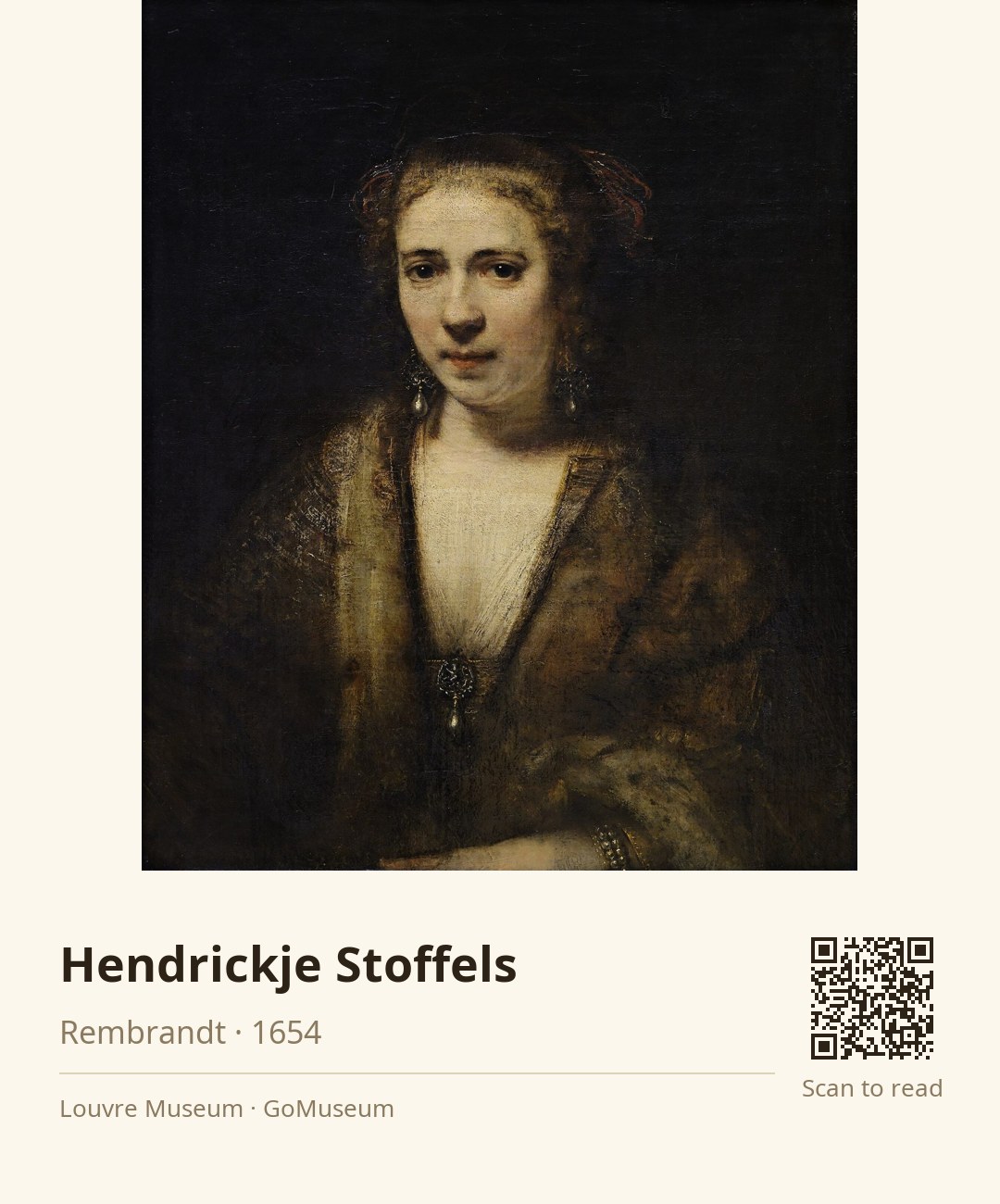
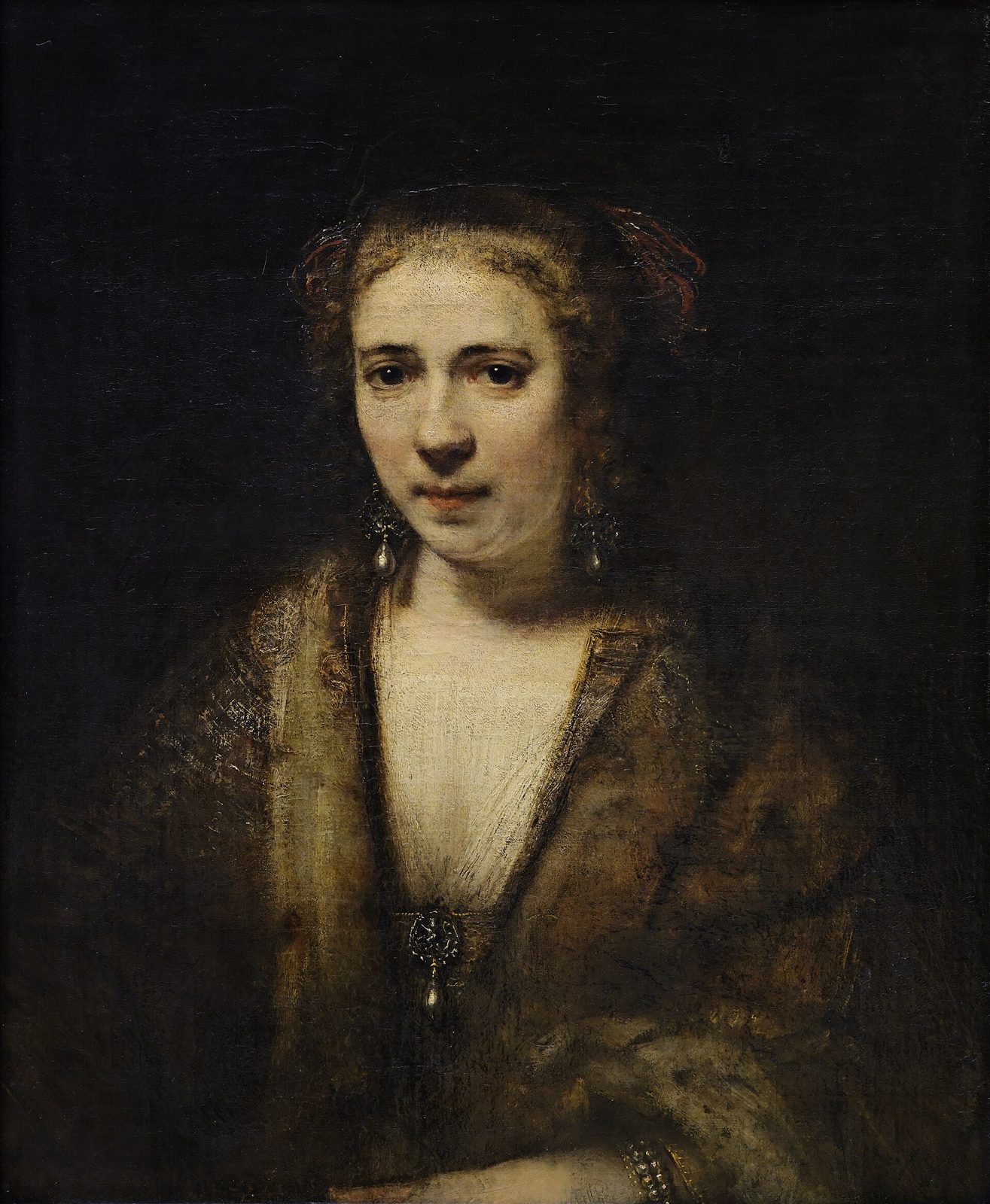
🎧 This work has audio narration — listen in the appHendrickje Stoffels gazes directly at you, her expression both inviting and contemplative. The deep neckline of her richly textured garment reveals a striking brooch with a pearl drop, while her pearl earrings catch the light, enhancing her elegance. The dark background serves to illuminate her face and upper body, creating a captivating contrast that draws you in.
This painting, created by Rembrandt in 1654, captures not just a likeness but a moment of intimacy. The detailed brushwork highlights the softness of her skin and the intricate fabric of her clothing, showcasing Rembrandt's mastery of texture and light. Hendrickje, who was both Rembrandt's muse and partner, embodies the warmth and complexity of his later works. The warm, earthy palette contributes to the intimate atmosphere, reflecting the personal connection between the artist and his subject.
Rembrandt's choice to depict Hendrickje in this manner speaks to his innovative approach during the Dutch Golden Age, where he often blended realism with emotional depth. His portraits are renowned for their ability to convey the humanity of their subjects, moving beyond mere representation. In the mid-17th century, Rembrandt's work was celebrated for its emotional resonance and technical prowess, solidifying his legacy as one of the greatest artists in Western art history.
Rembrandt Harmenszoon van Rijn, born on July 15, 1606, in Leiden, was a pivotal figure of the Dutch Golden Age and is celebrated as one of the greatest artists in Western art history. His oeuvre includes around three hundred paintings, three hundred etchings, and numerous drawings, showcasing a remarkable range of styles and subjects, from intimate portraits to grand historical and biblical scenes.
Rembrandt's artistic journey began in Leiden, where he was influenced by both Dutch and Italian masters. He opened his studio in 1625 and quickly gained recognition for his portrait work. His move to Amsterdam marked a significant turning point, as he became a sought-after portraitist and married Saskia van Uylenburgh, a union that brought both joy and tragedy. The couple faced immense personal losses, including the deaths of their children and Saskia's own passing in 1642, which deeply affected his work.
Despite financial struggles later in life, Rembrandt's innovative techniques, particularly in etching, transformed the medium into a respected art form. His mastery of light and shadow, known as chiaroscuro, and his empathetic portrayal of human experience set him apart from his contemporaries. Rembrandt's legacy endures through his profound ability to capture the complexities of the human condition, making him a cornerstone of art history.
Rembrandt's most acclaimed works include portraits of his contemporaries, self-portraits, and biblical scenes, showcasing his diverse artistic range.