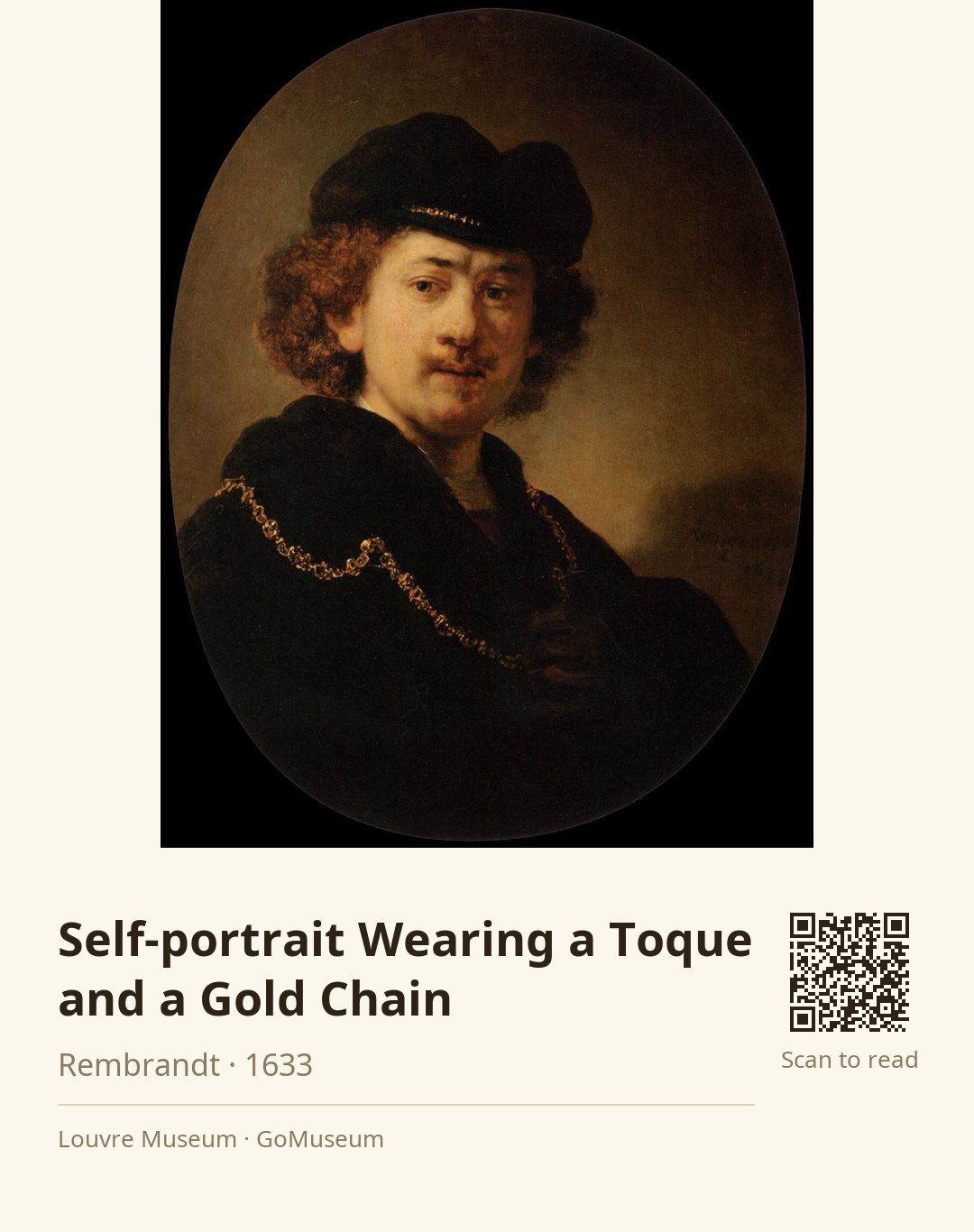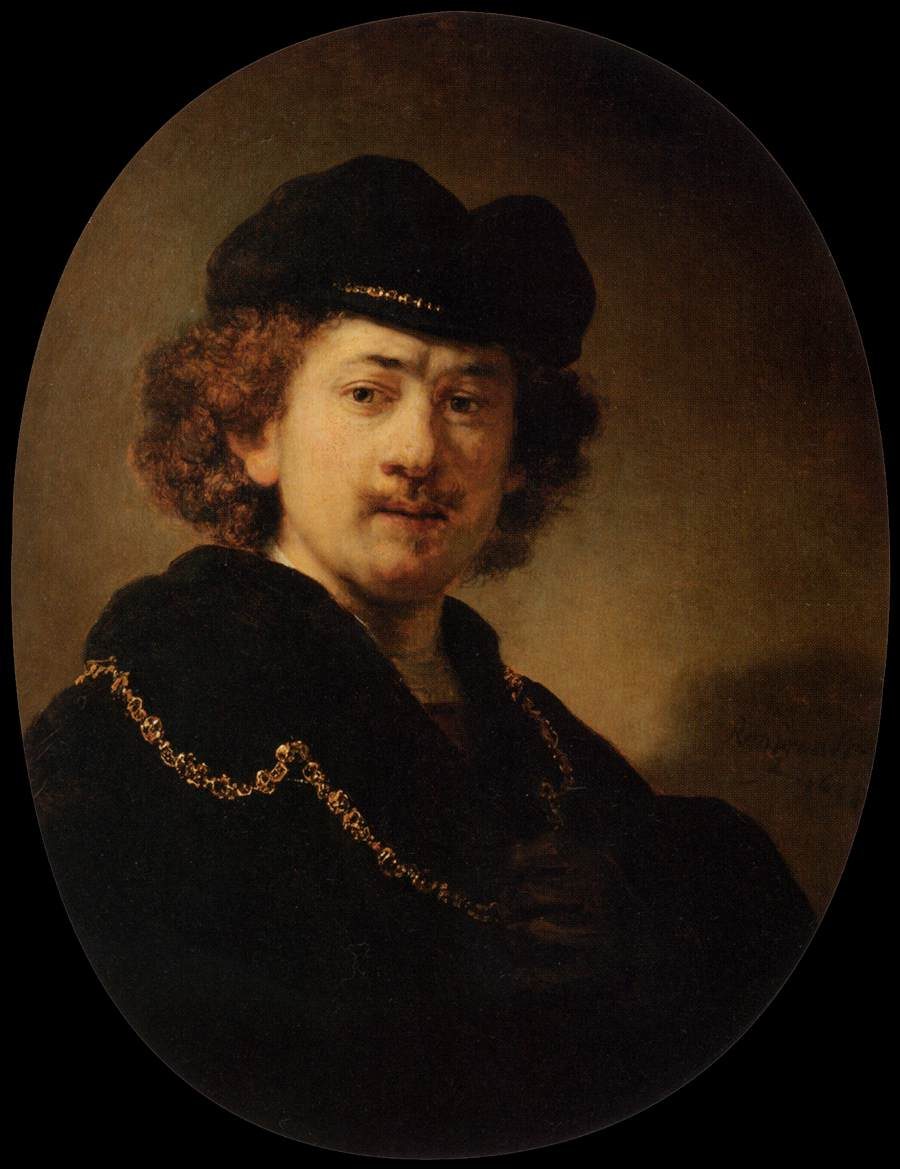
Self-portrait Wearing a Toque and a Gold Chain
🎧 This work has audio narration — listen in the appThe man in the dark, broad-brimmed hat gazes directly at you, his expression both confident and contemplative. The gold chain draped across his black cloak catches the light, drawing attention to the richness of his attire, while the warm, muted background enhances the depth of his features. Beneath the hat, his curly hair adds a touch of softness to the otherwise strong composition, which focuses on his face and upper body in an intimate oval frame.
This self-portrait, created in 1633, showcases Rembrandt's mastery in portraying human emotion and character. The smooth brushwork and subtle transitions in skin tones reveal his deep understanding of light and shadow, techniques that elevate the painting beyond mere representation to a profound exploration of identity. The inscription on the right, though partially obscured, hints at the artist's personal connection to the work, making it a significant piece in his extensive oeuvre of self-portraits.
Rembrandt, born in Leiden in 1606, became one of the most influential figures in Western art, known for his innovative techniques and emotional depth. His self-portraits, numbering around one hundred, serve as a visual autobiography, chronicling his life and experiences through the lens of his evolving artistry.
Rembrandt Harmenszoon van Rijn, born on July 15, 1606, in Leiden, was a pivotal figure of the Dutch Golden Age and is celebrated as one of the greatest artists in Western art history. His oeuvre includes around three hundred paintings, three hundred etchings, and numerous drawings, showcasing a remarkable range of styles and subjects, from intimate portraits to grand historical and biblical scenes.
Rembrandt's artistic journey began in Leiden, where he was influenced by both Dutch and Italian masters. He opened his studio in 1625 and quickly gained recognition for his portrait work. His move to Amsterdam marked a significant turning point, as he became a sought-after portraitist and married Saskia van Uylenburgh, a union that brought both joy and tragedy. The couple faced immense personal losses, including the deaths of their children and Saskia's own passing in 1642, which deeply affected his work.
Despite financial struggles later in life, Rembrandt's innovative techniques, particularly in etching, transformed the medium into a respected art form. His mastery of light and shadow, known as chiaroscuro, and his empathetic portrayal of human experience set him apart from his contemporaries. Rembrandt's legacy endures through his profound ability to capture the complexities of the human condition, making him a cornerstone of art history.
The smooth brushwork creates a lifelike quality, allowing the viewer to feel the texture of the man's skin and the fabric of his cloak. His choice of a dark, broad-brimmed hat and the gold chain contrasts beautifully with the warm, muted background, enhancing the subject's presence. The use of chiaroscuro, a hallmark of Rembrandt's style, draws your eye directly to the face, where the subtle transitions in skin tones reveal a depth of character and emotion. The oval composition focuses intently on the upper body, creating an intimate connection between the viewer and the subject. This careful arrangement not only highlights the man's features but also invites you to ponder the thoughts behind that contemplative gaze.
In addition to self-portraits, Rembrandt's work includes portraits of his contemporaries and illustrations of biblical scenes, showcasing a wide range of themes and subjects.
Rembrandt's self-portraits, numbering around 100, act as a visual autobiography that chronicles his life and evolving artistry.
Rembrandt faced significant personal tragedies, including the deaths of three children shortly after birth and the loss of his wife, Saskia, which deeply affected his life and work.