The Turkish Bath
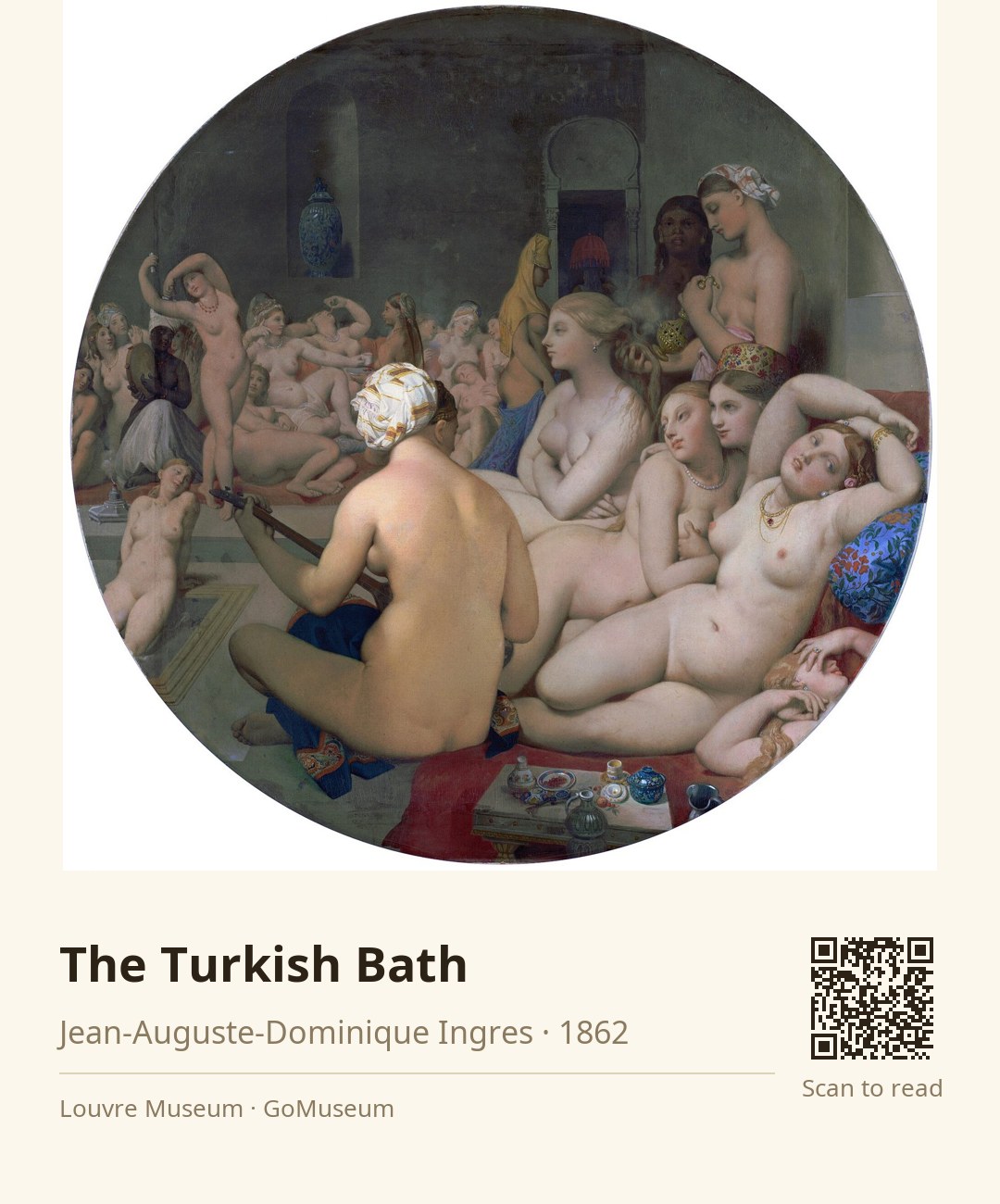
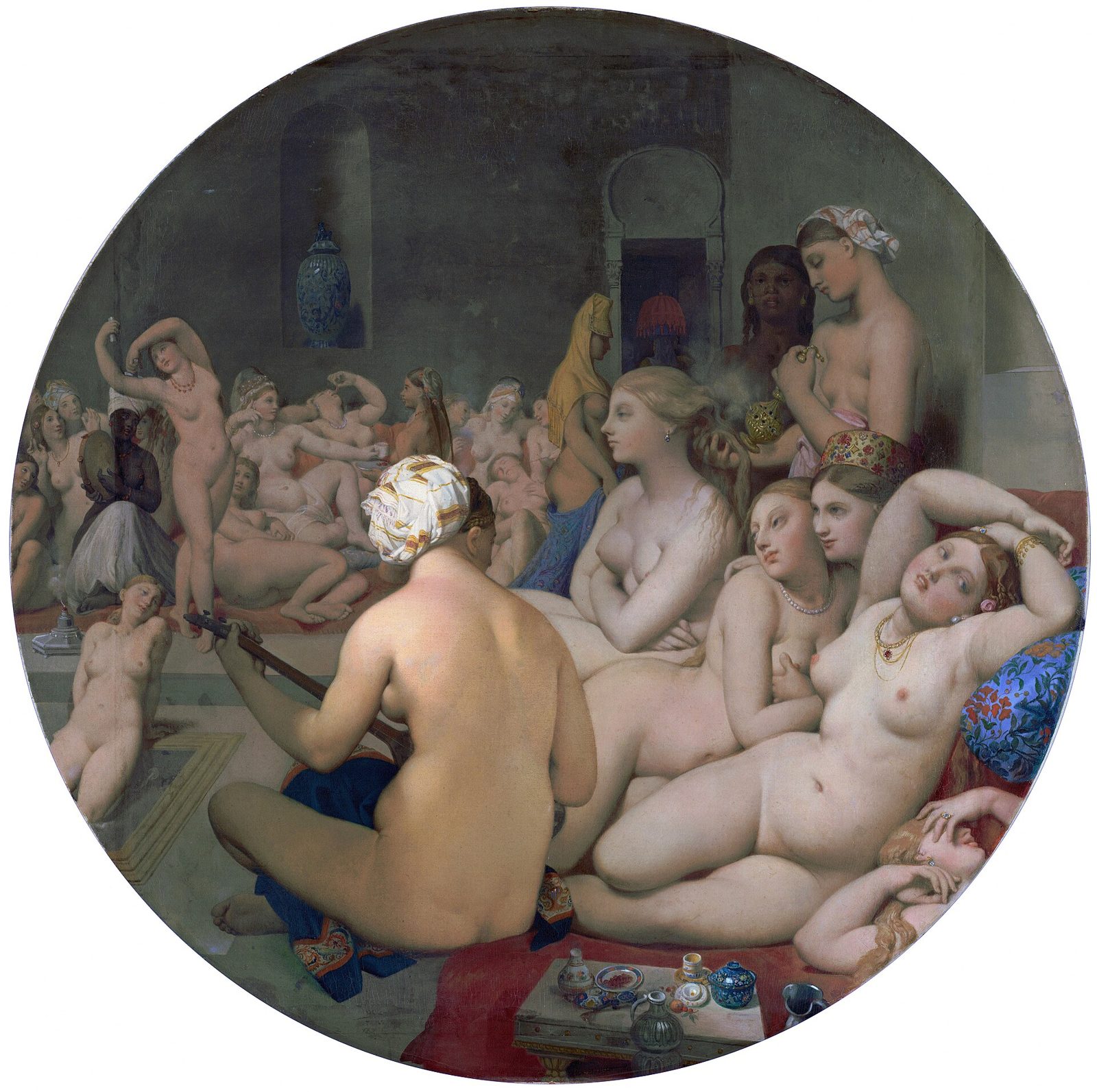
🎧 This work has audio narration — listen in the appTake a moment to really absorb the scene before you in Ingres' "The Turkish Bath." Notice how the women are arranged in a circular composition, their bodies intertwining in a way that creates a sense of harmony and intimacy. Look closely at the soft, pale skin of the figures, which contrasts beautifully with the rich, muted colors of the background.
These details matter because they evoke a dreamlike quality, drawing you into a world of sensuality and leisure. Ingres was 82 when he painted this, and yet he captures the essence of youthful vitality and eroticism, a testament to his skill and imagination. The tondo shape of the painting adds a voyeuristic element, as if you’re peeking into a private moment, heightening the sense of intimacy and allure.
While Ingres never traveled to the East, his work reflects the fascination with Orientalism that swept through Europe in the 19th century, fueled by literature and the exotic tales of harems. This painting is not just a depiction of a bath; it's a romanticized vision of femininity and desire, crafted from his imagination and earlier works.
As you stand here, consider how Ingres, in his old age, still managed to capture the fire of youth. What feelings does this painting stir in you about beauty, desire, and the passage of time?
Jean-Auguste-Dominique Ingres was a pivotal figure in French Neoclassicism, born on August 29, 1780, in Montauban. He was the son of a versatile artist, which nurtured his early artistic inclinations. Ingres studied under Jacques-Louis David in Paris, where he developed a commitment to academic traditions, aspiring to elevate history painting above all genres. His early career was marked by struggles, as critics dismissed his style as archaic, yet he persevered, achieving recognition with works like "The Vow of Louis XIII" in 1824.
His portraits, characterized by expressive distortions, became his most celebrated contributions, influencing modern artists such as Matisse and Picasso. Ingres's time in Italy, from 1806 to 1824, was crucial; he immersed himself in the study of Renaissance masters, which shaped his distinctive style. Despite facing criticism for his meticulous approach, he remained steadfast in his vision of beauty, emphasizing drawing over color.
Later in life, he returned to Paris, where he continued to create significant works, including "The Turkish Bath." Ingres's legacy endures as a bridge between classical traditions and modern art, embodying the tension between adherence to established norms and the evolving landscape of artistic expression. He passed away on January 14, 1867, leaving behind a profound impact on the art world.
Ingres began working on 'The Turkish Bath' around 1852, but it wasn't until 1862 that he signed and dated the painting, proudly marking his age as 'AETATIS LXXXII'—at 82 years old. This work, which showcases a group of nude women in a harem, was a culmination of themes he had explored throughout his career, particularly in earlier pieces like 'The Valpinçon Bather' and 'La Grande Odalisque.' Initially, the painting was rectangular, but Ingres transformed it into a tondo shape, enhancing its voyeuristic appeal. Its journey to the Louvre was fraught with challenges; it was initially rejected by a relative of Napoleon III for being 'inappropriate' before being acquired by Khalil Bey, a Turkish diplomat, in 1865. It wasn't until 1911 that it found a permanent home in the Louvre, thanks to a donation from the Friends of the Louvre society.
Take a closer look at how Ingres employs color and composition to create a dreamlike atmosphere. The circular arrangement of the figures feels almost like a dance, with their bodies flowing into one another, evoking a sense of intimacy and harmony. Notice the soft, pale skin tones that contrast beautifully with the muted browns and greys of the background, enhancing the sensuality of the scene. Ingres's brushwork is meticulous, with each stroke carefully placed to create a sense of depth and volume. The tondo format not only centralizes the composition but also invites you to peer into this private moment, making you feel like an intruder in a world of leisure. The subtle play of light across the figures adds to the painting's allure, highlighting the curves and contours of the bodies, while the inclusion of exotic elements like musical instruments and vases hints at a romanticized vision of the East.
The legacy of 'The Turkish Bath' is profound, influencing a myriad of artists across generations. Its eroticism and idealized portrayal of the female form paved the way for modern interpretations of femininity in art. Ingres's work has been referenced by notable figures such as Pablo Picasso and Tamara de Lempicka, demonstrating its lasting impact on the art world. The painting embodies the Orientalist fascination of the 19th century, yet it also critiques that very fascination by presenting a vision that is more about Western fantasies than authentic representations. This duality has made it a subject of study and admiration, solidifying its place in the canon of Western art history.
One intriguing tidbit about 'The Turkish Bath' is that Ingres did not paint from live models. Instead, he relied on sketches and figures from his earlier works, reimagining them in this composition. This method reflects his unique approach to art, where he blended past inspirations with his own vision, creating a work that feels both familiar and entirely new.
Initially, the painting was rejected by a relative of Napoleon III for being deemed 'inappropriate,' which reflects the controversial nature of its erotic content at the time.
Ingres transformed the painting from a rectangular format into a tondo shape, which not only centralized the composition but also enhanced its voyeuristic appeal, inviting viewers to feel like intruders in a private moment.
Instead of using live models, Ingres relied on sketches and figures from his earlier works, reimagining them in this composition, which showcases his ability to blend past inspirations with his own artistic vision.