 Image: Shonagon · Unknown artistUnknown artist · Unknown artistUnknown artist · Tangopaso
Lady of Auxerre
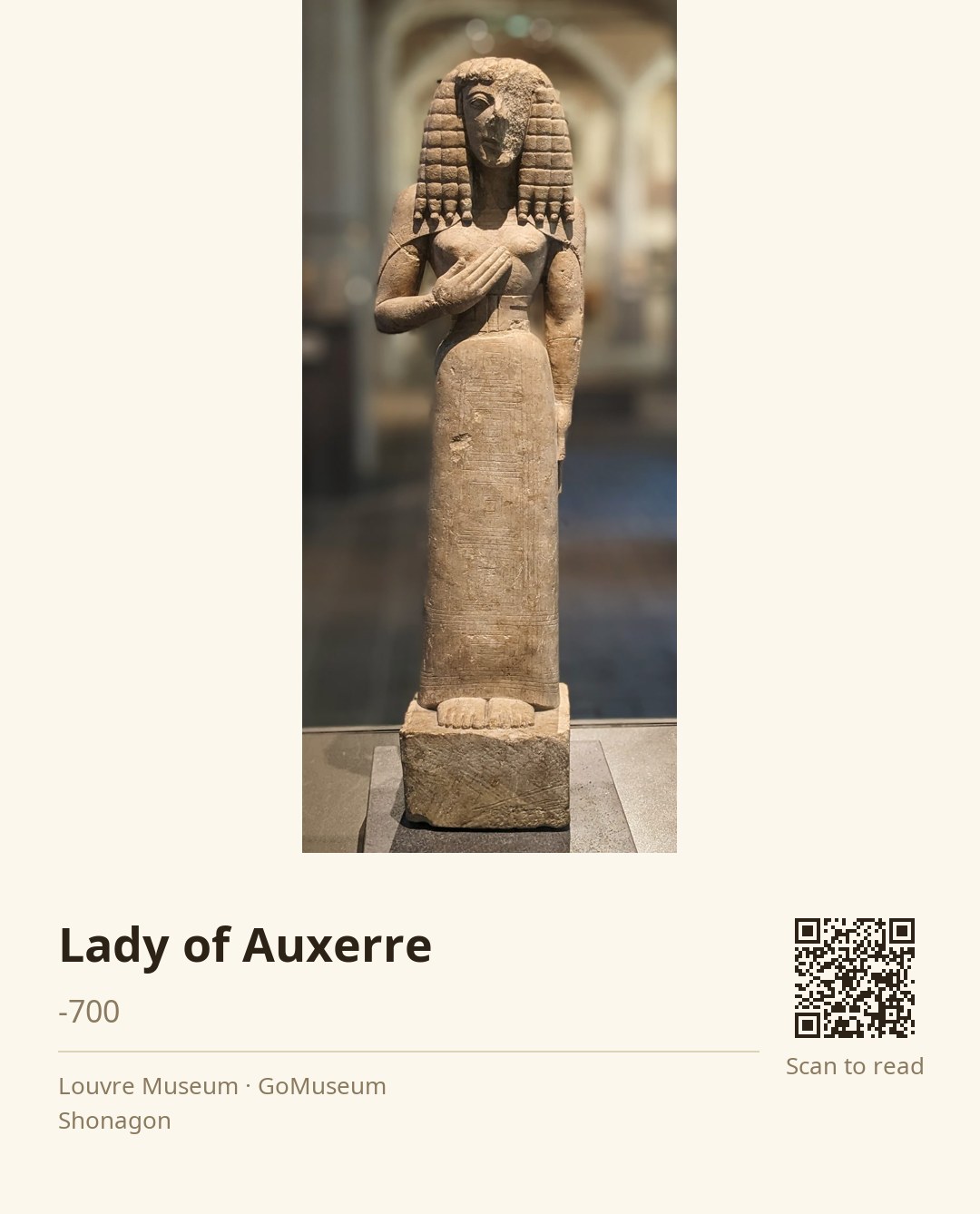
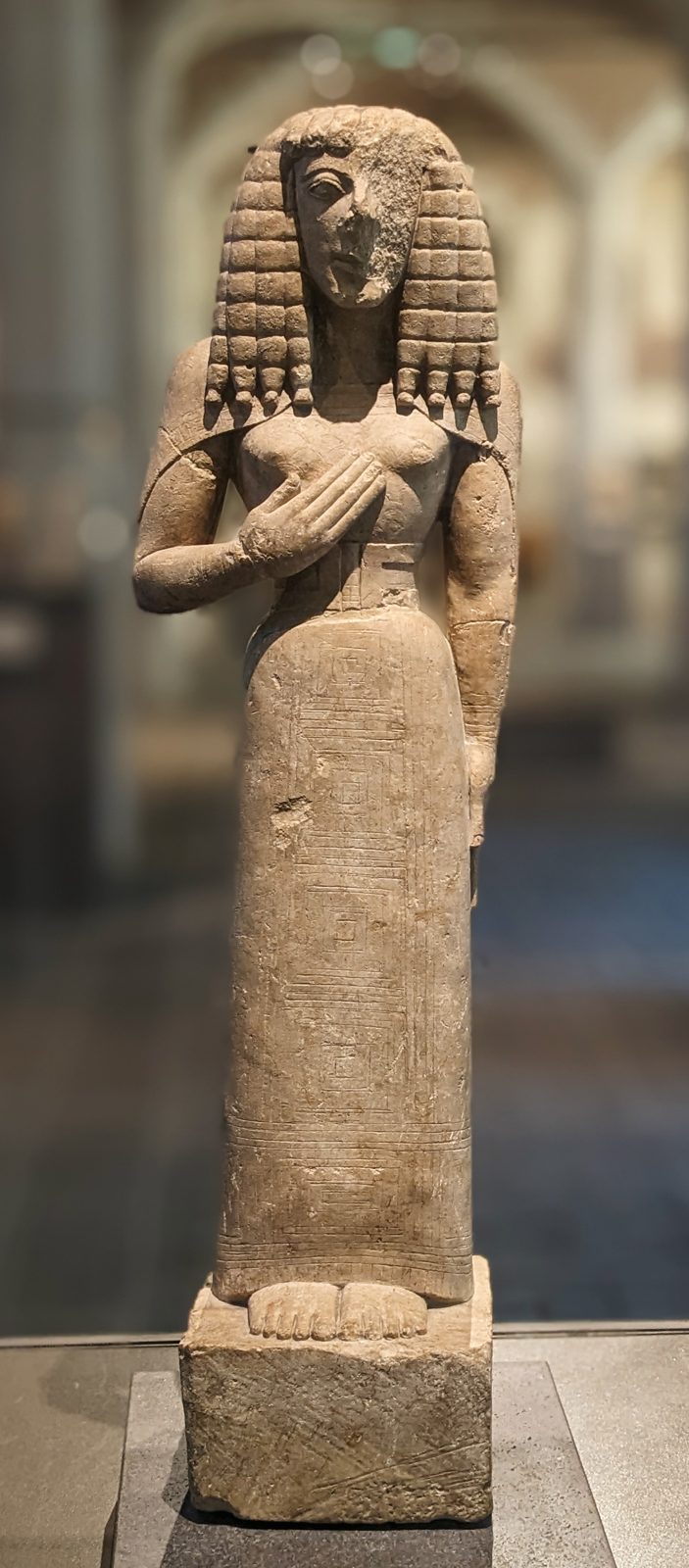
🎧 This work has audio narration — listen in the appTake a moment to really look at the Lady of Auxerre. Notice how her right hand gently touches her solar plexus, while her left arm hangs stiffly at her side. This pose isn’t just for show; it hints at her role as a Kore, a maiden who might be a votary or even a representation of someone who has passed on, caught in a moment of prayer or reverence.
Now, let’s zoom in on the intricate details of her attire. The incised patterns on her dress, especially the horizontal band crossing her chest, create a striking visual rhythm. These designs, once painted in vibrant colors, would have made her appear even more lifelike, bridging the gap between the divine and the earthly. This interplay of form and decoration reflects the early Archaic style that was emerging in Greece, a time when artists were beginning to explore more naturalistic representations.
Discovered in a storage vault in 1907, this limestone sculpture dates back to around 700 BCE, a period when Greece was just beginning to emerge from its Dark Age.
As you stand here, think about the stories this figure might tell. What prayers or hopes did she embody for those who created her?
As you take a closer look at the Lady of Auxerre, notice the limestone from which she is carved. This material, while soft enough to allow for intricate details, also presents challenges in terms of durability. The artist skillfully incised patterns into her dress, creating a visual rhythm that would have been even more striking when painted. The horizontal band across her chest features maeanders, a design that echoes the geometric motifs of the time. The way her hair is sculpted into six tresses at the back, ending in knobs, showcases the Daedalic style, which emphasizes symmetry and formality. Each detail, from her flat fingers to the careful carving of her features, reflects the early experimentation in Greek sculpture, merging simplicity with a hint of elegance.
The Lady of Auxerre, a captivating limestone sculpture standing at 75 cm, was unearthed in a rather unexpected way. In 1907, Maxime Collignon, a curator at the Louvre, stumbled upon this piece in a dusty storage vault at the Museum of Auxerre, located east of Paris. Its origins are shrouded in mystery, as no clear provenance exists. This discovery sparked intrigue, as it was a remarkable example of early Greek art, specifically the Daedalic style, which hints at the artistic influences of the time. After its discovery, the Lady made her way to the Louvre in 1909, exchanged for a landscape painting by Henri Joseph Harpignies, a move that solidified her place in the annals of art history. The Lady of Auxerre has since captivated audiences with her serene expression and intricate details, embodying the transition from the Dark Ages to a burgeoning artistic era in Greece.
One intriguing detail about the Lady of Auxerre is her original polychrome decoration. Though much of the paint has faded, traces of red remain on her torso, hinting at the vibrant colors that once adorned her. Imagine how striking she must have appeared in her original hues, captivating the eyes of those who gazed upon her in ancient times.
After its discovery, the sculpture was recognized for its significance in Greek art and was transferred to the Louvre Museum in 1909, in exchange for a painting by Henri Joseph Harpignies.
The sculpture was once owned by Édouard Bourgoin, an artist and art dealer, who had it in his possession until his death in 1895, after which it was purchased for a mere franc by a theater concierge.
Her hairstyle, characterized by thick tresses and knobs, reflects Egyptian influence, showcasing the cultural exchanges that were occurring in the Mediterranean during the Archaic period.