Francis I (1494–1547), King of France
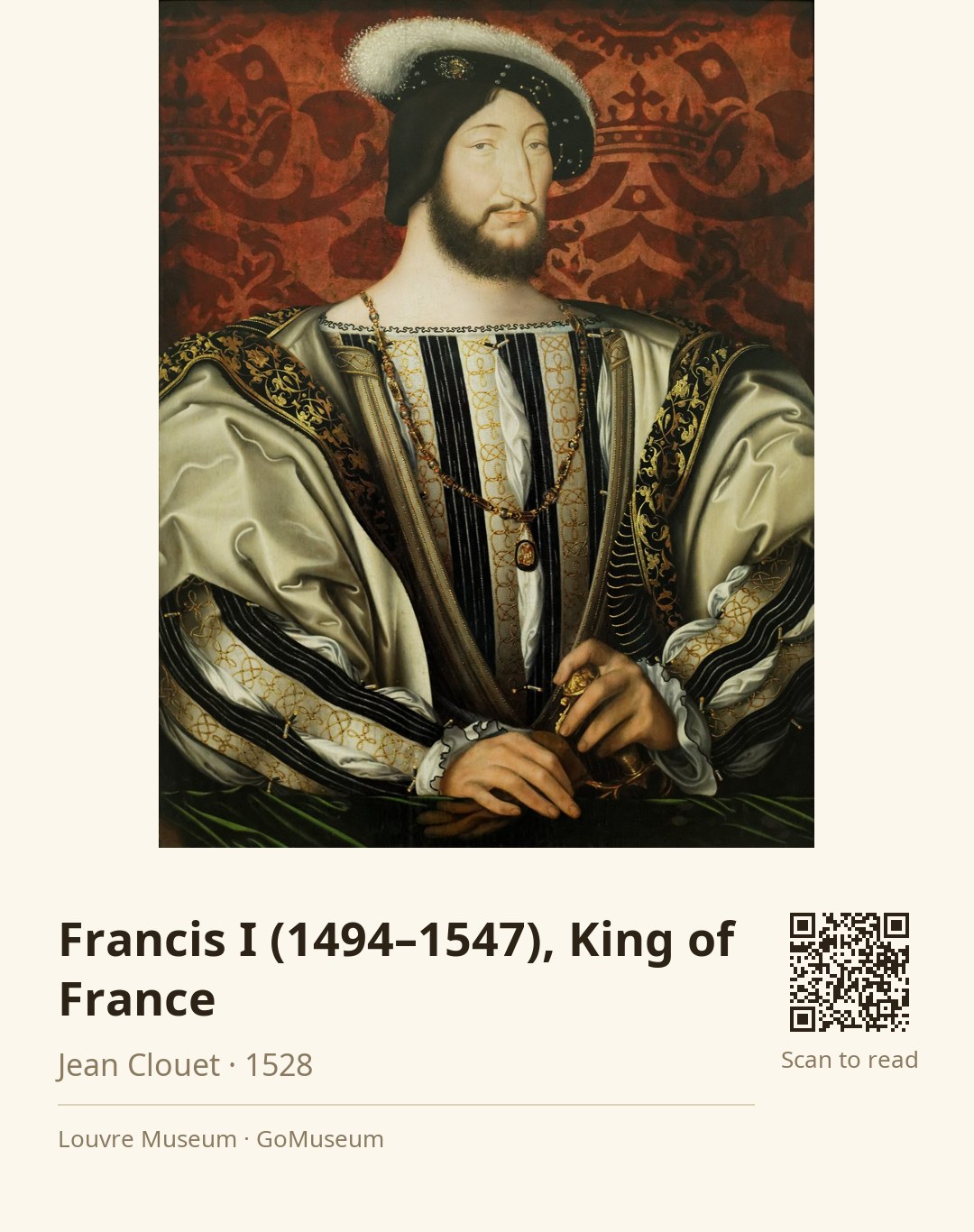
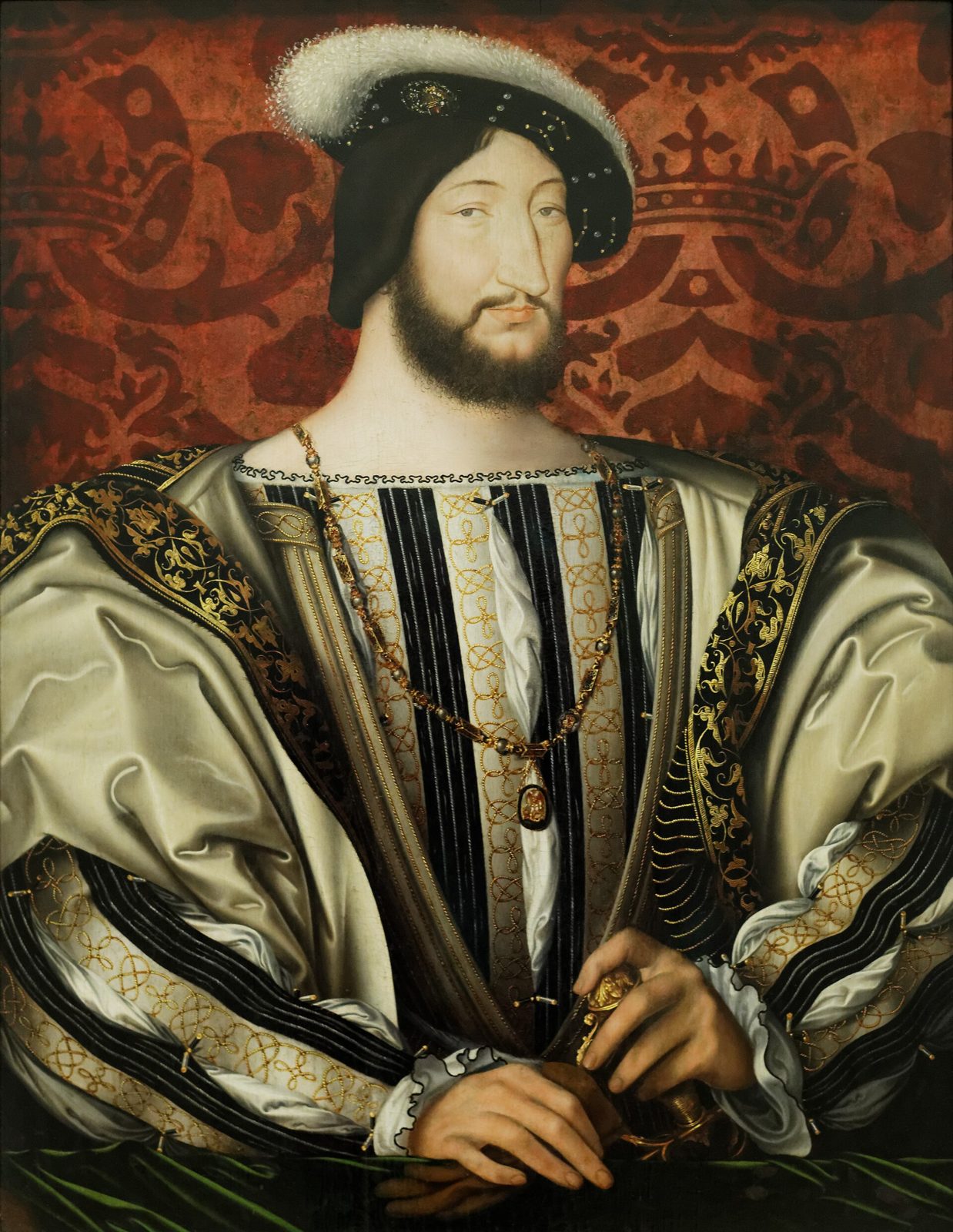
🎧 This work has audio narration — listen in the appThe striking figure of Francis I stands before you, captured in a moment of regal poise. Clouet has portrayed him in a three-quarter pose, his elaborate black and white striped doublet adorned with intricate gold embroidery, while a black hat with a white plume crowns his head. The deep red background, rich with stylized crown motifs, enhances the sense of authority and grandeur that surrounds the king.
The meticulous detail in Francis's attire reflects not only his royal status but also the artistry of the early 16th century. The gold chain and medallion he wears signify his connection to the Order of Saint Michael, a prestigious honor that underscores his power and influence. Clouet's smooth brushwork brings life to the fabric, making it almost tangible, while the positioning of Francis's hands, one resting on the other with a glove, adds an air of contemplation and dignity.
Jean Clouet, the artist behind this portrait, was a prominent figure in the French court, serving as the official painter to Francis I from 1516 until his death in 1541. His work is characterized by a keen attention to detail and a deep understanding of the human form, which he mastered through years of practice and observation. Clouet's portraits were not merely likenesses; they were carefully crafted representations that conveyed the personality and status of his subjects, making him one of the leading portraitists of his time. In 1528, he created this striking image of Francis I, solidifying his role as a key figure in the development of portrait painting in France.
Jean Clouet, a prominent painter and miniaturist from the Burgundian Netherlands, was active primarily in France during the early 16th century. Born around 1485, he likely hailed from Brussels and was trained in Flanders. Clouet became the court painter for King Francis I, a role he held from 1516 until his death in 1541. His skill in portraiture, particularly using black and red chalk, distinguished him alongside his son, François Clouet, as a leading artist of the time.
Clouet's portraits, characterized by their intimate scale and detailed representation of royal figures, played a significant role in shaping the visual culture of the French court. His work, though not extensively documented, includes several attributed portraits and a substantial collection of drawings preserved at the Musée Condé. Despite falling into obscurity after his death, Clouet's legacy was revived in the 19th century, revealing his innovative contributions to portrait drawing and establishing him as a key figure in Renaissance art history. His familial ties to the art world continued through his children, ensuring the Clouet name remained influential in the realm of portrait painting.
In 1528, Jean Clouet was commissioned to paint this striking portrait of King Francis I, a significant figure in French history. Clouet, who had been the official painter to Francis since 1516, was deeply embedded in the royal court. The painting was likely displayed in the royal palace, where it would have been seen by courtiers and visitors alike, reinforcing the king's image. The reception of Clouet's work was generally positive, as he was known for his detailed and lifelike representations. However, after Clouet's death in 1541, his contributions were somewhat overshadowed for centuries, with his work only gaining recognition again in the 19th century when art historians began to uncover his legacy.
The smooth brushwork creates a lifelike texture, particularly in the fabric of Francis's elaborate doublet, where the intricate gold embroidery seems to shimmer. Clouet's choice of a deep red background, adorned with crown motifs, not only enhances the regal atmosphere but also serves to elevate the figure of the king, making him stand out as the focal point. The three-quarter pose allows for a dynamic view of Francis, inviting the viewer to engage with his presence. The careful positioning of his hands, one resting on the other while holding a glove, adds a layer of contemplation and dignity, suggesting a moment of introspection. The overall composition balances the ornate details of the attire with the simplicity of the background, creating a harmonious yet striking visual impact.
Interestingly, while Clouet is celebrated for his portraits, he was also a skilled draughtsman. He created a large number of drawings, many of which are preserved in the Musée Condé in Chantilly.
Jean Clouet served at the French court from 1516 until 1537, establishing a long and influential career.
Clouet's work began to gain recognition again in the 19th century, long after his death in 1541, as art historians started to rediscover his contributions.