Grande Odalisque
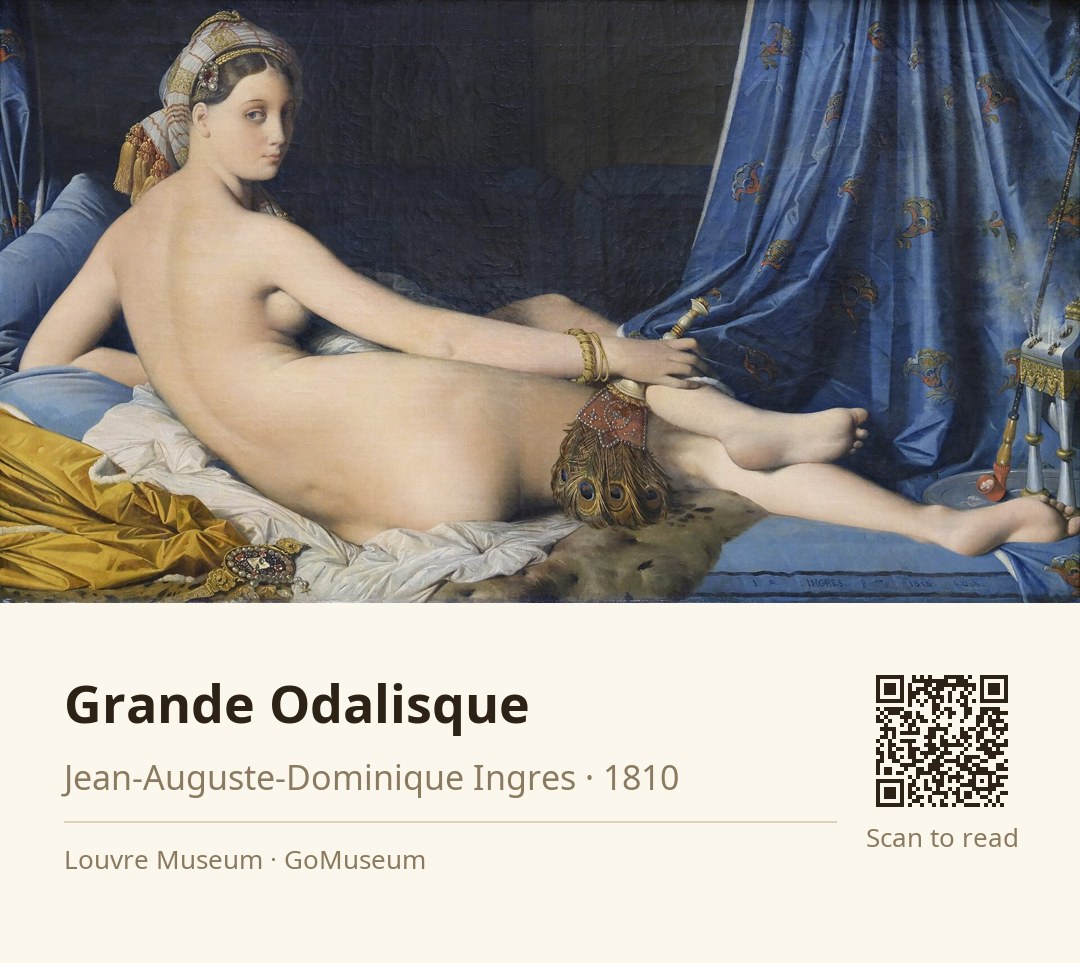
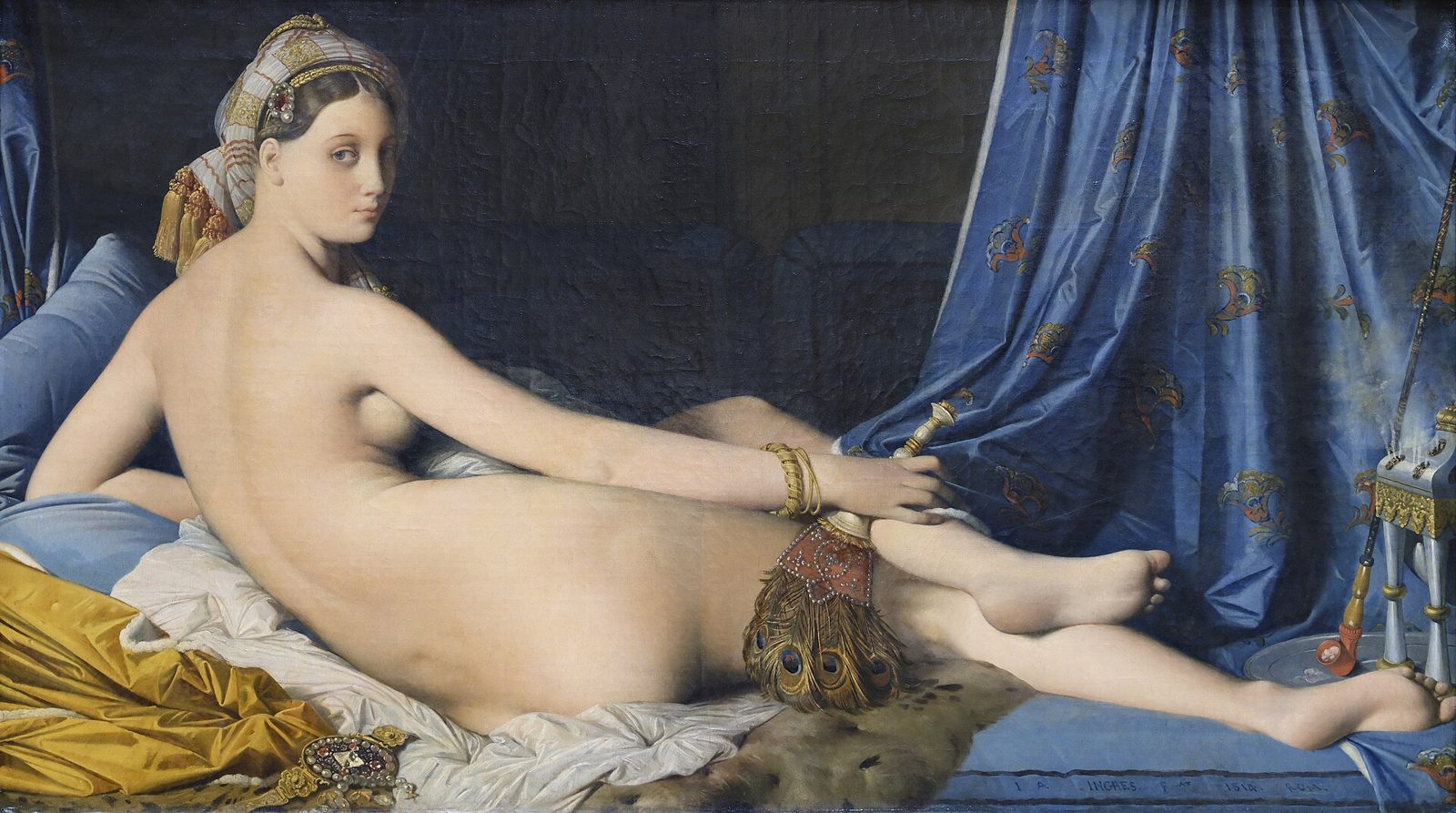
🎧 This work has audio narration — listen in the appTake a moment to really look at Ingres' "Grande Odalisque." Notice how her back seems to stretch on forever, almost like a ribbon unfurling. The way her left arm appears shorter than the right is not a mistake; it's a deliberate choice by Ingres, who bends the rules of anatomy to create a vision of beauty that feels both exotic and dreamlike.
Critics initially panned this painting for its lack of anatomical realism, but what they missed was Ingres' intention to convey a deeper, more complex idea of femininity. The odalisque, a concubine in a harem, is depicted not just as an object of desire but as a figure with a rich inner life, her gaze suggesting a world of thoughts and feelings that contrast with her languid pose.
Ingres was inspired by earlier works, yet he transformed them into something uniquely his own, blending classical form with a new, sensuous style.
As you stand here, think about what this odalisque represents. Is she merely a figure of beauty, or does she embody the complexities of desire and identity? What stories might she tell if she could speak?
Jean-Auguste-Dominique Ingres was a pivotal figure in French Neoclassicism, born on August 29, 1780, in Montauban. He was the son of a versatile artist, which nurtured his early artistic inclinations. Ingres studied under Jacques-Louis David in Paris, where he developed a commitment to academic traditions, aspiring to elevate history painting above all genres. His early career was marked by struggles, as critics dismissed his style as archaic, yet he persevered, achieving recognition with works like "The Vow of Louis XIII" in 1824.
His portraits, characterized by expressive distortions, became his most celebrated contributions, influencing modern artists such as Matisse and Picasso. Ingres's time in Italy, from 1806 to 1824, was crucial; he immersed himself in the study of Renaissance masters, which shaped his distinctive style. Despite facing criticism for his meticulous approach, he remained steadfast in his vision of beauty, emphasizing drawing over color.
Later in life, he returned to Paris, where he continued to create significant works, including "The Turkish Bath." Ingres's legacy endures as a bridge between classical traditions and modern art, embodying the tension between adherence to established norms and the evolving landscape of artistic expression. He passed away on January 14, 1867, leaving behind a profound impact on the art world.
Initially, it was meant to be a pendant to another nude, 'La Dormeuse de Naples,' which unfortunately disappeared shortly after its creation. When it was first exhibited at the Salon of 1819, the reception was harsh; critics derided its elongated proportions and lack of anatomical accuracy. One critic famously lamented that the painting had 'neither bones nor muscle, neither blood, nor life.' Despite the negative reviews, Ingres' work was a bold departure from Neoclassicism, signaling a shift toward Romanticism. The painting eventually found its home in the Louvre Museum in Paris, which acquired it in 1899, after passing through several notable owners, including the Count James de Pourtalès-Gorgier and Baron Seillière. This tumultuous history reflects the painting's journey from scorn to celebrated masterpiece, illustrating how perceptions of art can evolve over time.
As you gaze at 'Grande Odalisque,' pay attention to Ingres' masterful brushwork and his unique approach to form. The figure's elongated back and limbs create a sense of fluidity, almost like a ribbon unfurling, which enhances the sensuality of the piece. Ingres deliberately distorts proportions, sacrificing anatomical accuracy for a vision of beauty that captivates the viewer. The cool color palette, dominated by blues and greens, adds to the painting's dreamlike quality, while the soft, even light bathes the figure in a gentle glow, minimizing harsh shadows. This technique allows Ingres to emphasize the curves of the body, drawing your eye along the lines he has so carefully crafted. The composition is structured to guide your gaze from the figure's head down to her feet, creating a harmonious flow that feels both inviting and mysterious. Ingres' choice to depict the odalisque from behind, with her gaze directed away from the viewer, invites you to ponder her thoughts and emotions, adding layers of complexity to her portrayal.
The legacy of 'Grande Odalisque' is profound, as it marks a pivotal moment in the transition from Neoclassicism to Romanticism. Ingres' bold stylistic choices paved the way for future artists to explore the boundaries of form and representation. His expressive distortions influenced a generation of modern artists, including Henri Matisse and Pablo Picasso, who would further push the envelope of artistic expression. The painting's embrace of sensuality and emotional depth challenged the rigid conventions of its time, allowing for a broader interpretation of femininity in art. Moreover, its appropriation by feminist groups like the Guerrilla Girls highlights its ongoing relevance in discussions about the representation of women in art, making it a touchstone for both art history and contemporary discourse.
One surprising anecdote about 'Grande Odalisque' is that the commission by Queen Caroline was never fully paid for due to the fall of the Empire. This financial dispute adds an intriguing layer to the painting's history, as it underscores the tumultuous political climate of the time and how it affected artists and their patrons.
The painting was commissioned by Queen Caroline Murat of Naples, who was Napoleon Bonaparte's sister, but the commission was never fully paid due to the political upheaval following the fall of the Empire.
Ingres drew inspiration from earlier works, such as Titian's 'Venus of Urbino' and Parmigianino's 'Madonna with the Long Neck', blending classical elements with his own unique distortions to create a new vision of beauty.
Before being acquired by the Louvre in 1899, 'Grande Odalisque' passed through several notable owners, including Count James de Pourtalès-Gorgier and Baron Seillière, highlighting its tumultuous history and changing perceptions over time.