Self-portrait
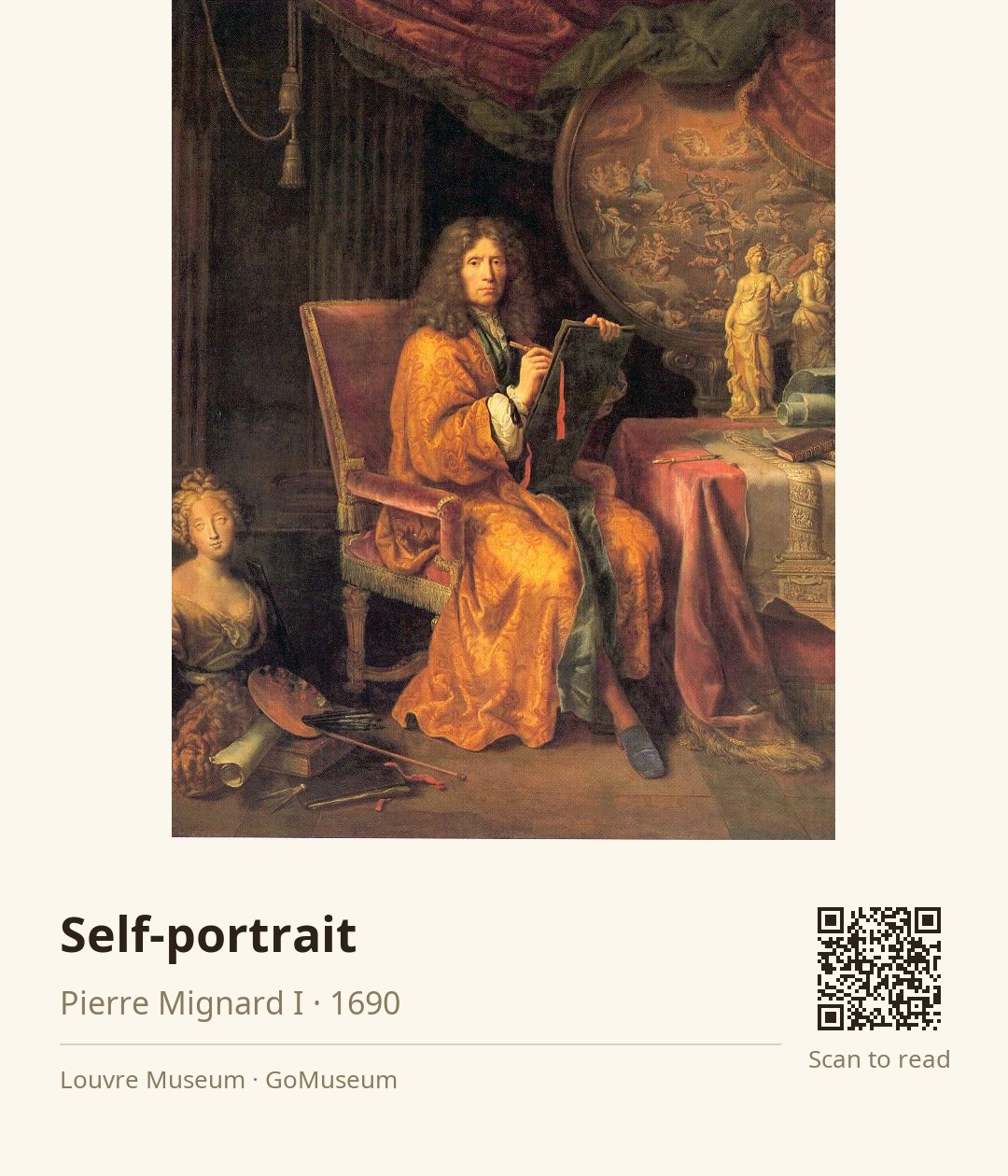
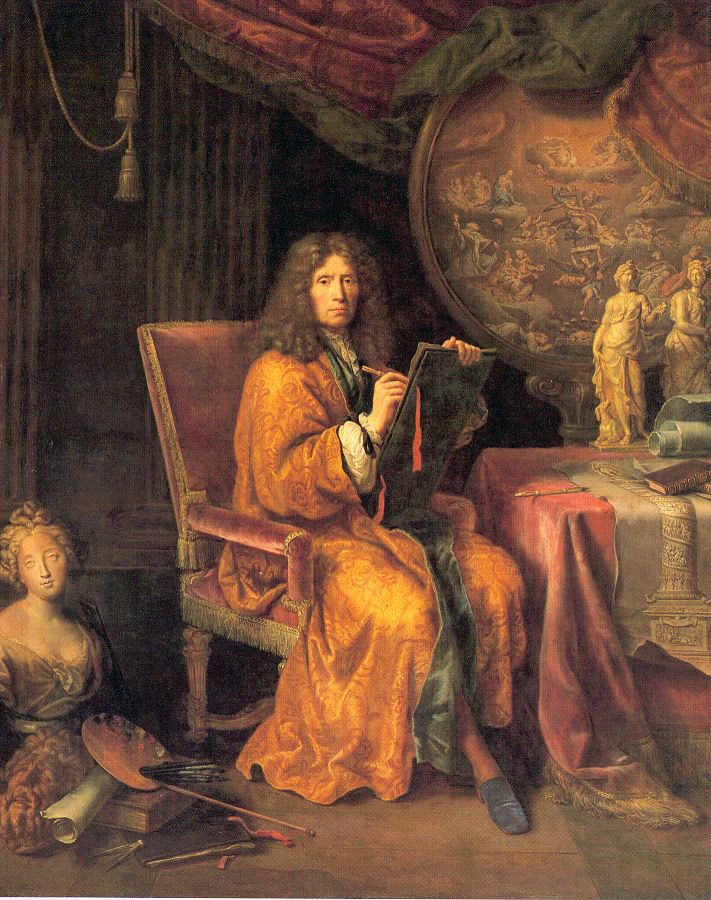
🎧 This work has audio narration — listen in the appTake a moment to really look at Pierre Mignard's self-portrait from 1690. Notice how he’s not just posing; he’s actively engaged in his craft, pencil in hand, as if inviting you into his creative process. Look closely at the drawing of a column on the table beside him.
Mignard, in this moment, is still in the act of creation, emphasizing his ongoing service to the king and the artistic community.
Mignard was a prominent figure in the French Baroque movement, known for his portraits and religious scenes, and this self-portrait reflects both his skill and his ambition. It’s a statement of identity, not just as an artist but as a man still striving for greatness.
As you stand here, think about the legacy of artists like Mignard. What does it mean to you to see an artist in the midst of creation?
Pierre Mignard, born in Troyes in 1612, was a prominent French painter known for his religious, mythological scenes, and portraits. A product of a family of artisans, he trained under Jean Boucher and later Simon Vouet, before moving to Rome in 1635, where he spent over two decades. His time in Italy shaped his artistic style, leading to the creation of beloved images of the Madonna and Child, dubbed "Mignardises." Mignard's reputation grew, and he returned to France in 1657, where he quickly became a favored portraitist of the French elite, including King Louis XIV.
His rivalry with Charles Le Brun, the leading painter of the time, defined much of his career. Mignard refused to join the Académie royale de peinture et de sculpture under Le Brun's direction, opting instead to lead a rival guild. After Le Brun's death in 1690, Mignard took over as the director of the academy and the premier painter to the King. Despite his success, some critics labeled his work as conventional. Mignard's legacy endures through his extensive body of work, which can be found in numerous prestigious collections worldwide. He passed away in Paris in 1695, leaving behind a significant mark on the French Baroque movement.
Mignard, often called 'Mignard le Romain' due to his long stay in Rome, was a prominent figure in the art scene, known for his portraits and religious works. This particular piece was likely influenced by his rivalry with Charles Le Brun, the premier painter to King Louis XIV. Mignard's self-portrait mirrors the pose and staging of Le Brun's portrait, but with a twist: while Le Brun showcased his completed works, Mignard depicts himself in the act of creation, suggesting he was still actively serving the king.
As you gaze at Mignard's self-portrait, pay attention to the brushwork and the way he handles the paint. The texture feels almost alive, with strokes that convey both confidence and a sense of urgency. The light falls dramatically across his face, emphasizing his features while casting shadows that suggest depth and introspection. Notice how the composition draws your eye to the drawing of the column on the table, a symbol of his architectural contributions. The choice of colors is equally striking; the rich tones create a warm yet serious atmosphere, inviting you to ponder the artist's thoughts.
Did you know that Pierre Mignard's self-portrait was actually a direct response to a famous portrait of Charles Le Brun? Mignard wanted to assert his own identity as an artist, showing himself still in the act of creation, unlike Le Brun, who presented only his completed works.