Scene of the Flood
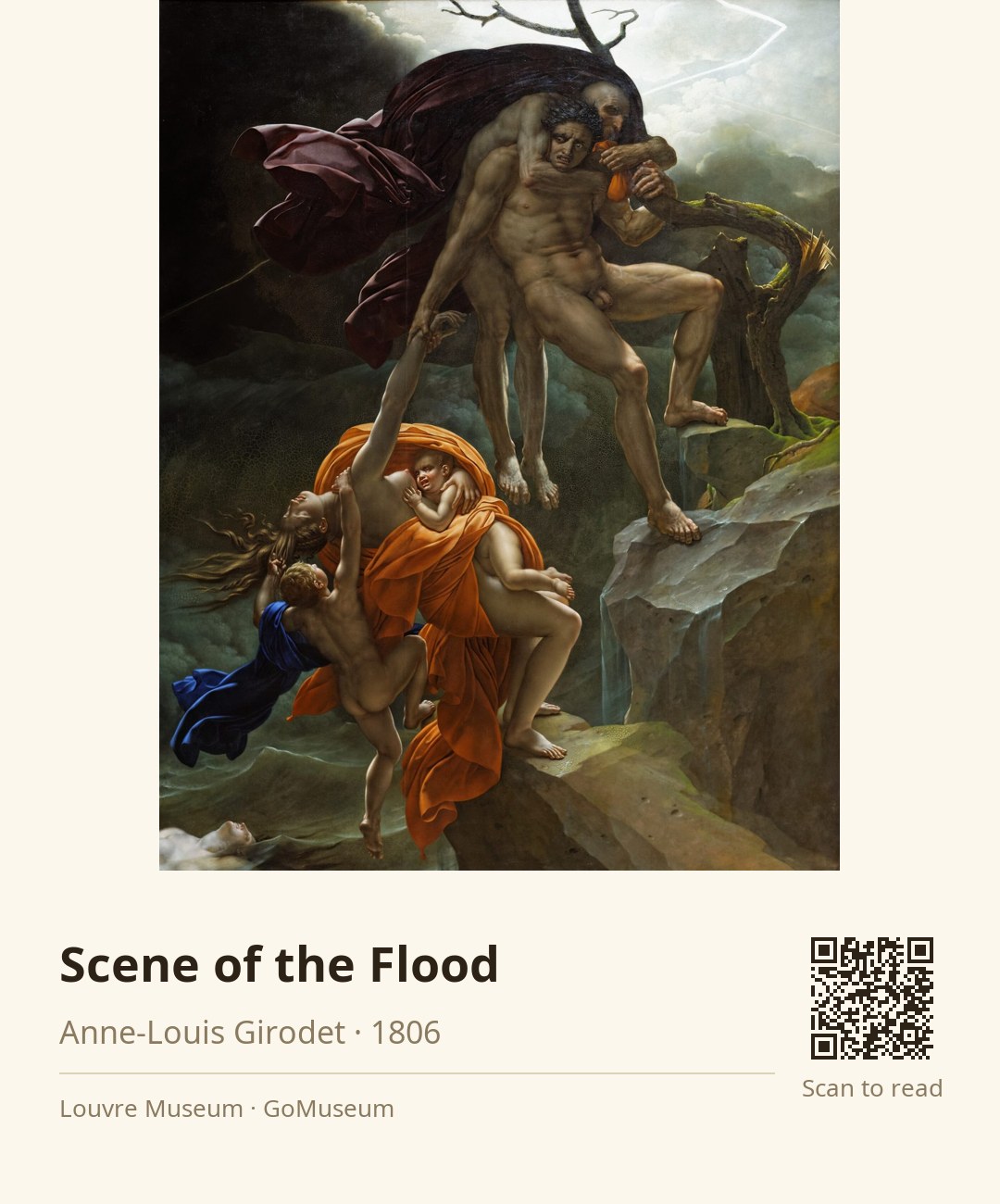
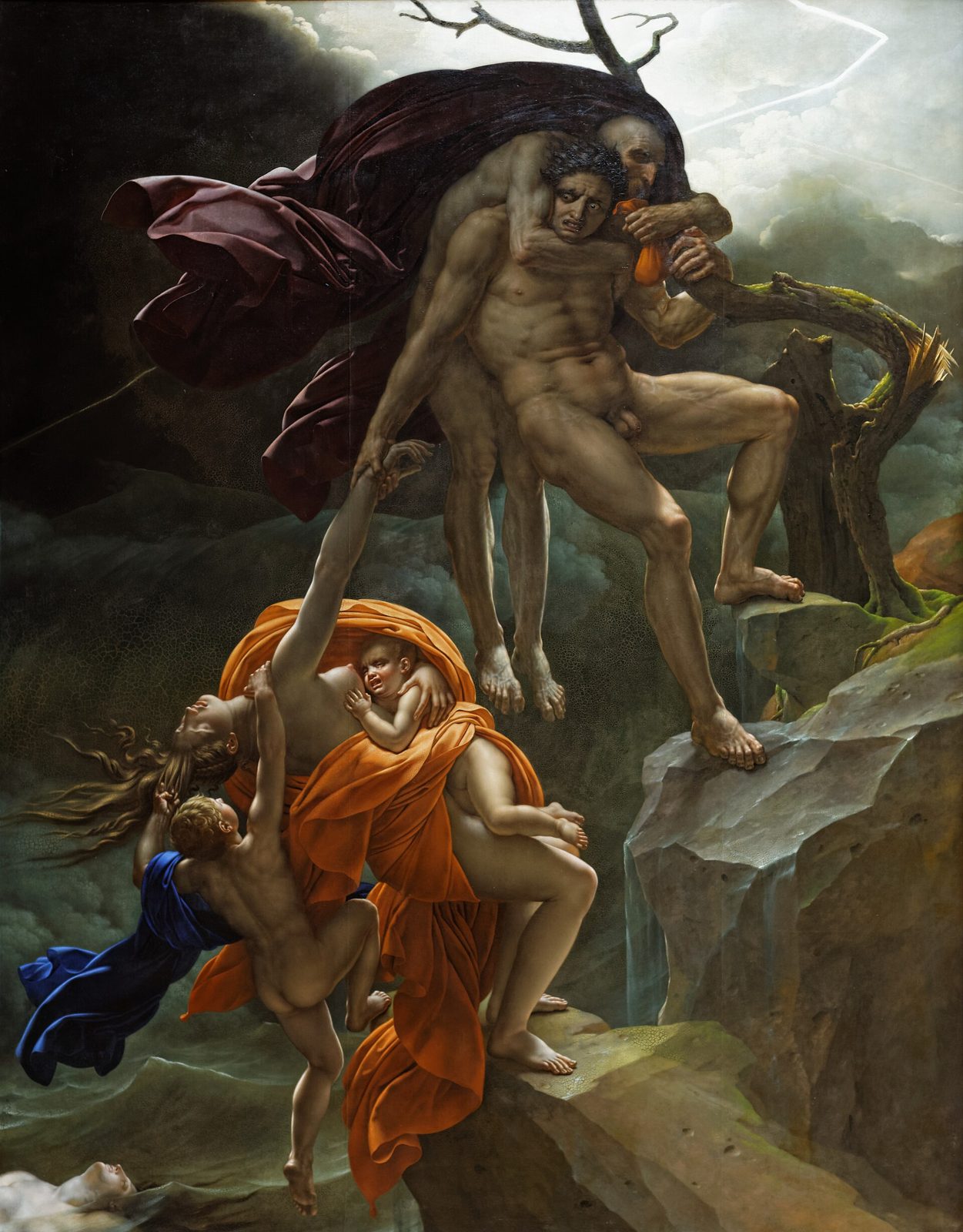
🎧 This work has audio narration — listen in the appTake a moment to really absorb the drama unfolding in Anne-Louis Girodet's "Scene of the Flood." Look closely at the man clinging to that precarious tree branch, his face twisted in terror as he struggles to save his family from the raging waters below. Notice how the lightning streaks across the dark sky, illuminating the chaos around him.
These details matter because they pull you into the raw emotion of the moment. Girodet captures not just a physical struggle against nature, but a deeper metaphor for human vulnerability. This painting, created in 1806, reflects the fears of a society still reeling from the upheaval of the French Revolution. The family's desperate plight can be seen as a commentary on the fragility of social order, hinting at the “rotten supports” of leadership that people clung to during turbulent times.
Girodet, a student of the neoclassical master Jacques-Louis David, was pushing boundaries here, moving toward a Romantic style that emphasized emotion and the sublime. His work was met with mixed reviews at the Salon, but it ultimately secured his place as a leading figure in Romantic art.
As you stand here, consider: what does this struggle against the flood say about our own lives today? Are we also clinging to fragile supports in the face of our own tempests?
Anne-Louis Girodet de Roussy-Trioson, born on January 29, 1767, in Montargis, was a pivotal figure in the transition from Neoclassicism to Romanticism in French art. A talented pupil of Jacques-Louis David, he gained recognition for his precise style and innovative approach, incorporating elements of eroticism and emotional depth into his works. After losing both parents in his youth, he was adopted by his guardian, Dr. Benoît-François Trioson, whose influence shaped his career.
Girodet's artistic journey began with a focus on architecture before he shifted to painting, winning the prestigious Prix de Rome at just 22. His time in Italy profoundly impacted his style, leading to acclaimed works like "Endymion" and "Hippocrates Refusing the Gifts of Artaxerxes." Upon returning to France, he painted notable portraits, including members of the Bonaparte family, and won the decennial prize for "Scène du déluge."
Despite his success, Girodet faced personal challenges, including declining health in his later years. His final works, such as "Pygmalion and Galatea," reflected a deterioration in his artistic vigor. He passed away on December 9, 1824, in Paris, leaving behind a legacy that bridged classical ideals and Romantic sensibilities, influencing future generations of artists. His contributions were later celebrated in major exhibitions, affirming his place in art history.
Anne-Louis Girodet's 'Scene of the Flood' was first unveiled at the Salon of 1806, where it sparked a whirlwind of reactions. Commissioned by the French art scene, it was a pivotal moment for Girodet, who was determined to make a mark after the mixed reception of his earlier work, 'Ossian Receiving the Ghosts of French Heroes.' The painting, now housed in the Louvre, was a bold departure from the neoclassical style of his mentor, Jacques-Louis David, pushing towards a more emotive Romanticism. Critics were divided; while some praised its dramatic composition, others, including David himself, condemned it for its perceived melodrama.
As you gaze at 'Scene of the Flood,' pay attention to the dynamic brushwork that seems to pulse with energy. Girodet employs a large canvas, measuring over 4 meters in height, to create an immersive experience. The figures are rendered with a sense of urgency, their expressions and postures conveying a desperate struggle against nature's fury. Notice how the lightning illuminates the scene, casting stark contrasts that heighten the emotional intensity. The composition is carefully structured; the man clinging to the tree is at the center, drawing your eye and embodying the family's plight. Girodet's choice of colors—dark, brooding tones punctuated by the bright flash of lightning—creates a palpable tension, inviting you to feel the chaos and fear that envelops the figures. This technique not only captures the physical struggle but also evokes a deeper sense of existential dread.
By infusing his paintings with elements of melodrama and the supernatural, Girodet influenced a generation of artists who sought to express emotion and the sublime. This painting, with its intense portrayal of a family struggling against nature's fury, captivated audiences and challenged the rigid ideals of his mentor, Jacques-Louis David. Critics initially struggled to categorize it, but its emotional depth and dramatic composition ultimately helped pave the way for Romantic artists, making it a cornerstone in the evolution of 19th-century art.
One intriguing detail about 'Scene of the Flood' is that Girodet faced initial confusion over its title. Critics mistakenly associated it with the biblical flood due to a misprint in the Salon catalog, which labeled it as 'Une Scene du Deluge' instead of 'Une Scene de Deluge.' This misunderstanding led to critiques that it lacked the grandeur typically expected of such a monumental theme. Girodet, however, clarified that his intention was to portray a sudden, localized inundation, reflecting a more contemporary interpretation of nature's chaos.
Upon its exhibition at the Salon of 1806, the painting captivated many viewers, with one observer noting that all eyes were drawn to it. However, despite the excitement it generated, critics were divided, with some praising its dramatic composition while others, including Girodet's mentor Jacques-Louis David, condemned it for its perceived melodrama.
Girodet's worldview was likely shaped by a violent attack he experienced during the French Revolution, which he narrowly survived. This personal trauma may have informed the themes of vulnerability and chaos depicted in 'Scene of the Flood', reflecting a society grappling with its own tumultuous circumstances.
The misprint that labeled the painting as 'Une Scene du Deluge' instead of 'Une Scene de Deluge' led to confusion among critics, who expected a grand depiction of the biblical flood. This misunderstanding prompted critiques about the painting's perceived lack of grandeur, which Girodet clarified by stating his intention was to illustrate a sudden, localized inundation.