Portrait of Maerten Soolmans
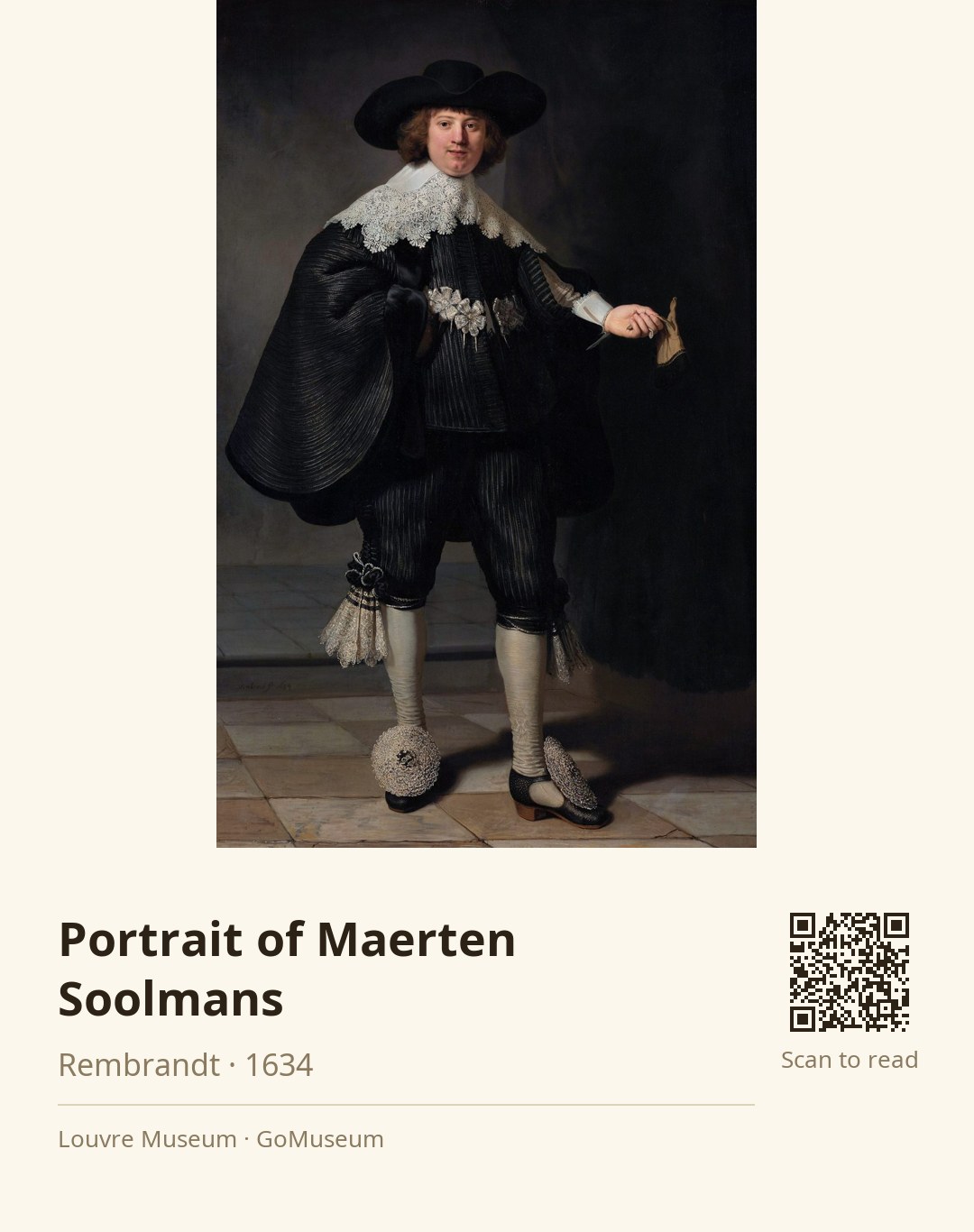
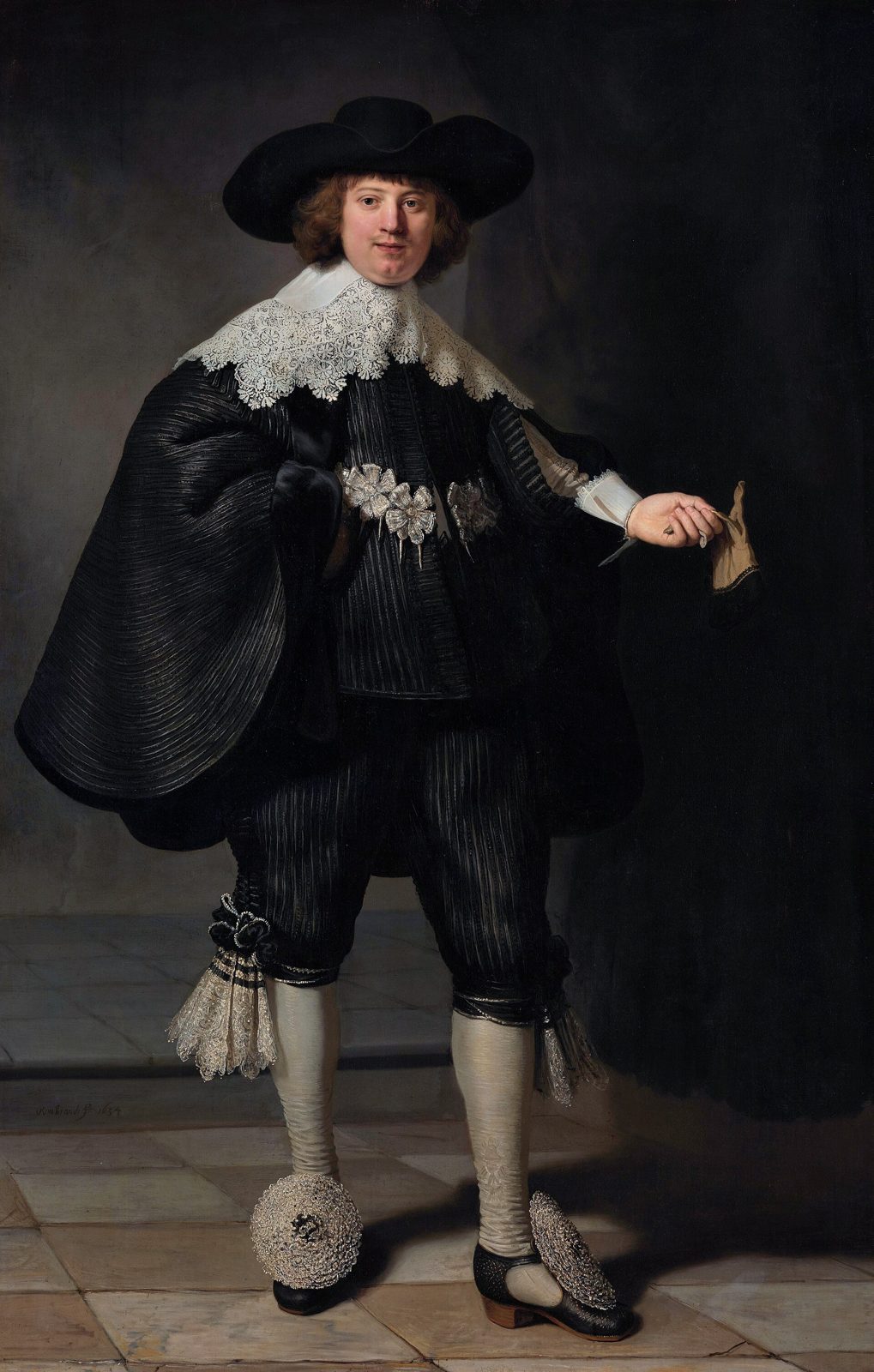
🎧 This work has audio narration — listen in the appMaerten Soolmans stands confidently in this striking portrait, dressed in an elaborate black outfit that showcases the fashion of the 17th century. His attire features intricate white lace at the collar and cuffs, while a large black hat adds a touch of grandeur. The way he holds a glove in his right hand and rests his left hand on his hip conveys both elegance and authority, inviting you to consider the status he held in society.
The rich textures of his clothing contrast beautifully with the dark background, which serves to highlight his lighter skin and the delicate details of his attire. This careful interplay of light and shadow not only enhances the visual impact but also reflects Rembrandt's mastery in capturing the essence of his subjects. The floral patterns and ribbons woven into his outfit further emphasize the wealth and refinement of the era, making this portrait a window into the opulence of 17th-century Dutch society.
Commissioned in 1634, this painting is part of a pair that includes the portrait of Maerten's wife, Oopjen Coppit.
Rembrandt Harmenszoon van Rijn, born on July 15, 1606, in Leiden, was a pivotal figure of the Dutch Golden Age and is celebrated as one of the greatest artists in Western art history. His oeuvre includes around three hundred paintings, three hundred etchings, and numerous drawings, showcasing a remarkable range of styles and subjects, from intimate portraits to grand historical and biblical scenes.
Rembrandt's artistic journey began in Leiden, where he was influenced by both Dutch and Italian masters. He opened his studio in 1625 and quickly gained recognition for his portrait work. His move to Amsterdam marked a significant turning point, as he became a sought-after portraitist and married Saskia van Uylenburgh, a union that brought both joy and tragedy. The couple faced immense personal losses, including the deaths of their children and Saskia's own passing in 1642, which deeply affected his work.
Despite financial struggles later in life, Rembrandt's innovative techniques, particularly in etching, transformed the medium into a respected art form. His mastery of light and shadow, known as chiaroscuro, and his empathetic portrayal of human experience set him apart from his contemporaries. Rembrandt's legacy endures through his profound ability to capture the complexities of the human condition, making him a cornerstone of art history.
This painting is part of a remarkable pair, with the other portrait depicting Oopjen herself. The two portraits remained in the Soolmans family for generations, a testament to their significance and the family's status. In 1798, the portraits left the Soolmans lineage and entered the collection of Pieter van Winter. After a series of ownership changes, including a purchase by a consortium led by Baron Gustave de Rothschild in the 19th century, the portraits spent over a century in France. They were rarely exhibited, only being shown publicly once in 150 years during a joint exhibition in 1956. In 2016, a landmark agreement was reached between France and the Netherlands, ensuring that the portraits would never be separated again, alternating their display between the Rijksmuseum and the Louvre.
The smooth brushwork brings the intricate textures of Soolmans' elaborate attire to life, each fold and lace detail rendered with precision. The dark background serves a dual purpose: it not only enhances the subject's lighter skin but also creates a dramatic contrast that draws your eye directly to Soolmans. The use of color is deliberate; the rich blacks of his clothing are punctuated by the bright whites of the lace, emphasizing the opulence of the 17th-century fashion. The composition is dynamic, with Soolmans standing in a three-quarter pose that conveys both authority and elegance. The positioning of his hands—one resting on his hip, the other holding a glove—adds to the sense of confidence and poise. This careful arrangement of elements creates a striking visual impact that captures the viewer's attention.
Interestingly, the portraits of Maerten Soolmans and Oopjen Coppit were sold for a staggering 80 million euros each in 2016, making them among the most expensive paintings ever acquired. This sale not only highlighted their immense value in the art world but also underscored the ongoing fascination with Rembrandt's work and the historical significance of these portraits.
A significant agreement was established in 2016 to ensure that the portraits of Maerten Soolmans and Oopjen Coppit would always be displayed together, alternating between the Rijksmuseum and the Louvre.