Portrait of Madeleine
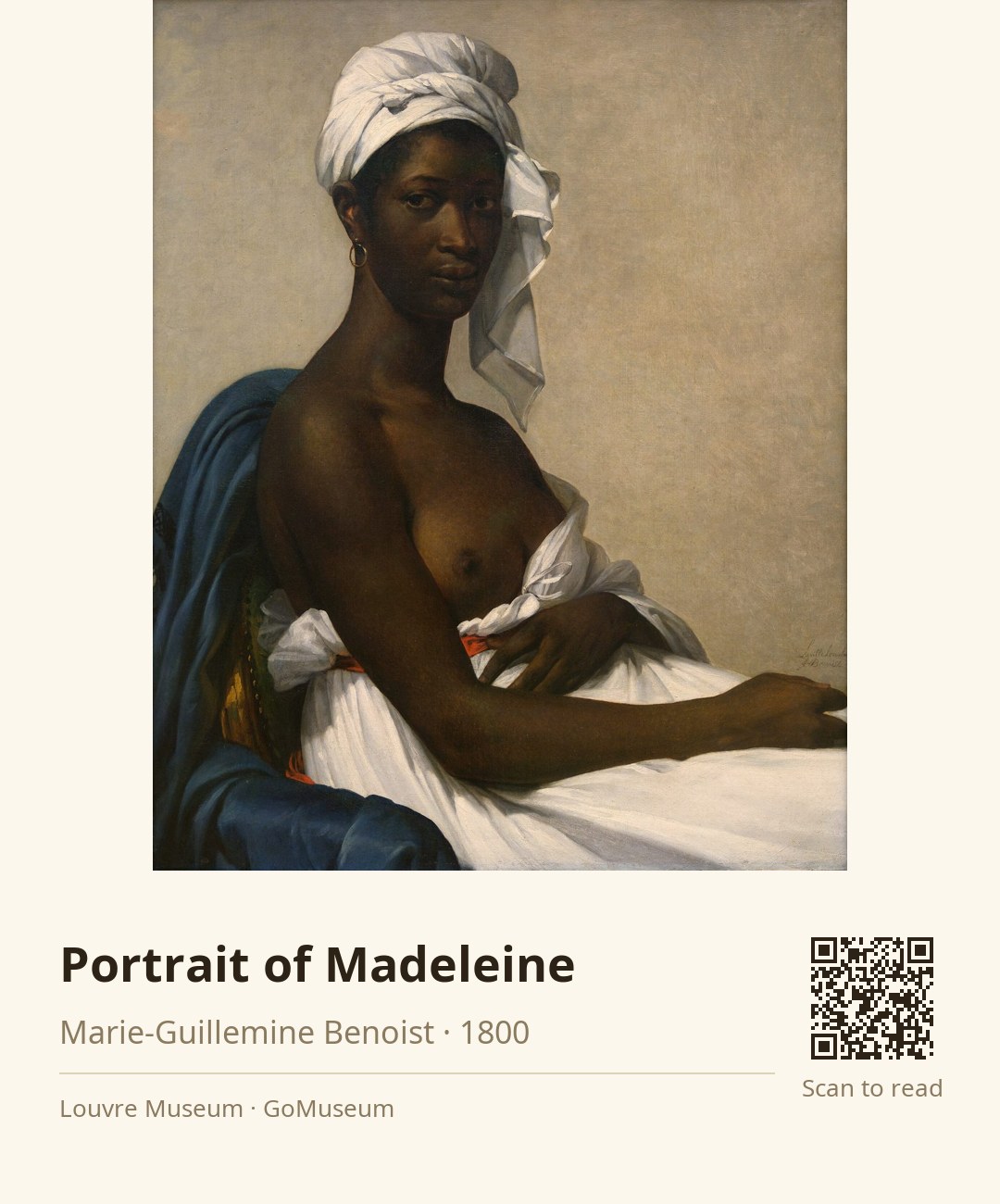
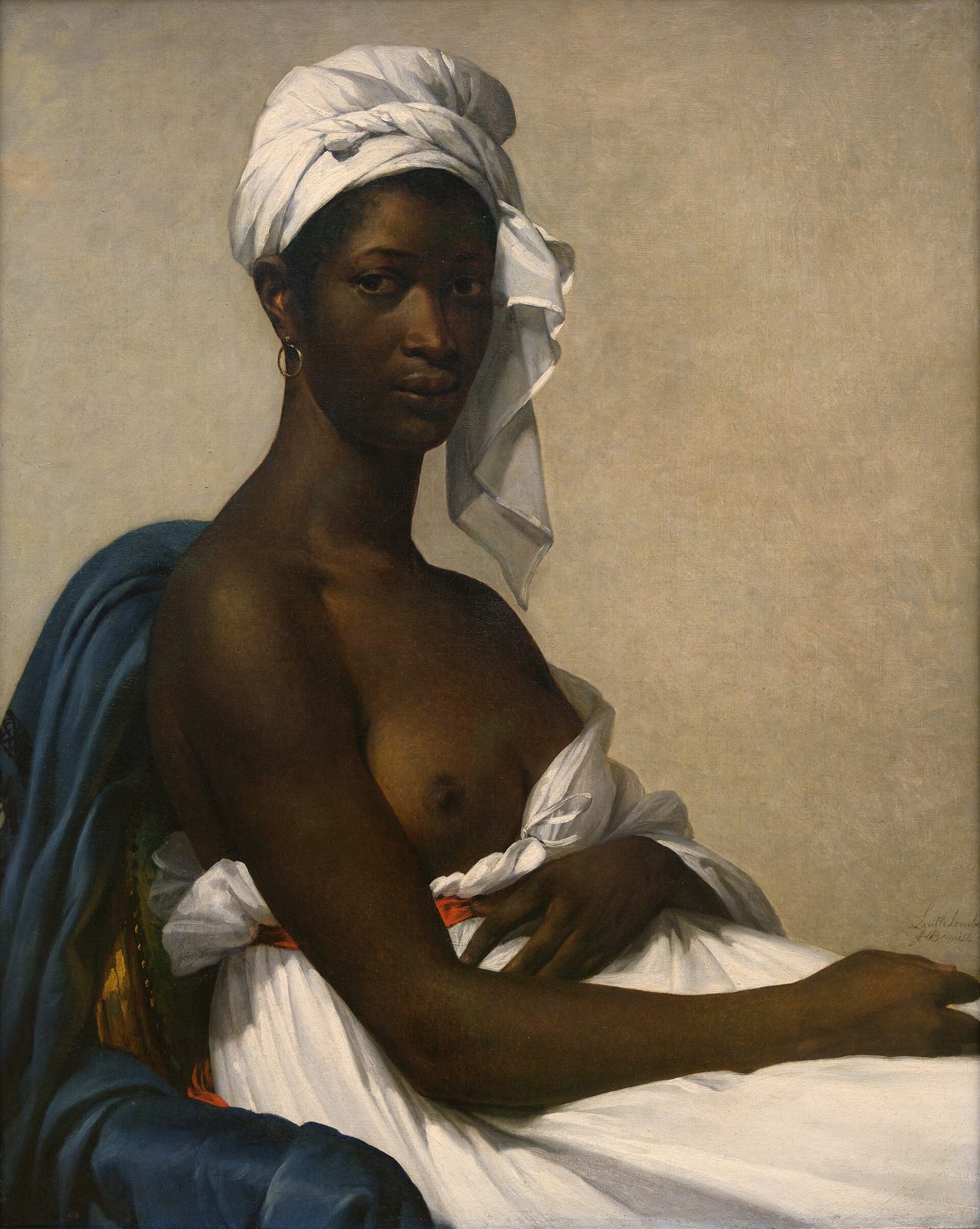
🎧 This work has audio narration — listen in the appTake a moment to really look at this striking portrait of Madeleine. Notice how she sits confidently, her gaze locked onto yours, with an expression that’s both composed and enigmatic. The way her white dress contrasts with her skin, and the subtle play of light across her features, draws you in, doesn’t it?
Now, focus on the details: the hoop earring glinting in the light and the rich blue fabric of the chair that envelops her. These elements aren’t just decorative; they tell a story of status and identity. In a time when Black women were often portrayed as servants, Benoist presents Madeleine as a figure of dignity and strength, seated in a luxurious chair, adorned with fine jewelry.
Created in 1800, this painting was made just after the first abolition of slavery in France, yet before it was reinstated. Benoist’s choice to depict a Black woman as the sole subject of her work was revolutionary. It challenges the norms of her time and invites us to reconsider the narratives surrounding race and gender.
Interestingly, the painting was originally titled “Portrait d’une négresse,” a label that stripped Madeleine of her identity. It wasn’t until 2019 that she was recognized by name, reclaiming her story in art history.
As you stand here, think about what it means to see someone like Madeleine portrayed with such dignity in a period of turmoil. How does this change your perception of both the artist and her subject?
Marie-Guillemine Benoist, born Marie-Guillemine Laville-Leroux in Paris on December 18, 1768, was a prominent French neoclassical painter known for her historical and genre works. She began her artistic training under Élisabeth Vigée Le Brun in 1781 and later joined Jacques-Louis David's studio, where she honed her skills alongside her sister. Benoist first exhibited in 1784 and gained recognition for her mythological themes, reflecting her feminist views, particularly in works like "L'Innocence entre la vertu et le vice."
Her 1800 painting, "Portrait of Madeleine," became a significant symbol of emancipation, showcasing a black woman as the central subject, a rarity in art at the time. Benoist's career flourished with commissions, including a notable portrait of Napoleon Bonaparte. However, political shifts during the Bourbon Restoration forced her to withdraw from public life and focus on women's issues, marking a decline in her artistic output. She ceased exhibiting in 1812 and passed away in Paris on October 8, 1826. Benoist's legacy endures as a trailblazer for women in art, blending personal conviction with broader social themes.
Marie-Guillemine Benoist's 'Portrait of Madeleine' was created in 1800, a pivotal moment in French history, just after the first abolition of slavery in 1794 and before its reinstatement in 1802. This painting was first exhibited at the Paris Salon of 1800, where it was simply titled 'Portrait d’une négresse.' This title stripped the subject, Madeleine, of her identity, reducing her to a racialized label. The work drew attention amid growing anxieties about race and slavery in France and its colonies. In 1818, it was acquired by Louis XVIII for the French state, marking its significance in the national collection. Initially displayed at the Luxembourg Palace, it has since found its home in the Louvre. It wasn't until 2019 that Madeleine was recognized by name, reclaiming her identity and story within the art historical narrative.
Benoist's technique in 'Portrait of Madeleine' is striking and deliberate. The painting measures 81 cm by 65 cm, a size that allows for intimate engagement with the viewer. Notice the soft brushwork that creates a gentle gradation of light across Madeleine's skin, highlighting her features with a warm glow. The use of light and shadow is masterful, giving depth to her expression and emphasizing her dignified posture. The composition is carefully structured; Madeleine sits in a gilt armchair draped with rich blue fabric, which contrasts beautifully with her white dress and the red cord that cinches it. This choice of colors not only enhances the visual appeal but also resonates with the colors of the French revolutionary tricolor. The bared breast, while unusual for a portrait, suggests layers of meaning—perhaps an allusion to fertility or the complexities of her identity as a woman of color in a society that often objectified Black bodies. Benoist's choices invite the viewer to grapple with these contradictions.
Created in 1800, it stands out as one of the earliest representations of a Black woman in European art, a stark contrast to the typical depictions of Black figures as subservient. This painting not only reflects the complex social dynamics of post-revolutionary France but also serves as a powerful statement on race and gender. By portraying Madeleine with dignity and individuality, Benoist influenced future artists to explore themes of identity and representation. The work has been interpreted as a symbol of women's emancipation and Black rights, making it a significant landmark in art history that continues to resonate today.
One surprising aspect of the 'Portrait of Madeleine' is its title evolution. Initially displayed as 'Portrait d'une négresse' at the 1800 Paris Salon, it was later renamed to honor the subject, Madeleine, only in 2019. This change reflects a growing recognition of her identity and significance, as she was a woman of color depicted with dignity and complexity during a time when such representations were rare. The painting's journey from a racialized label to a personal name highlights the ongoing conversation about race and identity in art.
At the 1800 Paris Salon, the painting was noted for its unusual subject, as it was one of the few portraits of a Black woman exhibited at the time. Critics and viewers were intrigued by Benoist's choice to present Madeleine as a dignified figure, which contrasted sharply with the typical depictions of Black women as servants.
Originally titled 'Portrait d’une négresse,' the painting was renamed 'Portrait de Madeleine' in 2019 after research identified the sitter by name, allowing her to reclaim her identity and story within art history.