Diana at her Bath
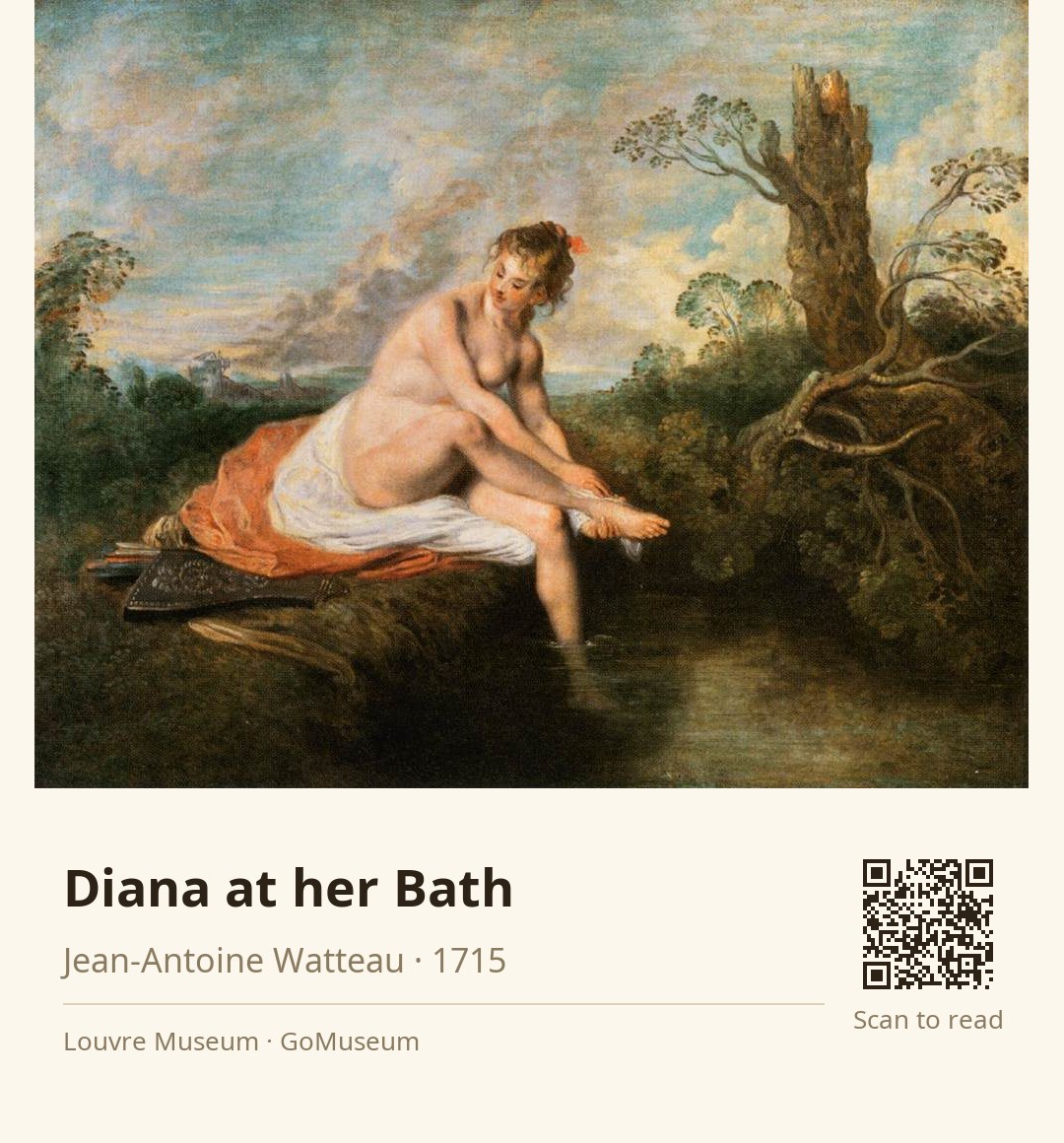
🎧 This work has audio narration — listen in the appThe serene figure of Diana, the Roman goddess of the hunt, captures your attention as she sits gracefully by the water's edge, her foot gently dipping into the cool surface. With her hair tied back by a striking red ribbon, the soft hues of her skin contrast beautifully against the lush greenery surrounding her, while a closed book rests nearby, hinting at a moment of quiet contemplation.
This intimate scene unfolds in a lush landscape, where a gnarled tree trunk and distant architecture create a sense of depth and tranquility. Watteau's choice of colors evokes a natural softness, enhancing the ethereal quality of the moment. The positioning of Diana, slightly turned towards her quiver, suggests a narrative of both vulnerability and strength, embodying the duality of her character as both a protector and a figure of beauty.
Created in 1715, "Diana at her Bath" exemplifies Watteau's mastery in blending mythological themes with a Rococo sensibility, a style that emphasizes elegance and charm.
Jean-Antoine Watteau, born in Valenciennes in 1684, was a pivotal French painter whose brief but impactful career transformed the Baroque style into the more playful Rococo. He is renowned for pioneering the genre of fêtes galantes, which depicted charming, idyllic scenes infused with theatricality, often inspired by the commedia dell'arte. Watteau's early life was marked by a tumultuous family environment, which likely influenced his introspective nature and artistic sensibilities.
After moving to Paris in 1702, he honed his skills under various influences, notably Claude Gillot and Claude Audran III, before establishing his unique style characterized by vibrant colors and fluid movement. His masterpieces, including "Pilgrimage to Cythera" and "Pierrot," reflect his fascination with love and leisure, capturing the essence of 18th-century French society.
Despite his struggles for recognition, Watteau achieved success during his lifetime, becoming a full member of the Académie Royale in 1717. His legacy endures through his extensive body of work, which continues to inspire artists and collectors alike, solidifying his place in art history as a master of color and emotion. Watteau passed away in 1721, leaving behind a rich artistic heritage that would influence generations to come.
This painting was part of a larger trend in the early 18th century where artists began to explore more intimate and personal subjects, moving away from the grand historical narratives that dominated the Baroque period. The work was later acquired by the Louvre in 1977, where it remains today. During its time, the painting was celebrated for its delicate portrayal of the goddess and the lush landscape, garnering attention for its emotional depth and technical finesse.
Watteau's technique in "Diana at her Bath" showcases his mastery of oil paint, with soft, fluid brushwork that creates a sense of movement and life. The colors are carefully chosen; the gentle pastels evoke a serene atmosphere, contrasting the warm skin tones of Diana with the cool greens of the foliage. His use of light is subtle, enhancing the ethereal quality of the scene without overwhelming it. The composition draws the viewer's eye across the canvas, from Diana's poised figure to the gnarled tree and distant architecture, creating a layered depth. Watteau's choice to depict Diana in a relaxed, almost vulnerable pose invites a connection with the viewer, making the divine seem more human and relatable. This blend of intimacy and grandeur is a hallmark of his style, marking a shift towards the more personal narratives of Rococo art.
Interestingly, Watteau's life was marked by health struggles, which many believe influenced the emotional depth of his work. He suffered from tuberculosis, which ultimately led to his early death at just 36 years old. Despite his brief career, he produced an impressive body of work, and his paintings were highly sought after during his lifetime, often fetching high prices from collectors, including the wealthy banker Pierre Crozat, who became one of his most important patrons.
Watteau's portrayal of mythological figures, like Diana, in relaxed and vulnerable poses made them more relatable and accessible to viewers.